
You have 200 applications on your desk and only a few hours to review them. Resume analysis seems like the obvious first step – after all, the CV shows who's qualified and who isn't. Right?
The reality is more complicated. Studies show that recruiters spend an average of just 43 seconds on the initial CV screening (Stepstone/Mind Take, 2018). In this brief moment, they decide candidates' futures – often influenced by unconscious biases that have little to do with actual job fit.
The good news: With the right methods, you can make your resume analysis significantly more objective and effective. In this guide, you'll learn what really matters in professional CV evaluation, what limitations resumes have, and how to put your candidate pre-selection on a scientifically sound foundation.
Current meta-analyses by Schmidt, Oh, and Shaffer (2016) provide surprising insights: The predictive power of resumes for future job success is significantly lower than many assume – and there are methods that are far more reliable.
What Is Resume Analysis? Definition and Importance in Recruiting
Resume analysis (also called CV screening) refers to the systematic review and evaluation of resumes to identify suitable candidates for a position. It's one of the most common tools in candidate pre-selection and is used in virtually every organization.
The Role of the CV in Candidate Pre-Selection
The resume remains the cornerstone of application documents. A Stepstone study shows that the CV accounts for approximately 68% of how an application is weighted – significantly more than cover letters (22%) or references (10%).
For you as an HR professional, this means: Most hiring decisions begin with resume screening. At the same time, 75% of HR professionals already use ATS (Applicant Tracking Systems) for pre-qualification before they even manually review CVs.
The challenge is clear: With an average job posting receiving over 200 applications, you can't spend minutes studying each resume. This makes a structured process that combines efficiency with quality all the more important.
Traditional Methods of Resume Evaluation
Various approaches have become established in practice:
Manual screening: The classic method where you review each CV individually. Advantage: You can detect nuances. Disadvantage: Time-consuming and susceptible to unconscious bias.
Keyword-based screening: ATS systems filter resumes based on defined keywords (skills, degrees, experience). Advantage: Fast and scalable. Disadvantage: Potentially good candidates may be filtered out if their CVs aren't "ATS-optimized."
CV parsing: The automatic extraction of information from resumes by software. The computer "reads" the CV and stores data (name, work experience, skills) in a structured database. This saves time but doesn't replace qualitative evaluation.
Structured evaluation forms: You define criteria in advance and evaluate each CV using the same framework. Advantage: Higher objectivity and comparability.
What to Look for in Resume Analysis: The Key Criteria
Before diving into detailed analysis, you should have defined clear evaluation criteria. This not only increases efficiency but also reduces the risk of unconscious bias.
Work Experience and Career Progression
Work experience receives the most attention during CV screening – and rightfully so. Pay attention to:
- Relevance: How well do previous roles match the advertised position?
- Scope of responsibility: Has the person taken on increasing responsibility?
- Industry experience: Is industry knowledge important for the position?
- Employers: What company sizes and cultures is the person familiar with?
Important: Evaluate experience in the context of the role, not by absolute standards. An entry-level candidate can be perfectly suited for a junior position, even without years of experience.
Qualifications and Competencies
Check whether the person meets the minimum required qualifications:
- Education/degree: Formal qualifications relevant to the position
- Technical skills: Hard skills such as programming languages, tools, certifications
- Professional development: Signs of learning readiness and growth
However, note: Formal qualifications say little about actual job performance. The meta-analysis by Schmidt and Hunter (1998/2016) shows that education level has only a moderate correlation with job success.
Properly Interpreting Resume Gaps
This is where it gets interesting – and where many HR professionals make a mistake. Resume gaps are often overvalued.
A study by Frank and Kanning (2014) at Osnabrück University of Applied Sciences was the first to systematically examine whether resume gaps are actually a valid criterion for personnel selection. The result: The correlation between gap duration and personality traits like conscientiousness is statistically very small.
This became even clearer in a follow-up study (Kanning, 2017) with over 2,200 participants: Significant negative correlations between gap duration and career success existed – but were so small that they're practically irrelevant. Particularly notable: For people who had traveled, there was no correlation at all between gaps and career success.
The consequence for your practice: Don't automatically reject candidates just because they have a gap in their CV. Instead, ask about the reasons in the interview – those are more decisive than the mere existence of the gap.
The "Red Thread" – Myth or Important Criterion?
Many companies look for a clear "red thread" in resumes: a consistent career development without breaks. But is this really sensible?
The answer: It depends on the position. For some roles, specialization is important. For others – such as in dynamic environments or leadership positions – versatility and experience across different areas can actually be an advantage.
Confirmation bias can become a problem here: If you expect a "red thread," you'll unconsciously interpret information to confirm your expectation – and potentially overlook promising career changers.
The Limitations of Resume Analysis: What Research Shows
Here we get to the core of the problem: Resume analysis has scientifically documented limitations that are often underestimated in practice.
Limited Predictive Power for Job Success
The most influential research on this topic comes from Frank Schmidt and John Hunter (1998), later updated by Schmidt, Oh, and Shaffer (2016). In their meta-analysis, they summarized research findings from 85 years and compared the predictive validity of various selection methods.
Predictive validity describes how well a method can predict future job success. The r value ranges from 0 (no predictive power) to 1 (perfect prediction).
The results:
| Selection Method | Validity (r) |
|---|---|
| Aptitude tests (cognitive abilities) | 0.54 |
| Structured interviews | 0.51 |
| Work samples | 0.44 |
| Biographical data (resume) | 0.35 |
| Unstructured interviews | 0.38 |
| School grades | 0.34 |
| References | 0.26 |
The message is clear: Resumes have moderate validity – but they're far from the best tool for predicting job success. Aptitude tests and structured interviews perform significantly better.
Why Resume Gaps Say Less Than You Think
We've already touched on this, but the research deserves deeper exploration. Professor Uwe Peter Kanning from Osnabrück University of Applied Sciences has studied this topic extensively.
His key findings:
- Gaps barely correlate with job success: The statistical correlations are so small that they're practically irrelevant for selection decisions.
- The reasons are what matter: Someone who took a sabbatical for world travel shows different characteristics than someone who dropped out of training. Blanket assessments are inappropriate.
- Bias is amplified: When you use gaps as an exclusion criterion, you're highly likely to make poor decisions – you may be filtering out the best talent.
Unconscious Bias in CV Screening
The biggest problem with traditional resume analysis lies in the unconscious biases that distort our evaluation. Several bias types are particularly relevant:
Halo effect: A single positive trait (e.g., a prestigious employer on the CV) overshadows the entire evaluation. You automatically perceive the person as more competent – regardless of other factors.
Affinity bias: You unconsciously favor people who are similar to you. Those who attended the same university or share similar hobbies are evaluated more positively – even though this has nothing to do with job suitability.
Stereotype bias: Prejudices based on gender, ethnicity, or age influence evaluation. Classic example: The study by Bertrand and Mullainathan (2004) showed that applicants with typically "white" names received 50% more callbacks than those with African-American names – with identical qualifications.
The problem: All these biases operate unconsciously. You don't realize you're being influenced. And that's exactly why "good intentions" aren't enough – structural measures are needed.
Optimizing CV Screening: 5 Methods for Greater Objectivity
The good news: You can significantly improve your resume analysis. Here are five evidence-based methods:
1. Define Clear Job Requirements Before Screening
Before you open the first resume, you should have a clear requirements profile:
- Must-haves: Which qualifications are essential?
- Nice-to-haves: What would be desirable but not mandatory?
- Weighting: How important is each criterion?
This step sounds basic but is often skipped. The consequence: You evaluate candidates based on implicit, unconscious criteria – opening the door wide for bias.
2. Use Structured Evaluation Criteria
Create a standardized evaluation form that you use for every CV. This increases comparability and reduces subjective influences.
Example checklist for objective CV screening:
- Meets minimum qualifications (yes/no)
- Relevant work experience (0-5 points)
- Technical skills (0-5 points)
- Industry knowledge (0-3 points)
- Development potential evident (0-3 points)
With such a system, you evaluate all applicants by the same standards – and can compare scores at the end rather than relying on gut feeling.
3. Anonymized Pre-Selection (Blind Hiring)
In blind hiring, personal information such as name, gender, age, and photo is removed before the initial screening. This eliminates much of the demographic bias.
Studies show that blind hiring increases diversity while simultaneously improving hiring quality – because you focus on what really matters: qualifications and experience.
4. Use CV Parsing and ATS Wisely
Technology can help – if you use it correctly:
- Use CV parsing for pre-structuring: Automatic data extraction saves time and enables standardized comparisons.
- Configure your ATS carefully: Define search criteria precisely but not too narrowly. Too many exclusion criteria can filter out good candidates.
- Don't blindly trust algorithms: ATS systems have their own biases (e.g., if trained on historical data). Use them as support, not as the sole decision criterion.
5. Add Aptitude Diagnostics as a Complement
The most effective method to improve your candidate pre-selection: Supplement resume analysis with scientifically validated aptitude diagnostics.
Diagnostic methods – such as structured interviews, personality assessments, or game-based assessments – capture potential and competencies that aren't visible in the resume. And they have demonstrably higher predictive power for job success.
Why Potential Matters More Than Past Performance
Here lies the crucial paradigm shift: The resume shows the past. But you're hiring for the future.
The Resume Only Shows Part of the Person
What you see in the CV:
- Formal degrees and certifications
- Previous employers and positions
- Time periods and career stations
What you don't see in the CV:
- Cognitive abilities and learning potential
- Personality traits and soft skills
- Actual work style and problem-solving capability
- Motivation and cultural fit
- Development potential for future challenges
The problem: Many factors that actually predict job success are invisible in the resume.
How Objective Aptitude Diagnostics Makes Potential Visible
Modern aptitude diagnostics addresses exactly this gap. Instead of only looking at the past, it directly captures relevant competencies and potential:
- Cognitive ability tests measure learning capacity and problem-solving skills
- Personality questionnaires assess job-relevant traits
- Situational assessments show how candidates respond in typical work situations
- Game-based assessments combine objective measurement with positive candidate experience
The advantage: These methods are standardized, scientifically validated, and largely independent of factors like name, appearance, or background. This reduces bias and increases accuracy.
Case Study: How Lufthansa Selects Candidates Independent of CVs
A real-world example shows how this approach works: Lufthansa has fundamentally restructured its selection processes and uses objective aptitude diagnostics before CV screening.
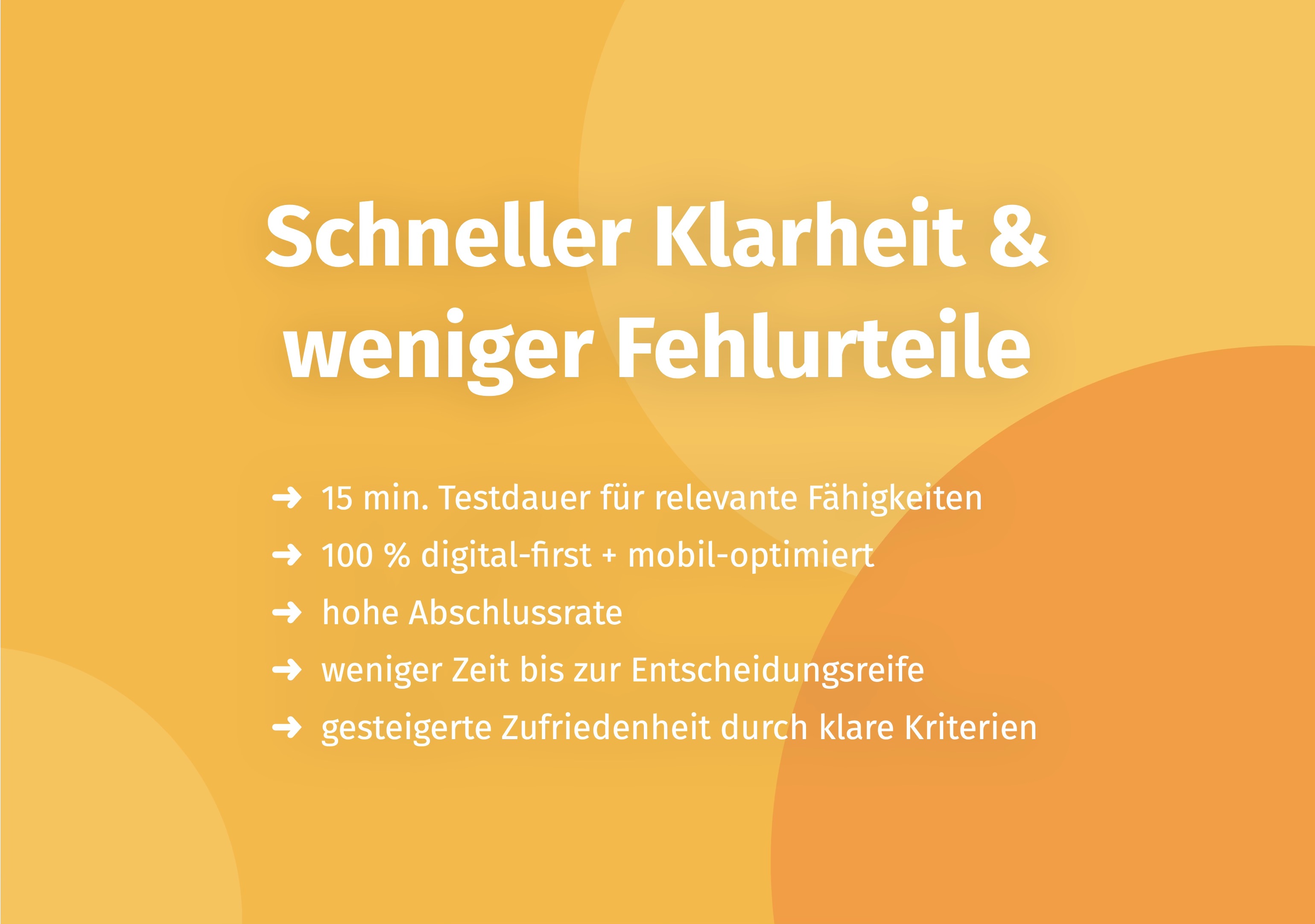
The results speak for themselves: The company achieves a 96% accuracy rate in predicting which applicants will be rated as suitable in the subsequent selection process. At the same time, 81% of applicants report high satisfaction with the process. Over 100 minutes of testing time per applicant are saved.
Susanne Berthold-Neumann from Lufthansa summarizes the approach: "We look at the documents later because they only show a small part of the person and say little about whether someone has the competencies for future challenges."
Other companies report similar experiences. At persona service, they deliberately define people's potential not just through their resume, but equally through personality and engagement. And OMR reports that through the use of objective diagnostics, candidates were hired who would have been rejected based on their CV – which strengthens diversity in the company long-term.
Combining Resume Analysis with Objective Diagnostics
The question isn't "resume or diagnostics?" – but rather: How do you optimally combine both?
When CV Screening Makes Sense – and When It Doesn't
CV screening makes sense for:
- Checking formal minimum requirements (e.g., required degrees)
- Initial orientation about career path and experience
- Identifying obvious exclusion criteria
CV screening is insufficient for:
- Assessing soft skills and personality
- Predicting job success
- Recognizing development potential
- Making objective, bias-free decisions
The Optimal Process: From CV to Potential Analysis
A modern recruiting process could look like this:
- Application receipt: All applications are captured
- Aptitude diagnostics: Candidates complete a brief online assessment (e.g., game-based assessments)
- Structured pre-selection: Combination of assessment results and CV criteria
- Structured interviews: In-depth conversations with top candidates
- Hiring decision: Data-based and transparent
The advantage of this approach: You save time (because you only review relevant CVs in detail), increase quality (because you recognize potential invisible in the CV), and reduce bias (because standardized methods are less susceptible to unconscious prejudice).
Objective aptitude diagnostics tools like Aivy integrate seamlessly into existing ATS systems and enable exactly this combined approach – scientifically grounded and practical.
Frequently Asked Questions (FAQ)
What's the difference between resume analysis and CV parsing?
Resume analysis is the overarching term for systematically reviewing and evaluating CVs. CV parsing is a specific technology that automatically extracts information from resumes and stores it in a structured format. Parsing is a tool within analysis that saves time – but doesn't replace qualitative evaluation.
How long should I spend reviewing a resume?
Studies show that many recruiters spend only 43-60 seconds on the initial screening. For a thorough analysis, you should plan at least 2-3 minutes and use structured criteria. With a two-stage process (first quick screening, then detailed analysis), you can use your time more efficiently.
What do resume gaps really indicate?
Less than many think. Professor Kanning's research shows that resume gaps barely correlate with personality traits or job success. What matters are the reasons for gaps – not their mere existence. Ask about them in the interview rather than making blanket rejections.
How can I reduce unconscious bias in CV screening?
Through multiple measures: Define clear job requirements in advance, use structured evaluation forms, consider blind hiring (anonymized applications), implement multiple reviewers, and supplement CV analysis with objective aptitude diagnostics that measures potential rather than past performance.
Can resumes predict job success?
To a limited extent. The Schmidt and Hunter meta-analysis shows: Biographical data has a validity of r=0.35 – meaning moderate but not optimal predictive power. Aptitude tests (r=0.54) and structured interviews (r=0.51) are significantly better suited to predicting future job success.
What does aptitude diagnostics add beyond resume analysis?
Aptitude diagnostics captures competencies and potential invisible in the CV: cognitive abilities, personality traits, problem-solving skills, and development potential. These factors are proven better predictors of job success than formal qualifications.
What's the best way to combine CV analysis with objective diagnostics?
Use the resume to check formal minimum requirements and for initial orientation. Supplement it with a brief online assessment (e.g., game-based assessments) that objectively captures potential. Then conduct structured interviews with top candidates. This combines efficiency with quality.
Conclusion: Rethinking Resume Analysis
Resume analysis remains an important component of the recruiting process – but it shouldn't be the only or most important tool.
Key takeaways:
- Resumes have limited predictive power for job success (r=0.35 according to Schmidt & Hunter)
- Resume gaps aren't a valid exclusion criterion (Kanning, 2014/2017)
- Unconscious bias distorts CV evaluation – structured criteria and objective methods help
- The combination of CV screening and aptitude diagnostics delivers the best results
- Potential matters more than past performance – because you're hiring for the future
Your next step: Review your current selection process. Are you using clear, pre-defined criteria? Have you implemented measures against unconscious bias? Are you supplementing CV analysis with scientifically validated diagnostics?
Objective aptitude diagnostics tools like Aivy help you make better hiring decisions – data-driven, fair, and efficient. Practice shows: Companies that take this path achieve not only better accuracy rates but also strengthen their diversity and candidate experience.
Sources
- Schmidt, F. L., & Hunter, J. E. (1998). The validity and utility of selection methods in personnel psychology: Practical and theoretical implications of 85 years of research findings. Psychological Bulletin, 124(2), 262-274.
- Schmidt, F. L., Oh, I.-S., & Shaffer, J. A. (2016). The validity and utility of selection methods in personnel psychology: Practical and theoretical implications of 100 years of research findings. Working Paper, University of Iowa.
- Frank, F., & Kanning, U. P. (2014). Lücken im Lebenslauf: Ein valides Kriterium der Personalauswahl? Zeitschrift für Arbeits- und Organisationspsychologie, 58(3), 155-162.
- Kanning, U. P. (2017). Zusammenhang zwischen Lücken im Lebenslauf und Berufserfolg: Ein Mythos der Personalauswahlpraxis. Zeitschrift für Arbeits- und Organisationspsychologie, 61(2), 61-71.
- Bertrand, M., & Mullainathan, S. (2004). Are Emily and Greg More Employable Than Lakisha and Jamal? A Field Experiment on Labor Market Discrimination. American Economic Review, 94(4), 991-1013.
- Stepstone/Mind Take (2018). Eye-tracking study on resume evaluation.
- Aivy Success Story Lufthansa: https://www.aivy.app/en/success-stories/lufthansa
- Aivy Success Story persona service: https://www.aivy.app/en/success-stories/persona-service

Make a better pre-selection — even before the first interview
In just a few minutes, Aivy shows you which candidates really fit the role. Beyond resumes based on strengths.