You want to explore your strengths as a talent?

This way

Login

Recruiting Costs: Calculation, Benchmarks & Optimization

Home
-
Lexicon
-
Recruiting Costs: Calculation, Benchmarks & Optimization

You're planning your recruiting budget and wondering: What does a new hire actually cost? Or you have the feeling that your budget never stretches far enough, without knowing exactly why?

You're not alone. According to current surveys, 63% of HR managers report an increase in recruiting costs compared to previous years. At the same time, many HR teams don't know which costs actually flow into their hires – and where the greatest optimization potential lies.

The good news: Recruiting costs are not a black box. With the right metrics and strategies, you can not only create transparency but also systematically reduce costs – without compromising on hiring quality.

In this guide, you'll learn how to calculate your cost-per-hire, what benchmarks apply in Germany, and which seven strategies have been proven to reduce recruiting costs. We'll draw on current studies and show you through real-world examples what actually works.

What Are Recruiting Costs? Definition and Overview

Recruiting costs (also called talent acquisition costs) encompass all financial expenditures incurred when searching for, selecting, and hiring new employees. These costs arise from the moment a job is posted until the employment contract is signed – and sometimes even beyond.

The most important metric in this context is the cost-per-hire (CPH): It indicates how much a single hire costs on average. This metric is essential for planning your recruiting budget, measuring the efficiency of your processes, and identifying optimization potential.

Only 36% of employers systematically measure their cost-per-hire – yet this metric offers enormous advantages for strategic workforce planning.

Internal vs. External Recruiting Costs

To fully capture your recruiting costs, you need to distinguish between internal and external cost factors:

Internal Costs:

  • Salaries of HR staff (proportional to recruiting activities)
  • Time spent by hiring managers on interviews and selection meetings
  • Onboarding and training efforts
  • Administrative tasks (contract preparation, communication)
  • Training for hiring managers

External Costs:

  • Job postings on job boards (€700–€1,300 per posting for 30 days)
  • Headhunters and recruitment agencies (23–35% of annual gross salary)
  • Recruiting software and applicant tracking systems
  • Employer branding initiatives
  • Job fairs and career events
  • Background checks and assessments

Hidden Costs: Vacancy Costs and Opportunity Costs

The obvious recruiting costs are just the tip of the iceberg. Far more significant – and often overlooked – are the hidden costs:

Vacancy Costs (Cost of Vacancy): Every day a position remains unfilled costs your company money. Experts estimate these costs at an average of €600–€900 per day – through productivity losses, overtime for other team members, and missed business opportunities. In the IT sector, costs per unfilled position can exceed €37,000.

The German Federal Employment Agency puts the average vacancy time in Germany at 170 days. This means: A single unfilled position can cost your company over €100,000 before anyone is even hired.

Opportunity Costs: Add to this lost orders, delayed projects, and missed market opportunities. These indirect costs are difficult to quantify but are often the biggest cost drivers in the entire recruiting process.

How to Calculate Cost-per-Hire: The Formula with Example

Calculating cost-per-hire is simpler than many think. The basic formula is:

Cost-per-Hire = (Internal Costs + External Costs) / Number of Hires

Step-by-Step Guide to Calculation

Step 1: Capture all internal costsCalculate the proportional time investment of all people involved in recruiting. If your HR manager spends 40% of their work time on recruiting and earns €5,000 monthly, that's €2,000 in internal costs per month.

Step 2: Add all external costsCollect all invoices for job postings, software, external service providers, and events.

Step 3: Define a time periodTypically, annual figures are used for meaningful results.

Step 4: Divide by the number of hiresTotal costs divided by the number of successfully filled positions gives you your cost-per-hire.

Sample Calculation:

Cost Type Amount (annually)
HR salaries (proportional) €48,000
Interview time from departments €12,000
Job postings €15,000
Recruiting software €6,000
Job fairs €4,000
Total Costs €85,000
Hires per year 15
Cost-per-Hire €5,667

Free Template: Cost-per-Hire Calculator

A standardized calculation is important so you can make comparisons over time and across departments. Define once which cost items you include, and keep this definition consistent.

Tip: Track your costs separately by position and department. This helps you identify whether certain roles are particularly cost-intensive – and where optimization potential exists.

Average Recruiting Costs in Germany

One of the most common questions in HR is: "Are our costs in line with the average?" Current studies provide insightful benchmarks.

Cost-per-Hire by Industry and Position

The average cost-per-hire in Germany ranges between €4,700 and €10,000 – depending on the study, industry, and position. In one survey, more than half of the HR managers surveyed reported an average cost-per-hire of over €10,000.

Position Level Typical Cost-per-Hire
Entry-level positions €3,000–€5,000
Skilled professionals €5,000–€8,000
Management positions €10,000–€25,000
C-Level / Executive €25,000–€50,000+

Industries with particularly high costs:

  • IT and Technology (skills shortage)
  • Engineering
  • Healthcare
  • Finance and Controlling

Current Benchmarks and Trends 2026

The recruiting landscape is changing: Job boards and service providers have increased their prices in the low double-digit percentage range. However, this doesn't mean your recruiting budget needs to increase proportionally.

The trend is toward more efficient processes: Companies that rely on structured selection, automation, and data-driven decisions can reduce their costs despite rising market prices.

Important: Budget does not equal costs. What matters is not how much you spend – but how efficiently you hire and how good your selection decisions are.

The Underestimated Risk: Cost of Bad Hires

While many HR teams focus on direct recruiting costs, they overlook the biggest cost driver: bad hires. A wrong hiring decision can cost your company many times the actual recruiting costs.

Why Bad Hires Are So Expensive (Studies)

The numbers are alarming: According to a study by Kienbaum Management Consultants, the costs of a hiring mistake for executives amount to 1.5 to 3 times the annual salary. For an annual salary of €80,000, that's up to €240,000 in losses.

The costs are also significant for skilled workers: CareerBuilder puts the average cost of a bad hire in Germany at more than €50,000. In Germany, 29% of companies report losses exceeding €50,000 per bad hire.

What makes bad hires so expensive?

  • New recruiting costs for re-filling the position
  • Lost onboarding time and productivity
  • Salary payments during the (failed) probation period
  • Demotivation and additional burden on the team
  • Potential customer attrition
  • Possible severance payments and legal costs
  • Reputation damage as an employer

The "Recruiting Trends" study (Pape Consulting) shows: One-third of the companies surveyed stated that they had made at least one hiring mistake within six months.

How Gut Feeling vs. Objective Selection Compares

Why do so many bad hires happen? The answer often lies in the selection method.

A survey by the German Association of HR Managers shows: Only 38% of medium-sized companies use structured interview techniques. Even fewer – just 22% – use validated selection procedures such as assessment centers or psychometric tests.

The scientific research is clear on this: Schmidt and Hunter analyzed the validity of different selection methods in their landmark meta-study (1998). The result:

Selection Method Validity (r)
Unstructured interviews 0.38
Structured interviews 0.51
Aptitude tests 0.54
Assessment centers 0.37
Combination (tests + interview) 0.63

What does this mean? Unstructured interviews – the classic "gut feeling conversation" – have a hit rate barely better than chance. Structured procedures and personnel assessment, on the other hand, significantly increase the probability of a successful hire.

Cognitive biases such as Affinity Bias (the tendency to prefer similar people) or Confirmation Bias (wanting to confirm preconceptions) exacerbate the problem. Without structured processes, these biases are almost unavoidable.

7 Proven Strategies to Reduce Recruiting Costs

The good news: You can systematically reduce your recruiting costs without compromising on hiring quality. In fact – the most effective cost-saving strategies often simultaneously improve selection quality.

Strategy 1: Leverage Internal Mobility and Talent Pools

Developing an employee who is already part of the company carries significantly lower risk than a new external hire. Performance and soft skills are known, integration takes less time, and costs are significantly lower.

How to implement it:

  • Build an active talent pool from former applicants
  • Communicate open positions internally before searching externally
  • Invest in professional development for key positions

Strategy 2: Structured Interviews Instead of Gut Feeling

As research shows, structured job interviews significantly increase hit rates. In these interviews, all candidates are asked the same questions and evaluated according to uniform criteria.

Benefits:

  • Better comparability between candidates
  • Reduction of unconscious bias
  • Higher validity of selection decisions
  • Fewer bad hires = lower follow-up costs

Strategy 3: Implement Objective Personnel Assessment

Scientifically validated assessment procedures provide objective data about candidates' suitability. Unlike interviews, which are heavily influenced by subjective impressions, these procedures measure relevant competencies in a standardized and comparable way.

Objective assessment tools like Aivy rely on data-driven decisions instead of gut feeling. The platform uses Game-Based Assessments that are both engaging and scientifically validated – developed as a spin-off from Freie Universität Berlin.

The result: Measurably better selection decisions and fewer bad hires. MCI Germany was able to reduce time-to-hire by 55% and simultaneously lower cost-per-hire by 92% through the use of Game-Based Assessments. Matthias Kühne, Director People & Culture at MCI, emphasizes: "With Aivy, we have digitized another process step in talent acquisition and significantly professionalized it through a more objective evaluation basis."

Strategy 4: Systematize Employee Referrals

Your employees often have friends and acquaintances with similar interests and qualifications. Employee referral programs are among the most cost-effective recruiting channels.

How it works:

  • Establish a structured referral program
  • Offer attractive bonuses (typically €1,000–€2,500)
  • Actively communicate open positions to your team
  • Make the referral process simple and transparent

Strategy 5: Reduce Time-to-Hire Through Process Optimization

Every additional day in the recruiting process costs money – through vacancy costs and the risk of losing good candidates to faster competitors. 73% of candidates abandon the application process if it's too complicated or lengthy.

Optimization levers:

  • Reduce the number of interview rounds
  • Speed up feedback loops
  • Automate administrative tasks
  • Use digital tools for efficient pre-screening

Strategy 6: Improve Candidate Experience

A poor application process not only damages your recruiting but also your employer brand. 55% of candidates share negative experiences on social media. Conversely, a positive candidate experience leads to higher acceptance rates and lower drop-off rates.

Frankfurt School achieved a 30% better candidate experience through improved selection processes – and simultaneously 30% fewer bad decisions even before the first interview. The result: A 4x ROI in the very first year.

Strategy 7: Track and Optimize Recruiting KPIs

You can only optimize what you measure. Establish systematic tracking of your most important recruiting metrics:

KPI What It Measures Target Direction
Cost-per-Hire Cost per hire Reduce
Time-to-Hire Time to hire Shorten
Quality of Hire Quality of hires Increase
Offer Acceptance Rate Acceptance rate Increase
Source of Hire Source of successful hires Optimize

Through regular analysis, you'll recognize which measures work – and where potential still exists.

Objective Personnel Assessment as a Cost Lever: How Tools Help

Of all the cost levers in recruiting, objective personnel assessment offers the greatest potential. Why? Because it addresses the root of the problem: the quality of the selection decision.

Why Scientifically Validated Methods Save Costs

The connection is simple: Better selection decisions lead to fewer bad hires. Fewer bad hires mean lower follow-up costs for re-hiring, onboarding, and productivity losses.

Scientifically validated methods like Game-Based Assessments measure relevant competencies objectively and in a standardized way. Unlike unstructured interviews:

  • No distortion through personal sympathy
  • No unconscious biases
  • Comparable results across all candidates
  • Higher validity in predicting job success

Case Study: How MCI Reduced Cost-per-Hire by 92%

The MCI Germany example impressively shows what's possible. The company faced typical challenges: high recruiting costs, long time-to-fill, and uncertainty about the quality of selection decisions.

After implementing Game-Based Assessments, MCI achieved:

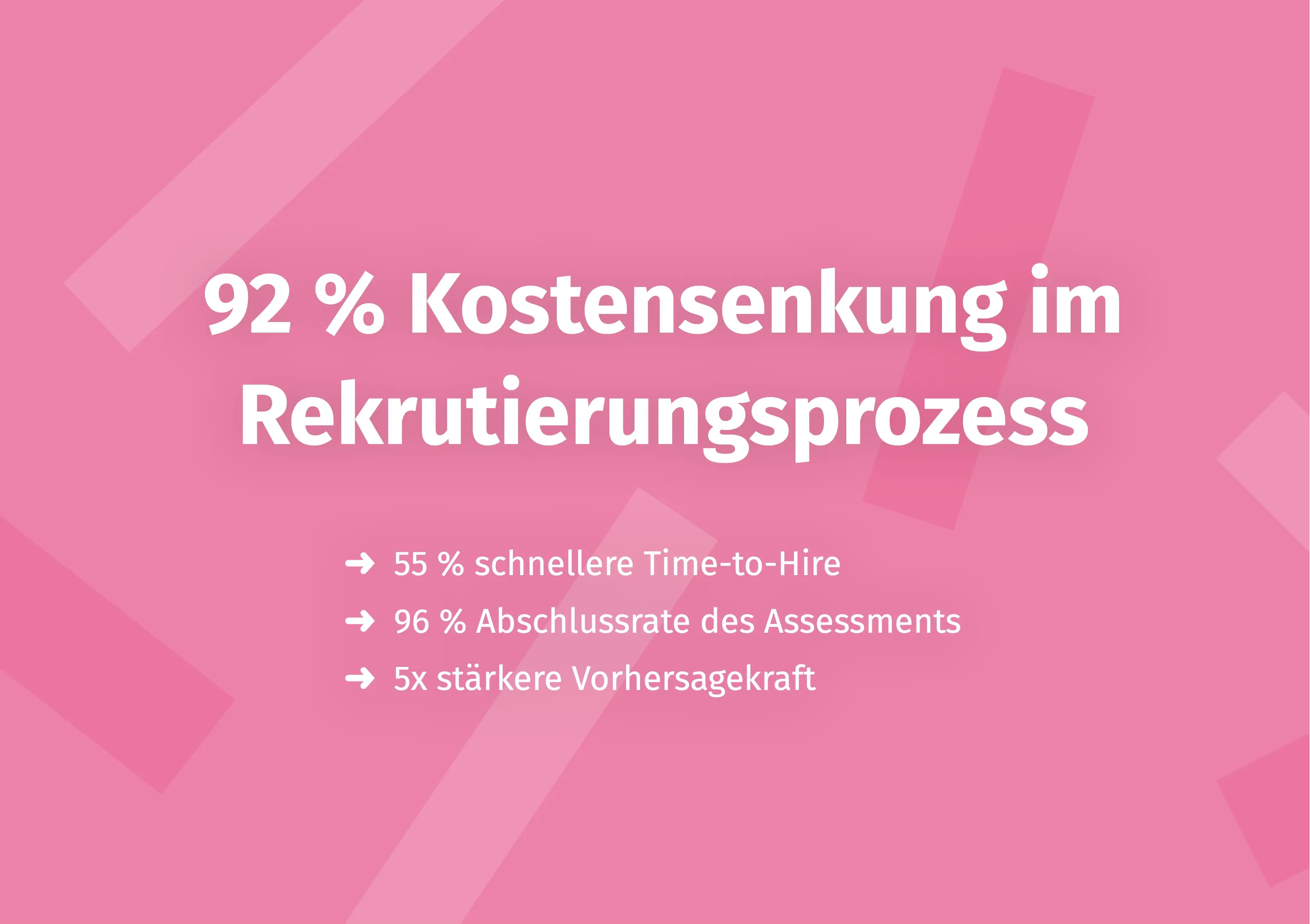
  • 55% faster time-to-hire
  • 96% completion rate in the assessment
  • 92% lower cost-per-hire

The investment paid off almost immediately. Other companies report similar successes: Callways was able to reduce recruiting effort to one-third. CEO Achim Reinhardt summarizes: "Without Aivy, we would have 2-3 times as much work and recruit worse."

Find more details in the MCI Success Story.

Calculating ROI: When Is the Investment Worth It?

A simple calculation shows when objective personnel assessment pays off:

Example:

  • Current bad hire rate: 30%
  • Cost per bad hire: €50,000
  • 20 hires per year
  • → Bad hire costs: 6 × €50,000 = €300,000

If you halve the bad hire rate to 15% through better assessment, you save €150,000 annually – many times the investment in professional selection tools.

Frankfurt School achieved a 4x ROI in the very first year after introducing objective personnel assessment. The investment thus paid for itself within three months.

Frequently Asked Questions (FAQ)

What is the average cost of a new hire in Germany? The average cost-per-hire in Germany ranges between €4,700 and €10,000. For executives, costs can be significantly higher – headhunters often charge 23–35% of the annual gross salary.

How do I calculate cost-per-hire? The formula is: Cost-per-Hire = (Internal Costs + External Costs) / Number of Hires. Internal costs include HR staff salaries and interview time from departments. External costs include job postings, job boards, headhunters, and software.

What does a bad hire cost? According to studies, a bad hire costs between €30,000 and €140,000. For executives, costs can amount to 1.5 to 3 times the annual salary (Kienbaum study). In Germany, 29% of companies report losses exceeding €50,000 per bad hire.

What does an unfilled position cost per day? Experts estimate vacancy costs at an average of €600–€900 per day. In IT, they can exceed €37,000 per unfilled position. The average vacancy time in Germany is 170 days.

How can I reduce recruiting costs? Effective strategies include: (1) Leverage internal mobility, (2) Use structured interviews instead of gut feeling, (3) Implement objective personnel assessment, (4) Systematize employee referrals, (5) Reduce time-to-hire through process optimization, (6) Improve candidate experience, (7) Track and optimize recruiting KPIs.

Is recruiting software or personnel assessment worth it? Yes, if it reduces bad hires and shortens time-to-hire. Frankfurt School achieved a 4x ROI in the first year through objective personnel assessment. MCI reduced cost-per-hire by 92% and time-to-hire by 55%.

What is the difference between internal and external recruiting costs? Internal costs arise within the company itself: HR salaries, interview time, onboarding effort. External costs go to third parties: job postings (€700–€1,300), headhunters (23–35% annual salary), job boards, software subscriptions.

What hidden recruiting costs are often overlooked? Often underestimated: vacancy costs (productivity loss during open positions), opportunity costs (lost orders), onboarding costs, time from departments for interviews, and the costs of bad hires including re-hiring.

How much should my recruiting budget be? A rule of thumb: Calculate your average cost-per-hire times planned hires. With 30 planned hires and €4,500 cost-per-hire, that would be €135,000 budget. Plan a buffer for bad hires.

Conclusion: The Key Levers for Efficient Recruiting

Reducing recruiting costs doesn't mean cutting corners in the wrong places. On the contrary: The most effective measures simultaneously improve the quality of your hires.

Key Takeaways:

  • Know your numbers: Without systematic tracking of your cost-per-hire, time-to-hire, and bad hire rate, you're operating in the dark.
  • Focus on bad hires: A single bad hire costs more than ten successful ones. Investments in better selection have the highest ROI.
  • Structure your processes: Structured interviews and objective personnel assessment demonstrably increase hit rates – and thus reduce follow-up costs.
  • Use data instead of gut feeling: Scientifically validated methods provide better predictions than intuitive assessments.

Objective personnel assessment tools like Aivy help you implement these levers in practice. The platform combines scientifically grounded Game-Based Assessments with a positive candidate experience – and delivers measurable results, as the successes at MCI, Frankfurt School, and many other companies demonstrate.

Your next step: Analyze your current recruiting costs, identify the biggest cost drivers, and start with the optimizations that promise the highest impact.

Sources

  • Kienbaum Management Consultants (2020): Study on costs of bad hires
  • Schmidt, F.L. & Hunter, J.E. (1998): The Validity and Utility of Selection Methods in Personnel Psychology
  • German Federal Employment Agency (2024): Vacancy times in Germany
  • German Economic Institute (IW Köln) (2024): Costs of skills shortage
  • Pape Consulting (2014): Recruiting Trends – Bad hire rates
  • CareerBuilder (2023): International study on bad hire costs
  • Aivy Success Stories: MCI Germany, Frankfurt School

Home
-
lexicon
-
Recruiting Costs: Calculation, Benchmarks & Optimization

You're planning your recruiting budget and wondering: What does a new hire actually cost? Or you have the feeling that your budget never stretches far enough, without knowing exactly why?

You're not alone. According to current surveys, 63% of HR managers report an increase in recruiting costs compared to previous years. At the same time, many HR teams don't know which costs actually flow into their hires – and where the greatest optimization potential lies.

The good news: Recruiting costs are not a black box. With the right metrics and strategies, you can not only create transparency but also systematically reduce costs – without compromising on hiring quality.

In this guide, you'll learn how to calculate your cost-per-hire, what benchmarks apply in Germany, and which seven strategies have been proven to reduce recruiting costs. We'll draw on current studies and show you through real-world examples what actually works.

What Are Recruiting Costs? Definition and Overview

Recruiting costs (also called talent acquisition costs) encompass all financial expenditures incurred when searching for, selecting, and hiring new employees. These costs arise from the moment a job is posted until the employment contract is signed – and sometimes even beyond.

The most important metric in this context is the cost-per-hire (CPH): It indicates how much a single hire costs on average. This metric is essential for planning your recruiting budget, measuring the efficiency of your processes, and identifying optimization potential.

Only 36% of employers systematically measure their cost-per-hire – yet this metric offers enormous advantages for strategic workforce planning.

Internal vs. External Recruiting Costs

To fully capture your recruiting costs, you need to distinguish between internal and external cost factors:

Internal Costs:

  • Salaries of HR staff (proportional to recruiting activities)
  • Time spent by hiring managers on interviews and selection meetings
  • Onboarding and training efforts
  • Administrative tasks (contract preparation, communication)
  • Training for hiring managers

External Costs:

  • Job postings on job boards (€700–€1,300 per posting for 30 days)
  • Headhunters and recruitment agencies (23–35% of annual gross salary)
  • Recruiting software and applicant tracking systems
  • Employer branding initiatives
  • Job fairs and career events
  • Background checks and assessments

Hidden Costs: Vacancy Costs and Opportunity Costs

The obvious recruiting costs are just the tip of the iceberg. Far more significant – and often overlooked – are the hidden costs:

Vacancy Costs (Cost of Vacancy): Every day a position remains unfilled costs your company money. Experts estimate these costs at an average of €600–€900 per day – through productivity losses, overtime for other team members, and missed business opportunities. In the IT sector, costs per unfilled position can exceed €37,000.

The German Federal Employment Agency puts the average vacancy time in Germany at 170 days. This means: A single unfilled position can cost your company over €100,000 before anyone is even hired.

Opportunity Costs: Add to this lost orders, delayed projects, and missed market opportunities. These indirect costs are difficult to quantify but are often the biggest cost drivers in the entire recruiting process.

How to Calculate Cost-per-Hire: The Formula with Example

Calculating cost-per-hire is simpler than many think. The basic formula is:

Cost-per-Hire = (Internal Costs + External Costs) / Number of Hires

Step-by-Step Guide to Calculation

Step 1: Capture all internal costsCalculate the proportional time investment of all people involved in recruiting. If your HR manager spends 40% of their work time on recruiting and earns €5,000 monthly, that's €2,000 in internal costs per month.

Step 2: Add all external costsCollect all invoices for job postings, software, external service providers, and events.

Step 3: Define a time periodTypically, annual figures are used for meaningful results.

Step 4: Divide by the number of hiresTotal costs divided by the number of successfully filled positions gives you your cost-per-hire.

Sample Calculation:

Cost Type Amount (annually)
HR salaries (proportional) €48,000
Interview time from departments €12,000
Job postings €15,000
Recruiting software €6,000
Job fairs €4,000
Total Costs €85,000
Hires per year 15
Cost-per-Hire €5,667

Free Template: Cost-per-Hire Calculator

A standardized calculation is important so you can make comparisons over time and across departments. Define once which cost items you include, and keep this definition consistent.

Tip: Track your costs separately by position and department. This helps you identify whether certain roles are particularly cost-intensive – and where optimization potential exists.

Average Recruiting Costs in Germany

One of the most common questions in HR is: "Are our costs in line with the average?" Current studies provide insightful benchmarks.

Cost-per-Hire by Industry and Position

The average cost-per-hire in Germany ranges between €4,700 and €10,000 – depending on the study, industry, and position. In one survey, more than half of the HR managers surveyed reported an average cost-per-hire of over €10,000.

Position Level Typical Cost-per-Hire
Entry-level positions €3,000–€5,000
Skilled professionals €5,000–€8,000
Management positions €10,000–€25,000
C-Level / Executive €25,000–€50,000+

Industries with particularly high costs:

  • IT and Technology (skills shortage)
  • Engineering
  • Healthcare
  • Finance and Controlling

Current Benchmarks and Trends 2026

The recruiting landscape is changing: Job boards and service providers have increased their prices in the low double-digit percentage range. However, this doesn't mean your recruiting budget needs to increase proportionally.

The trend is toward more efficient processes: Companies that rely on structured selection, automation, and data-driven decisions can reduce their costs despite rising market prices.

Important: Budget does not equal costs. What matters is not how much you spend – but how efficiently you hire and how good your selection decisions are.

The Underestimated Risk: Cost of Bad Hires

While many HR teams focus on direct recruiting costs, they overlook the biggest cost driver: bad hires. A wrong hiring decision can cost your company many times the actual recruiting costs.

Why Bad Hires Are So Expensive (Studies)

The numbers are alarming: According to a study by Kienbaum Management Consultants, the costs of a hiring mistake for executives amount to 1.5 to 3 times the annual salary. For an annual salary of €80,000, that's up to €240,000 in losses.

The costs are also significant for skilled workers: CareerBuilder puts the average cost of a bad hire in Germany at more than €50,000. In Germany, 29% of companies report losses exceeding €50,000 per bad hire.

What makes bad hires so expensive?

  • New recruiting costs for re-filling the position
  • Lost onboarding time and productivity
  • Salary payments during the (failed) probation period
  • Demotivation and additional burden on the team
  • Potential customer attrition
  • Possible severance payments and legal costs
  • Reputation damage as an employer

The "Recruiting Trends" study (Pape Consulting) shows: One-third of the companies surveyed stated that they had made at least one hiring mistake within six months.

How Gut Feeling vs. Objective Selection Compares

Why do so many bad hires happen? The answer often lies in the selection method.

A survey by the German Association of HR Managers shows: Only 38% of medium-sized companies use structured interview techniques. Even fewer – just 22% – use validated selection procedures such as assessment centers or psychometric tests.

The scientific research is clear on this: Schmidt and Hunter analyzed the validity of different selection methods in their landmark meta-study (1998). The result:

Selection Method Validity (r)
Unstructured interviews 0.38
Structured interviews 0.51
Aptitude tests 0.54
Assessment centers 0.37
Combination (tests + interview) 0.63

What does this mean? Unstructured interviews – the classic "gut feeling conversation" – have a hit rate barely better than chance. Structured procedures and personnel assessment, on the other hand, significantly increase the probability of a successful hire.

Cognitive biases such as Affinity Bias (the tendency to prefer similar people) or Confirmation Bias (wanting to confirm preconceptions) exacerbate the problem. Without structured processes, these biases are almost unavoidable.

7 Proven Strategies to Reduce Recruiting Costs

The good news: You can systematically reduce your recruiting costs without compromising on hiring quality. In fact – the most effective cost-saving strategies often simultaneously improve selection quality.

Strategy 1: Leverage Internal Mobility and Talent Pools

Developing an employee who is already part of the company carries significantly lower risk than a new external hire. Performance and soft skills are known, integration takes less time, and costs are significantly lower.

How to implement it:

  • Build an active talent pool from former applicants
  • Communicate open positions internally before searching externally
  • Invest in professional development for key positions

Strategy 2: Structured Interviews Instead of Gut Feeling

As research shows, structured job interviews significantly increase hit rates. In these interviews, all candidates are asked the same questions and evaluated according to uniform criteria.

Benefits:

  • Better comparability between candidates
  • Reduction of unconscious bias
  • Higher validity of selection decisions
  • Fewer bad hires = lower follow-up costs

Strategy 3: Implement Objective Personnel Assessment

Scientifically validated assessment procedures provide objective data about candidates' suitability. Unlike interviews, which are heavily influenced by subjective impressions, these procedures measure relevant competencies in a standardized and comparable way.

Objective assessment tools like Aivy rely on data-driven decisions instead of gut feeling. The platform uses Game-Based Assessments that are both engaging and scientifically validated – developed as a spin-off from Freie Universität Berlin.

The result: Measurably better selection decisions and fewer bad hires. MCI Germany was able to reduce time-to-hire by 55% and simultaneously lower cost-per-hire by 92% through the use of Game-Based Assessments. Matthias Kühne, Director People & Culture at MCI, emphasizes: "With Aivy, we have digitized another process step in talent acquisition and significantly professionalized it through a more objective evaluation basis."

Strategy 4: Systematize Employee Referrals

Your employees often have friends and acquaintances with similar interests and qualifications. Employee referral programs are among the most cost-effective recruiting channels.

How it works:

  • Establish a structured referral program
  • Offer attractive bonuses (typically €1,000–€2,500)
  • Actively communicate open positions to your team
  • Make the referral process simple and transparent

Strategy 5: Reduce Time-to-Hire Through Process Optimization

Every additional day in the recruiting process costs money – through vacancy costs and the risk of losing good candidates to faster competitors. 73% of candidates abandon the application process if it's too complicated or lengthy.

Optimization levers:

  • Reduce the number of interview rounds
  • Speed up feedback loops
  • Automate administrative tasks
  • Use digital tools for efficient pre-screening

Strategy 6: Improve Candidate Experience

A poor application process not only damages your recruiting but also your employer brand. 55% of candidates share negative experiences on social media. Conversely, a positive candidate experience leads to higher acceptance rates and lower drop-off rates.

Frankfurt School achieved a 30% better candidate experience through improved selection processes – and simultaneously 30% fewer bad decisions even before the first interview. The result: A 4x ROI in the very first year.

Strategy 7: Track and Optimize Recruiting KPIs

You can only optimize what you measure. Establish systematic tracking of your most important recruiting metrics:

KPI What It Measures Target Direction
Cost-per-Hire Cost per hire Reduce
Time-to-Hire Time to hire Shorten
Quality of Hire Quality of hires Increase
Offer Acceptance Rate Acceptance rate Increase
Source of Hire Source of successful hires Optimize

Through regular analysis, you'll recognize which measures work – and where potential still exists.

Objective Personnel Assessment as a Cost Lever: How Tools Help

Of all the cost levers in recruiting, objective personnel assessment offers the greatest potential. Why? Because it addresses the root of the problem: the quality of the selection decision.

Why Scientifically Validated Methods Save Costs

The connection is simple: Better selection decisions lead to fewer bad hires. Fewer bad hires mean lower follow-up costs for re-hiring, onboarding, and productivity losses.

Scientifically validated methods like Game-Based Assessments measure relevant competencies objectively and in a standardized way. Unlike unstructured interviews:

  • No distortion through personal sympathy
  • No unconscious biases
  • Comparable results across all candidates
  • Higher validity in predicting job success

Case Study: How MCI Reduced Cost-per-Hire by 92%

The MCI Germany example impressively shows what's possible. The company faced typical challenges: high recruiting costs, long time-to-fill, and uncertainty about the quality of selection decisions.

After implementing Game-Based Assessments, MCI achieved:

  • 55% faster time-to-hire
  • 96% completion rate in the assessment
  • 92% lower cost-per-hire

The investment paid off almost immediately. Other companies report similar successes: Callways was able to reduce recruiting effort to one-third. CEO Achim Reinhardt summarizes: "Without Aivy, we would have 2-3 times as much work and recruit worse."

Find more details in the MCI Success Story.

Calculating ROI: When Is the Investment Worth It?

A simple calculation shows when objective personnel assessment pays off:

Example:

  • Current bad hire rate: 30%
  • Cost per bad hire: €50,000
  • 20 hires per year
  • → Bad hire costs: 6 × €50,000 = €300,000

If you halve the bad hire rate to 15% through better assessment, you save €150,000 annually – many times the investment in professional selection tools.

Frankfurt School achieved a 4x ROI in the very first year after introducing objective personnel assessment. The investment thus paid for itself within three months.

Frequently Asked Questions (FAQ)

What is the average cost of a new hire in Germany? The average cost-per-hire in Germany ranges between €4,700 and €10,000. For executives, costs can be significantly higher – headhunters often charge 23–35% of the annual gross salary.

How do I calculate cost-per-hire? The formula is: Cost-per-Hire = (Internal Costs + External Costs) / Number of Hires. Internal costs include HR staff salaries and interview time from departments. External costs include job postings, job boards, headhunters, and software.

What does a bad hire cost? According to studies, a bad hire costs between €30,000 and €140,000. For executives, costs can amount to 1.5 to 3 times the annual salary (Kienbaum study). In Germany, 29% of companies report losses exceeding €50,000 per bad hire.

What does an unfilled position cost per day? Experts estimate vacancy costs at an average of €600–€900 per day. In IT, they can exceed €37,000 per unfilled position. The average vacancy time in Germany is 170 days.

How can I reduce recruiting costs? Effective strategies include: (1) Leverage internal mobility, (2) Use structured interviews instead of gut feeling, (3) Implement objective personnel assessment, (4) Systematize employee referrals, (5) Reduce time-to-hire through process optimization, (6) Improve candidate experience, (7) Track and optimize recruiting KPIs.

Is recruiting software or personnel assessment worth it? Yes, if it reduces bad hires and shortens time-to-hire. Frankfurt School achieved a 4x ROI in the first year through objective personnel assessment. MCI reduced cost-per-hire by 92% and time-to-hire by 55%.

What is the difference between internal and external recruiting costs? Internal costs arise within the company itself: HR salaries, interview time, onboarding effort. External costs go to third parties: job postings (€700–€1,300), headhunters (23–35% annual salary), job boards, software subscriptions.

What hidden recruiting costs are often overlooked? Often underestimated: vacancy costs (productivity loss during open positions), opportunity costs (lost orders), onboarding costs, time from departments for interviews, and the costs of bad hires including re-hiring.

How much should my recruiting budget be? A rule of thumb: Calculate your average cost-per-hire times planned hires. With 30 planned hires and €4,500 cost-per-hire, that would be €135,000 budget. Plan a buffer for bad hires.

Conclusion: The Key Levers for Efficient Recruiting

Reducing recruiting costs doesn't mean cutting corners in the wrong places. On the contrary: The most effective measures simultaneously improve the quality of your hires.

Key Takeaways:

  • Know your numbers: Without systematic tracking of your cost-per-hire, time-to-hire, and bad hire rate, you're operating in the dark.
  • Focus on bad hires: A single bad hire costs more than ten successful ones. Investments in better selection have the highest ROI.
  • Structure your processes: Structured interviews and objective personnel assessment demonstrably increase hit rates – and thus reduce follow-up costs.
  • Use data instead of gut feeling: Scientifically validated methods provide better predictions than intuitive assessments.

Objective personnel assessment tools like Aivy help you implement these levers in practice. The platform combines scientifically grounded Game-Based Assessments with a positive candidate experience – and delivers measurable results, as the successes at MCI, Frankfurt School, and many other companies demonstrate.

Your next step: Analyze your current recruiting costs, identify the biggest cost drivers, and start with the optimizations that promise the highest impact.

Sources

  • Kienbaum Management Consultants (2020): Study on costs of bad hires
  • Schmidt, F.L. & Hunter, J.E. (1998): The Validity and Utility of Selection Methods in Personnel Psychology
  • German Federal Employment Agency (2024): Vacancy times in Germany
  • German Economic Institute (IW Köln) (2024): Costs of skills shortage
  • Pape Consulting (2014): Recruiting Trends – Bad hire rates
  • CareerBuilder (2023): International study on bad hire costs
  • Aivy Success Stories: MCI Germany, Frankfurt School

Heading 1

Heading 2

Heading 3

Heading 4

Heading 5
Heading 6

Lorem ipsum dolor sit amet, consectetur adipiscing elit, sed do eiusmod tempor incididunt ut laboratories et dolore magna aliqua. Ut Enim ad Minim Veniam, Quis Nostrud Exercitation Ullamco Laboris Nisi ut Aliquip ex ea Commodo Consequat. Duis aute irure dolor in reprehenderite in voluptate velit eat cillum dolore eu fugiate nulla pariature.

Block quote

Ordered list

  1. Item 1
  2. Item 2
  3. Item 3

Unordered list

  • Item A
  • Item B
  • Item C

Text link

Bold text

Emphasis

Superscript

Subscript

Heading 1

Heading 2

Heading 3

Heading 4

Heading 5
Heading 6

Lorem ipsum dolor sit amet, consectetur adipiscing elit, sed do eiusmod tempor incididunt ut laboratories et dolore magna aliqua. Ut Enim ad Minim Veniam, Quis Nostrud Exercitation Ullamco Laboris Nisi ut Aliquip ex ea Commodo Consequat. Duis aute irure dolor in reprehenderite in voluptate velit eat cillum dolore eu fugiate nulla pariature.

Block quote

Ordered list

  1. Item 1
  2. Item 2
  3. Item 3

Unordered list

  • Item A
  • Item B
  • Item C

Text link

Bold text

Emphasis

Superscript

Subscript

Florian Dyballa

CEO, Co-Founder

About Florian

  • Founder & CEO of Aivy — develops innovative ways of personnel diagnostics and is one of the top 10 HR tech founders in Germany (business punk)
  • More than 500,000 digital aptitude tests successfully used by more than 100 companies such as Lufthansa, Würth and Hermes
  • Three times honored with the HR Innovation Award and regularly featured in leading business media (WirtschaftsWoche, Handelsblatt and FAZ)
  • As a business psychologist and digital expert, combines well-founded tests with AI for fair opportunities in personnel selection
  • Shares expertise as a sought-after thought leader in the HR tech industry — in podcasts, media, and at key industry events
  • Actively shapes the future of the working world — by combining science and technology for better and fairer personnel decisions
success stories

You can expect these results

Discover what successes other companies are achieving by using Aivy. Be inspired and do the same as they do.

Many innovative employers already rely on Aivy

Say that #HeRoes

“Through the very high response rate Persuade and retain We our trainees early in the application process. ”

Tamara Molitor
Training manager at Würth
Tamara Molitor

“That Strengths profile reflects 1:1 our experience in a personal conversation. ”

Wolfgang Böhm
Training manager at DIEHL
Wolfgang Böhm Portrait

“Through objective criteria, we promote equal opportunities and Diversity in recruiting. ”

Marie-Jo Goldmann
Head of HR at Nucao
Marie Jo Goldmann Portrait

Aivy is the bestWhat I've come across so far in the German diagnostics start-up sector. ”

Carl-Christoph Fellinger
Strategic Talent Acquisition at Beiersdorf
Christoph Feillinger Portrait

“Selection process which Make fun. ”

Anna Miels
Learning & Development Manager at apoproject
Anna Miels Portrait

“Applicants find out for which position they have the suitable competencies bring along. ”

Jürgen Muthig
Head of Vocational Training at Fresenius
Jürgen Muthig Fresenius Portrait

“Get to know hidden potential and Develop applicants in a targeted manner. ”

Christian Schütz
HR manager at KU64
Christian Schuetz

Saves time and is a lot of fun doing daily work. ”

Matthias Kühne
Director People & Culture at MCI Germany
Matthias Kühne

Engaging candidate experience through communication on equal terms. ”

Theresa Schröder
Head of HR at Horn & Bauer
Theresa Schröder

“Very solid, scientifically based, innovative even from a candidate's point of view and All in all, simply well thought-out. ”

Dr. Kevin-Lim Jungbauer
Recruiting and HR Diagnostics Expert at Beiersdorf
Kevin Jungbauer
YOUR assistant FOR TALENT ASSESSMENT

Try it for free

Become a HeRo 🦸 and understand candidate fit - even before the first job interview...