
Vocational retraining is a professional requalification that enables individuals to make a complete switch into a new occupational field — culminating in a recognised vocational qualification. It differs fundamentally from continuing education: while continuing education deepens existing knowledge within the same profession, vocational retraining is aimed at a complete fresh start. Funding is provided, depending on the individual case, by the Federal Employment Agency (Bundesagentur für Arbeit), the German Pension Insurance (Deutsche Rentenversicherung), or the employer.
Definition: What Is Vocational Retraining?
Under Section 1 (5) of the Vocational Training Act (Berufsbildungsgesetz, BBiG), vocational retraining is a measure of professional education designed to enable individuals to take up a different qualified occupation. It targets people who can no longer pursue their previous profession — or no longer wish to — for example due to health limitations, technological change, or structural shifts within a company.
Unlike initial vocational training, retraining is aimed at adults with existing professional experience. Since prior knowledge is credited, the duration is typically reduced to two thirds of the regular training period — meaning it usually takes two years rather than three. It concludes with a final examination before the relevant chamber (IHK or HWK), leading to a state-recognised vocational qualification.
Distinction: Retraining, Continuing Education and Advanced Training
These three terms are frequently confused in everyday use:
Vocational retraining (Umschulung): Complete change of profession, leading to a new vocational qualification. Duration typically 2 years.
Continuing education (Weiterbildung): Deepening or expanding knowledge within the existing professional field. No new qualification, variable duration.
Advanced training (Fortbildung): Adaptation or advancement within the existing profession (e.g. master craftsperson, technician). Builds on an existing qualification.
Types of Vocational Retraining
Company-Based Retraining (Betriebliche Umschulung)
In company-based retraining, the qualification takes place directly within the organisation — similar to a regular apprenticeship. Employers conclude a retraining contract with the employee and register it with the relevant chamber. The retraining concludes with an examination before the IHK or HWK.
For companies, this model offers a decisive advantage: the retrained individual remains within the organisation and is qualified directly for the new role. At the same time, funding via a training voucher (Bildungsgutschein) from the Federal Employment Agency can significantly reduce costs.
External Retraining (Außerbetriebliche Umschulung)
External retraining takes place at an external training provider — such as a vocational rehabilitation centre (Berufsförderungswerk, BFW), a vocational school, or a private training institute. This is often the route for employees seeking retraining outside their current employer.
Eligibility and Entitlement
Who Is Eligible for Funded Retraining?
There is no automatic statutory entitlement to funded retraining. Funding is linked to specific requirements and is assessed on a case-by-case basis.
Under Sections 81 ff. of Social Code Book III (SGB III), the Federal Employment Agency funds retraining when:
- the person is unemployed or at imminent risk of job loss,
- the measure is necessary to maintain or restore employability,
- a training voucher (Bildungsgutschein) has been issued in advance.
The German Pension Insurance (DRV) covers retraining costs when a health impairment permanently prevents continuation of the previous profession. In this case, a medical assessment is required.
The Role of the Federal Employment Agency and the DRV
The Federal Employment Agency is the primary funding body for retraining in the context of unemployment or the imminent threat thereof. Applications are submitted via the responsible employment agency or job centre. The so-called training voucher — an official document confirming the funding of a measure — must be applied for and issued before the retraining begins. The measure may only commence once the voucher has been granted.
The DRV is responsible when retraining is medically necessary. In this context, the measure is referred to as a "participation benefit for working life" (Leistung zur Teilhabe am Arbeitsleben, LTA).
Funding and Financial Support
Funding via the Federal Employment Agency
When the Federal Employment Agency approves retraining by means of a training voucher, it generally covers all course costs as well as any travel and accommodation expenses incurred. During the measure, participants continue to receive unemployment benefit (Arbeitslosengeld I or II) — depending on their prior entitlement basis.
Funding via the German Pension Insurance
When the DRV funds retraining as a participation benefit, a transitional allowance (Übergangsgeld) is paid in addition to the measure costs. The amount is based on the most recently earned income.
Employer-Funded Retraining
Employers can also fund retraining in full or in part — for example when an existing role becomes redundant due to automation or digitalisation, and internal requalification is more practical than external recruitment. In such cases, a combination of employer investment and public funding can be beneficial.
Vocational Retraining from an Employer Perspective
When Does Company-Based Retraining Make Sense?
For organisations, company-based retraining is particularly worthwhile when:
- skilled employees with specific organisational knowledge are to be retained long-term,
- digitalisation or restructuring renders certain roles obsolete,
- the external labour market offers no suitable candidates,
- employer branding considerations are relevant (demonstrating a culture of development).
Compared to external recruitment, internal retraining eliminates recruiting costs and onboarding time. The employee already knows the company's structures, values and processes.
For well-founded decisions on which employees are suited to retraining, a structured potential assessment can be valuable. It provides objective insights into learning readiness, cognitive ability and development potential — independent of subjective impressions.
Process: How Employers Apply for Funding
- Identify the requalification need: Which positions are affected, and which occupational profiles are realistic?
- Contact the employer service: The Federal Employment Agency has dedicated contact persons for companies.
- Submit the funding application: The training voucher is applied for jointly with the affected employees.
- Conclude the retraining contract: For company-based retraining, a written contract is mandatory — including details on duration, remuneration, training content and examination objective.
- Register with the IHK or HWK: The contract must be registered with the relevant chamber.
- Accompany and complete the retraining: Coordinate examination preparation and arrange any necessary leave of absence.
Common Occupational Fields for Retraining
According to the Federal Institute for Vocational Education and Training (BIBB), there are around 325 state-recognised training occupations in Germany — all of which are in principle eligible for retraining. Those most commonly pursued in practice include:
- IT occupations (IT specialist, IT systems merchant)
- Nursing and healthcare professions
- Commercial occupations (office administrator, retail merchant)
- Logistics and warehousing roles
- Electrical and technical skilled trades
Frequently Asked Questions about Vocational Retraining
What is the difference between vocational retraining and continuing education?
Vocational retraining leads to a fully new, state-recognised vocational qualification in a different occupational field. Continuing education, by contrast, deepens or expands knowledge within the existing profession — without a new qualification. Retraining typically takes two years; continuing education can range from a few days to several months.
How long does vocational retraining take?
Typically two years. This corresponds to two thirds of a regular vocational training programme, as prior knowledge is credited (Section 8 BBiG). In cases of particularly extensive prior knowledge, an individual reduction in duration can be agreed upon application.
Who pays for vocational retraining?
The costs are borne depending on the situation by the Federal Employment Agency (in cases of unemployment or imminent unemployment, via the training voucher), the German Pension Insurance (for health-related reasons), or the employer (in company-based retraining). Mixed funding is possible.
Does one receive a salary during vocational retraining?
This depends on the funding body. In funded retraining, participants generally continue to receive unemployment benefit (Arbeitslosengeld I or II). In company-based retraining, a retraining allowance is customary, the amount of which is set out in the retraining contract. There is no statutory minimum amount.
Who is entitled to funded vocational retraining?
There is no automatic legal entitlement. The Federal Employment Agency assesses on a case-by-case basis whether the measure is necessary and appropriate (Section 81 SGB III). The usual prerequisites are unemployment or a specifically imminent redundancy, as well as prior approval via the training voucher.
Can an employer require an employee to undergo retraining?
No. Retraining cannot be unilaterally ordered by the employer. It is always a mutual agreement between employer and employee. A separate retraining contract is required for company-based retraining.
How do I apply for retraining at the Federal Employment Agency?
The first step is an advisory consultation at the responsible employment agency or job centre. There, the necessity of the measure is assessed and a training voucher is issued — provided all requirements are met. Retraining may only begin once the voucher has been granted. Further information is available directly at: https://www.arbeitsagentur.de/bildung/umschulung
Which occupations are suitable for retraining?
In principle, all approximately 325 state-recognised training occupations in Germany. The choice should be guided by personal strengths, health suitability and the regional labour market situation. The Federal Employment Agency provides guidance on career selection and assesses whether the targeted occupation is eligible for funding.
Conclusion
Vocational retraining enables a complete career change with a recognised qualification — funded by the Federal Employment Agency, the German Pension Insurance, or the employer. For organisations, it is a strategically sound alternative to external recruitment, particularly in times of digitalisation and skilled labour shortages. Early planning is key: identify the requalification need, submit the funding application, and conclude the retraining contract on a legally sound basis.
Would you like to make HR decisions — from identifying suitable retraining candidates to structured talent development — more objective and efficient? Discover how the digital platform Aivy enables scientifically grounded aptitude diagnostics for modern HR management: Learn more now.
Sources
- Social Code Book III (SGB III) – Sections 81–87: Promotion of vocational training. Federal Ministry of Justice, 2024. https://www.gesetze-im-internet.de/sgb_3/__81.html
- Vocational Training Act (BBiG) – Section 1 (5): Retraining. Federal Ministry of Justice, 2020. https://www.gesetze-im-internet.de/bbig_2005/__1.html
- Federal Employment Agency: Vocational Retraining – Information and Funding. 2024. https://www.arbeitsagentur.de/bildung/umschulung
- Federal Ministry of Labour and Social Affairs (BMAS): Overview of continuing education funding. 2024. https://www.bmas.de/DE/Arbeit/Weiterbildung/weiterbildung.html
- Institute for Employment Research (IAB): Reports on continuing education participation in Germany. 2023. https://iab.de/

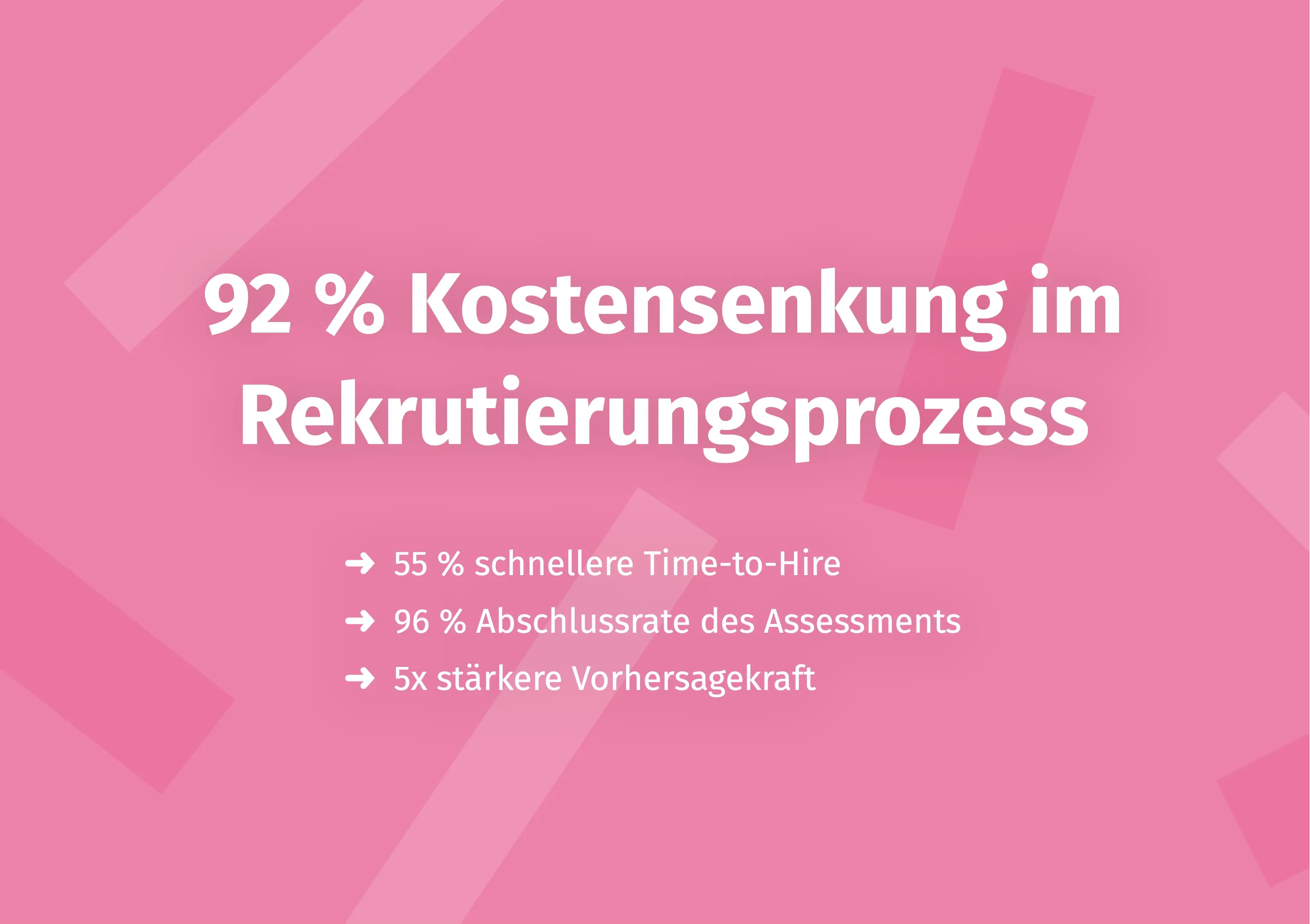
Make a better pre-selection — even before the first interview
In just a few minutes, Aivy shows you which candidates really fit the role. Beyond resumes based on strengths.