You want to explore your strengths as a talent?

This way

Login

Talent Pool: Definition, Setup & Best Practices

Home
-
Lexicon
-
Talent Pool: Definition, Setup & Best Practices

You know the scenario: A position opens up, and recruiting starts from scratch. Post job ads, screen applications, conduct interviews – all under time pressure. Yet just three months ago, you had five excellent candidates who narrowly missed out. Where is their data now?

In times of talent shortages, this approach is not only inefficient but also expensive. A study by the University of Bamberg shows that 44.4% of Germany's top 1,000 companies have already implemented their own talent pool. In the IT sector, it's nearly two-thirds. The reason is clear: Those who proactively collect and nurture candidates reach their goal faster when the next vacancy arises.

In this guide, you'll learn exactly what a talent pool is, how to build one step by step, which GDPR rules you need to follow, and how to significantly improve the quality of your hires from the pool. Current studies and practical examples demonstrate how companies achieve measurable results.

What Is a Talent Pool? Definition and Fundamentals

Before diving into practice, let's clarify the basics: What exactly is a talent pool, and how does it differ from related concepts?

Definition: More Than Just an Applicant Database

A talent pool (also called candidate pool or applicant pool) is a structured database containing profiles of individuals who could be suitable for future positions at your company. Unlike a pure applicant database that only contains current applications, a talent pool encompasses various categories of candidates:

  • Silver Medalists: Applicants who progressed far in the selection process but narrowly missed being hired
  • Passive Candidates: Professionals who aren't actively searching but have expressed interest in your company
  • Former Interns and Working Students: Young talent who already know the company
  • Contacts from Career Fairs and Networks: People you've connected with at events
  • Alumni: Former employees who might want to return

The crucial difference from a classic applicant database: A talent pool is actively maintained and engaged. Candidates receive regular relevant information and are specifically approached when suitable vacancies arise.

Internal vs. External Talent Pool

Depending on focus, we distinguish between two types of talent pools:

For a holistic Talent Relationship Management strategy, combining both approaches is recommended. This allows you to leverage internal development potential while also binding external talent to your company long-term.

The Difference Between Talent Pool and Talent Pipeline

These terms are often used interchangeably but describe different concepts:

The talent pool is primarily a database – a collection of candidate profiles you can access when needed. It's rather static and reactive.

The talent pipeline, on the other hand, describes an active process: Candidates are systematically guided through various stages of relationship nurturing – from initial contact through regular nurturing to hiring. The pipeline is dynamic and proactive.

In practice, both concepts go hand in hand: The talent pool provides the data, the pipeline strategy ensures this data stays alive.

Why You Need a Talent Pool: 8 Key Benefits

Building and maintaining a talent pool requires time and resources. Is it worth it? The numbers speak clearly.

Faster Position Filling (Time-to-Hire)

The most obvious benefit: You don't have to start from zero when a vacancy opens. Instead of posting job ads and waiting for applications, you directly access pre-qualified candidates.

Time-to-hire refers to the period from job posting to contract signing. A well-maintained talent pool can dramatically reduce this time. MCI Germany, for example, achieved a 55% faster time-to-hire through the use of objective assessment diagnostics.

Lower Recruiting Costs (Cost-per-Hire)

Every new search costs money: job postings, recruiters, HR team time. A talent pool significantly reduces these costs since much of the sourcing work is already done.

Cost-per-hire includes all direct and indirect costs of a hire. At MCI, this metric dropped by an impressive 92% – an ROI that quickly pays off the investment in pool building.

Higher Quality of Hires (Quality of Hire)

An often underestimated benefit: The candidates in your pool are already pre-qualified. You know their strengths and why they were interesting back then. This leads to better matches and fewer bad hires.

Studies on the validity of selection methods (Schmidt & Hunter, 1998) show that structured procedures significantly increase predictive power. Combine your talent pool with objective assessment diagnostics, and quality of hire increases even further.

Access to Passive Candidates

According to the LinkedIn Workforce Report, 70% of the global workforce are passive talents – professionals who aren't actively searching but are open to interesting offers. You can't reach these people through traditional job postings.

A talent pool allows you to build long-term relationships with these passive candidates. When you have a suitable position, you're already in conversation.

Better Candidate Experience

Candidates who are accepted into a talent pool feel valued – even if they didn't get the job this time. A professional rejection with an offer to stay in touch for future positions leaves a positive impression.

Proactive Rather Than Reactive Recruiting

With a talent pool, you shift from a reactive to a proactive recruiting strategy. Instead of reacting to talent shortages, you build a network that makes you more independent of market conditions.

Strengthening Your Employer Brand

A well-maintained talent pool is also an employer branding tool. Through regular, relevant communication, you stay present as an attractive employer – even when there's no suitable position currently open.

Competitive Advantage in Talent Shortages

According to a Robert Walters study, 55% of recruiters have difficulty meeting deadlines – primarily due to talent shortages. A talent pool gives you a decisive advantage: While others are still searching, you're already conducting interviews.

Building a Talent Pool: Step-by-Step Guide

Building a talent pool isn't rocket science, but it does require a well-thought-out strategy. Here are the five essential steps:

Step 1: Define Target Groups and Segmentation

Before collecting candidates, you need to know who you're looking for. Which roles are critical for your company? Which competencies will be particularly important in the future?

Define clear segments for your talent pool:

  • By Department: IT, Sales, Marketing, Production
  • By Experience Level: Junior, Senior, Executive
  • By Availability: Immediately, in 3-6 months, long-term interested
  • By Qualification: Silver Medalists (highly qualified), potential matches, networking contacts

Clean segmentation enables targeted communication later – newsletters for young professionals should look different from communication with experienced executives.

Step 2: Identify Candidate Sources

Where do the candidates for your pool come from? The main sources are:

Application Processes:

  • Rejected applicants with good profiles (Silver Medalists)
  • Candidates who declined themselves
  • Speculative applications without current fit

Active Sourcing:

  • LinkedIn contacts from research
  • Xing outreach
  • Industry-specific platforms

Events and Networks:

  • Career fairs
  • University partnerships
  • Industry events
  • Employee referrals

Digital Touchpoints:

  • Newsletter sign-ups
  • Whitepaper downloads
  • Career site registrations

Step 3: Obtain GDPR-Compliant Consent

This step is not optional but legally mandatory. More on this in the next chapter.

Step 4: Create and Categorize Candidate Profiles

For each candidate in the pool, you should capture relevant information:

Basic Data:

  • Name, contact details
  • Work experience, qualifications
  • Desired position, salary range
  • Availability, mobility

Relationship History:

  • Source of contact (application, fair, referral)
  • Previous interactions
  • Results from assessment procedures
  • Notes from conversations

Segment Assignment:

  • Department
  • Experience level
  • Pool category (Silver Medalist, passively interested, etc.)

Most Applicant Tracking Systems (ATS) offer integrated talent pool features with tagging and filtering options.

Step 5: Develop an Engagement Strategy

A talent pool is only as valuable as the relationship with the candidates in it. Without regular communication, contacts go cold and data becomes outdated.

Plan a nurturing strategy with various touchpoints:

  • Regular Newsletters: Company news, industry trends, new job openings
  • Personalized Updates: Relevant positions based on the candidate profile
  • Event Invitations: Webinars, career events, open days
  • Feedback Loops: Asking if their situation or interests have changed

A good rule of thumb: Contact your pool candidates 1-2 times per month – often enough to stay present, but not so frequently that it becomes annoying.

GDPR & Data Protection: Keeping Your Talent Pool Legally Compliant

Handling applicant data is strictly regulated in Europe. A GDPR violation can not only be expensive but can also damage your reputation as an employer.

Legal Bases for Data Storage

After completing an application process, applicant data may generally only be retained for 2-3 months – this covers potential discrimination claims. For longer storage in a talent pool, you need a separate legal basis.

The most common solution: Consent under Art. 6(1)(a) GDPR in conjunction with relevant national employment law. The candidate explicitly agrees that their data may be stored for future job offers.

Obtaining Consent Correctly

Valid consent must meet several requirements:

Voluntariness: Consent must be given without pressure. No disadvantage may arise from refusing.

Informed: The candidate must know which data is stored, for what purpose, and for how long.

Specificity: The purpose of storage (inclusion in talent pool) must be clearly stated.

Revocability: Candidates must be able to withdraw their consent at any time without giving reasons.

Sample Consent Statement:

"I consent to [Company] storing my application data for the purpose of inclusion in the talent pool and contacting me about suitable job opportunities. I can withdraw this consent at any time. The data will be stored for [period, e.g., 24 months] and then deleted unless renewed."

Retention Periods and Data Currency

Define clear retention periods for your talent pool:

  • Without Renewal: Typically 12-24 months after consent
  • With Renewal: Actively ask before the deadline whether interest continues
  • Upon Withdrawal: Immediate deletion (Art. 17 GDPR)

Many ATS systems offer automatic reminders and deletion functions that make compliance easier.

Important: Document every consent verifiably. In case of doubt, you must be able to prove that the person concerned agreed.

Maintaining Your Talent Pool: How to Keep Candidates Engaged

A talent pool that exists only as a "data graveyard" provides no value. The real work begins after setup: continuous maintenance.

Regular Communication

Candidates in the pool want to know they haven't been forgotten. Plan regular touchpoints:

Monthly:

  • Newsletter with company news and open positions
  • Industry-relevant insights and trends

Quarterly:

  • Personalized check-ins: "Is your situation still current?"
  • Invitations to events or webinars

As Needed:

  • Direct outreach for suitable vacancies
  • Relevant articles or whitepapers

Relevant Content and Career Updates

Not every message is relevant to everyone. Use your segmentation to send targeted content:

  • Young Professionals: Entry-level positions, trainee programs, career tips
  • Experienced Professionals: Senior roles, project descriptions, technical topics
  • Executives: Strategic developments, leadership insights

The key is relevance: Candidates should feel that the communication is personally valuable to them – not like mass mailings.

Keeping Data Current

Profiles become outdated quickly: People change jobs, acquire new qualifications, relocate. Plan regular data updates:

  • Automated Profile Update Requests: "Has anything changed for you?"
  • Cleanup of Inactive Contacts: Those who don't respond to multiple messages should be removed after a final inquiry
  • LinkedIn Sync: Some ATS systems allow automatic profile updates

A maintained pool with 500 current contacts is more valuable than a neglected pool with 5,000 outdated records.

The Quality Question: How to Identify the Right Candidates

A common problem with talent pools: Segmentation is primarily based on resumes. But paper qualifications say little about whether someone really fits the position and team.

The Problem with CV-Based Selection

Research is clear: The predictive validity of resumes is limited. A meta-analysis by Schmidt and Hunter (1998) shows that aptitude tests (r=.54) and structured interviews (r=.51) enable significantly better predictions of job success than unstructured procedures (r=.38) or pure CV screening.

What does this mean for your talent pool? If you only categorize candidates by work experience and degrees, you may overlook talents with great potential – and overestimate others whose CV looks impressive.

Potential vs. Experience: What Really Counts?

Experience shows what someone has done. Potential shows what someone could achieve. Especially in times of rapid change, potential is often more important than experience.

Relevant factors for potential assessment:

  • Cognitive Abilities: Learning ability, problem-solving skills
  • Personality Traits: Openness, conscientiousness, emotional stability
  • Motivation and Values: Fit with company culture
  • Transferability: Can existing competencies be transferred to new contexts?

These factors cannot be read from a resume – but they can be measured.

Objective Assessment Through Diagnostics

To increase the quality of your talent pool, you should go beyond pure CV data. Scientifically validated assessments enable a more objective evaluation of competencies and potential.

Methods of objective assessment diagnostics:

  • Cognitive Performance Tests: Measure learning ability and problem-solving skills
  • Personality Questionnaires: Capture stable traits like the Big Five
  • Situational Procedures: Simulate work-relevant situations
  • Game-Based Assessments: Combine playful elements with scientific measurement

The advantage: You get objective data points that are independent of Affinity Bias or other unconscious prejudices. This makes career changers and hidden talents visible who might have slipped through the cracks based on their CV.

Case Study: How Companies Find Better Matches with Assessments

Practice shows that objective assessment diagnostics deliver measurable results. At OMR, the talent pool is actively engaged – not just used as a "consolation prize" for rejected applicants. Assessment scores provide additional information for strength matching, and the hiring team is often curious about the results.

The outcome: Candidates were invited who would have been rejected based on their CV – and some of them were hired. Kaya Kruse, People Lead at OMR, summarizes: "Aivy works. We reduce bias, gain more objectivity in hiring, and strengthen diversity in the long term."

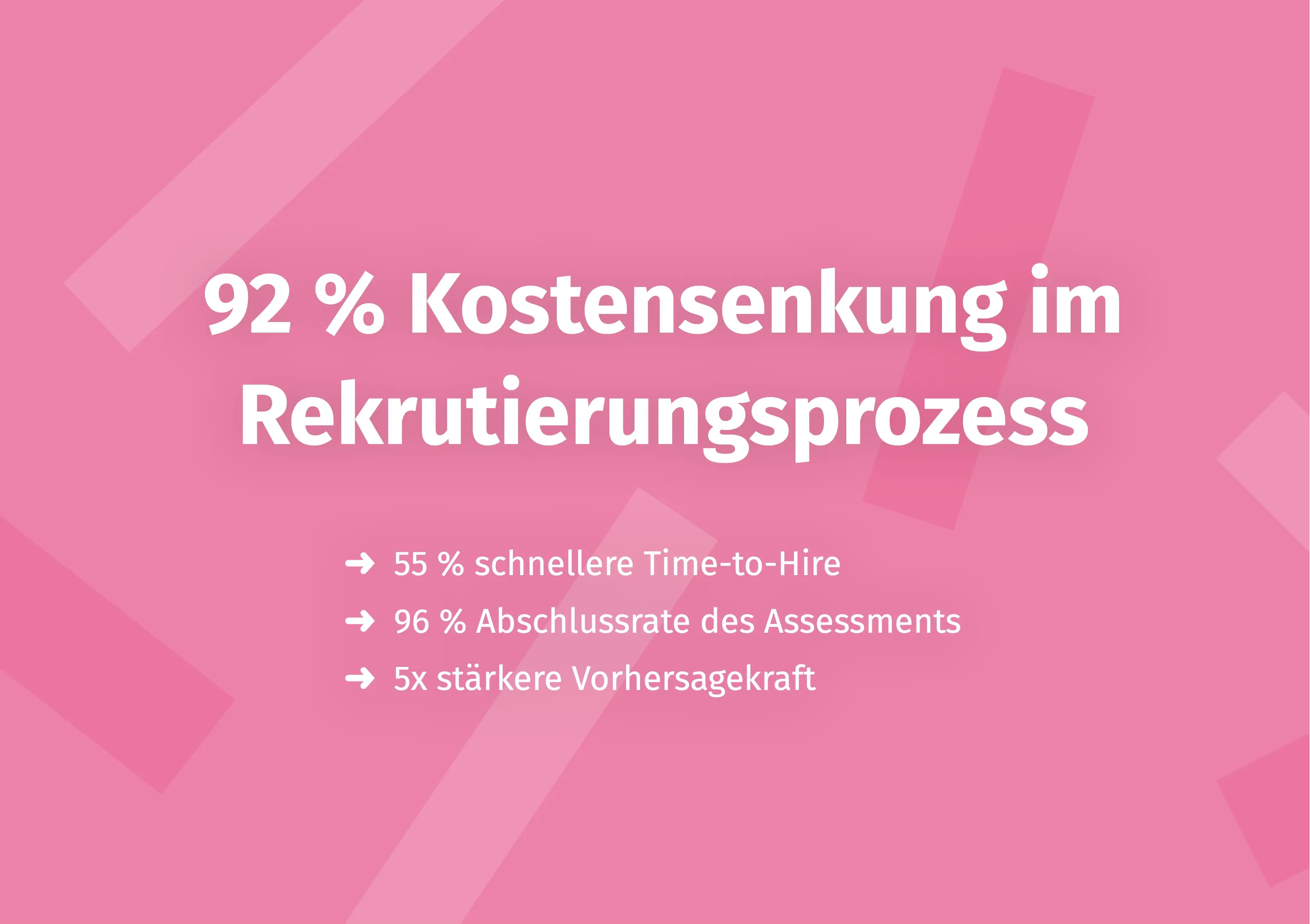
MCI Germany also relies on objective assessment diagnostics and achieved impressive results: 55% faster time-to-hire, 92% lower cost-per-hire, and a 96% completion rate in the assessment. Matthias Kühne, Director People & Culture, highlights the "more objective evaluation basis" that has greatly professionalized the process. Find more details in the MCI success story.

Beiersdorf takes an innovative approach: Students complete a self-assessment before applying. This way, they learn which areas match their strengths and receive specific internship suggestions. Dr. Kevin-Lim Jungbauer, Recruiting and HR Diagnostics Expert at Beiersdorf, describes the process as "very solid, scientifically grounded, innovative from the candidate's perspective, and simply well thought out overall."

Measuring Success: The Most Important KPIs

What you don't measure, you can't improve. To demonstrate the ROI of your talent pool and continuously optimize, you should track the following metrics:

Time-to-Hire from Pool vs. External Search

Compare how long it takes to fill positions from the talent pool vs. traditional methods. A well-functioning pool should significantly reduce time-to-hire.

Benchmark: Pool hires should be 30-50% faster than external searches.

Cost-per-Hire Comparison

Calculate the cost per hire for pool candidates compared to external hires. Consider:

  • Job posting costs (with pool: 0)
  • Recruiter fees (with pool: 0)
  • Time spent on sourcing (with pool: reduced)
  • Pool maintenance costs (proportional)

Conversion Rate

How many pool candidates become hires? Track conversion at various stages:

  • Pool → Interview invitation
  • Interview → Offer
  • Offer → Hire

A low conversion rate can indicate outdated data, incorrect segmentation, or lack of pool maintenance.

Other Relevant KPIs

  • Engagement Rate: Open and click rates for pool communications
  • Pool Size per Segment: Enough candidates for critical roles?
  • Data Currency: What percentage of profiles are current?
  • Quality of Hire: Performance and retention of pool hires

Common Talent Pool Mistakes – And How to Avoid Them

Even well-intentioned talent pools often fail due to avoidable errors. Here are the most common pitfalls:

Mistake 1: Pool as Data Graveyard The pool is built, then forgotten. Candidates never hear anything again.→ Solution: Establish a fixed nurturing strategy with regular touchpoints.

Mistake 2: No Segmentation All candidates receive the same communication.→ Solution: Define clear segments and communicate target group-specifically.

Mistake 3: Ignoring GDPR Consent is missing or insufficient.→ Solution: Establish legally compliant consent processes, adhere to deletion deadlines.

Mistake 4: Only Storing CVs Selection is based exclusively on paper qualifications.→ Solution: Integrate objective assessments to capture potential.

Mistake 5: No Ownership Nobody is responsible for the pool.→ Solution: Define clear accountability (role or team).

Mistake 6: Outdated Data Profiles are never updated, contact details no longer match.→ Solution: Regular update requests and cleanup cycles.

Frequently Asked Questions (FAQ)

What is a talent pool? A talent pool is a database with profiles of candidates who could be suitable for future positions. It contains former applicants, silver medalists, passive candidates, and contacts from networks. Unlike a pure applicant database, the pool is actively maintained and engaged.

How do I build a talent pool? In five steps: 1) Define target groups and segments, 2) Identify candidate sources (applications, active sourcing, events), 3) Obtain GDPR-compliant consent, 4) Create and categorize profiles, 5) Develop an engagement strategy.

Is a talent pool GDPR-compliant? Yes, if you obtain explicit consent from candidates (Art. 6(1)(a) GDPR). This consent must be voluntary, informed, and revocable. Without consent, you may only store applicant data for 2-3 months after the process ends.

How long can I store candidate data? Without consent, only 2-3 months after the application ends. With talent pool consent, data can be stored longer – typically 12-24 months with optional renewal. Upon withdrawal, data must be deleted immediately.

What are Silver Medalists? Silver Medalists are candidates who progressed far in the selection process but narrowly missed being hired. They are ideal pool candidates because they were already qualified and showed interest in the company.

What's the difference between a talent pool and talent pipeline? A talent pool is a database of candidates. A talent pipeline is an active process where candidates are guided through various stages of relationship nurturing. The pool provides the data, the pipeline describes the process.

How do I keep candidates in the pool engaged? Through regular, relevant communication: career updates, company news, suitable job offers, event invitations. Personalized by segment, not too frequent (1-2x per month). Important: Provide value, don't just send advertising.

How do I improve the quality of hires from the pool? Through objective evaluation criteria rather than just CV data. Assessment diagnostics help recognize potential, not just experience. This makes career changers and hidden talents visible who might have been overlooked based on their resume.

Conclusion: Your Talent Pool as a Strategic Competitive Advantage

In a job market characterized by talent shortages and rapid change, a well-maintained talent pool can make the decisive difference. Instead of starting from scratch with every vacancy, you access a network of pre-qualified candidates who already know and are interested in your company.

Key takeaways:

  • Proactive rather than reactive: A talent pool makes you more independent of market conditions
  • Measurable results: Companies like MCI achieve 55% faster time-to-hire and 92% lower cost-per-hire
  • Mind the GDPR: Without legally compliant consent, it won't work
  • Maintain actively: A pool is only as valuable as the relationship with the candidates in it
  • Quality through objectivity: Supplement CV data with assessment results to capture potential rather than just experience

Objective assessment diagnostics tools like Aivy help you significantly increase the quality of your talent pool. Through scientifically validated game-based assessments, you gain insights into competencies and potential that aren't visible from resumes – while simultaneously reducing unconscious bias in selection.

Your next step: Start strategically building your talent pool today. Define your target groups, establish GDPR-compliant processes, and develop an engagement strategy that binds candidates long-term.

Sources

  • University of Bamberg (2018): Recruiting Trends – Social Recruiting and Active Sourcing.
  • Schmidt, F.L. & Hunter, J.E. (1998): The Validity and Utility of Selection Methods in Personnel Psychology. Psychological Bulletin, 124(2), 262-274.
  • LinkedIn Workforce Report: Global Talent Trends.
  • Robert Walters: Global Salary Survey.
Home
-
lexicon
-
Talent Pool: Definition, Setup & Best Practices

You know the scenario: A position opens up, and recruiting starts from scratch. Post job ads, screen applications, conduct interviews – all under time pressure. Yet just three months ago, you had five excellent candidates who narrowly missed out. Where is their data now?

In times of talent shortages, this approach is not only inefficient but also expensive. A study by the University of Bamberg shows that 44.4% of Germany's top 1,000 companies have already implemented their own talent pool. In the IT sector, it's nearly two-thirds. The reason is clear: Those who proactively collect and nurture candidates reach their goal faster when the next vacancy arises.

In this guide, you'll learn exactly what a talent pool is, how to build one step by step, which GDPR rules you need to follow, and how to significantly improve the quality of your hires from the pool. Current studies and practical examples demonstrate how companies achieve measurable results.

What Is a Talent Pool? Definition and Fundamentals

Before diving into practice, let's clarify the basics: What exactly is a talent pool, and how does it differ from related concepts?

Definition: More Than Just an Applicant Database

A talent pool (also called candidate pool or applicant pool) is a structured database containing profiles of individuals who could be suitable for future positions at your company. Unlike a pure applicant database that only contains current applications, a talent pool encompasses various categories of candidates:

  • Silver Medalists: Applicants who progressed far in the selection process but narrowly missed being hired
  • Passive Candidates: Professionals who aren't actively searching but have expressed interest in your company
  • Former Interns and Working Students: Young talent who already know the company
  • Contacts from Career Fairs and Networks: People you've connected with at events
  • Alumni: Former employees who might want to return

The crucial difference from a classic applicant database: A talent pool is actively maintained and engaged. Candidates receive regular relevant information and are specifically approached when suitable vacancies arise.

Internal vs. External Talent Pool

Depending on focus, we distinguish between two types of talent pools:

For a holistic Talent Relationship Management strategy, combining both approaches is recommended. This allows you to leverage internal development potential while also binding external talent to your company long-term.

The Difference Between Talent Pool and Talent Pipeline

These terms are often used interchangeably but describe different concepts:

The talent pool is primarily a database – a collection of candidate profiles you can access when needed. It's rather static and reactive.

The talent pipeline, on the other hand, describes an active process: Candidates are systematically guided through various stages of relationship nurturing – from initial contact through regular nurturing to hiring. The pipeline is dynamic and proactive.

In practice, both concepts go hand in hand: The talent pool provides the data, the pipeline strategy ensures this data stays alive.

Why You Need a Talent Pool: 8 Key Benefits

Building and maintaining a talent pool requires time and resources. Is it worth it? The numbers speak clearly.

Faster Position Filling (Time-to-Hire)

The most obvious benefit: You don't have to start from zero when a vacancy opens. Instead of posting job ads and waiting for applications, you directly access pre-qualified candidates.

Time-to-hire refers to the period from job posting to contract signing. A well-maintained talent pool can dramatically reduce this time. MCI Germany, for example, achieved a 55% faster time-to-hire through the use of objective assessment diagnostics.

Lower Recruiting Costs (Cost-per-Hire)

Every new search costs money: job postings, recruiters, HR team time. A talent pool significantly reduces these costs since much of the sourcing work is already done.

Cost-per-hire includes all direct and indirect costs of a hire. At MCI, this metric dropped by an impressive 92% – an ROI that quickly pays off the investment in pool building.

Higher Quality of Hires (Quality of Hire)

An often underestimated benefit: The candidates in your pool are already pre-qualified. You know their strengths and why they were interesting back then. This leads to better matches and fewer bad hires.

Studies on the validity of selection methods (Schmidt & Hunter, 1998) show that structured procedures significantly increase predictive power. Combine your talent pool with objective assessment diagnostics, and quality of hire increases even further.

Access to Passive Candidates

According to the LinkedIn Workforce Report, 70% of the global workforce are passive talents – professionals who aren't actively searching but are open to interesting offers. You can't reach these people through traditional job postings.

A talent pool allows you to build long-term relationships with these passive candidates. When you have a suitable position, you're already in conversation.

Better Candidate Experience

Candidates who are accepted into a talent pool feel valued – even if they didn't get the job this time. A professional rejection with an offer to stay in touch for future positions leaves a positive impression.

Proactive Rather Than Reactive Recruiting

With a talent pool, you shift from a reactive to a proactive recruiting strategy. Instead of reacting to talent shortages, you build a network that makes you more independent of market conditions.

Strengthening Your Employer Brand

A well-maintained talent pool is also an employer branding tool. Through regular, relevant communication, you stay present as an attractive employer – even when there's no suitable position currently open.

Competitive Advantage in Talent Shortages

According to a Robert Walters study, 55% of recruiters have difficulty meeting deadlines – primarily due to talent shortages. A talent pool gives you a decisive advantage: While others are still searching, you're already conducting interviews.

Building a Talent Pool: Step-by-Step Guide

Building a talent pool isn't rocket science, but it does require a well-thought-out strategy. Here are the five essential steps:

Step 1: Define Target Groups and Segmentation

Before collecting candidates, you need to know who you're looking for. Which roles are critical for your company? Which competencies will be particularly important in the future?

Define clear segments for your talent pool:

  • By Department: IT, Sales, Marketing, Production
  • By Experience Level: Junior, Senior, Executive
  • By Availability: Immediately, in 3-6 months, long-term interested
  • By Qualification: Silver Medalists (highly qualified), potential matches, networking contacts

Clean segmentation enables targeted communication later – newsletters for young professionals should look different from communication with experienced executives.

Step 2: Identify Candidate Sources

Where do the candidates for your pool come from? The main sources are:

Application Processes:

  • Rejected applicants with good profiles (Silver Medalists)
  • Candidates who declined themselves
  • Speculative applications without current fit

Active Sourcing:

  • LinkedIn contacts from research
  • Xing outreach
  • Industry-specific platforms

Events and Networks:

  • Career fairs
  • University partnerships
  • Industry events
  • Employee referrals

Digital Touchpoints:

  • Newsletter sign-ups
  • Whitepaper downloads
  • Career site registrations

Step 3: Obtain GDPR-Compliant Consent

This step is not optional but legally mandatory. More on this in the next chapter.

Step 4: Create and Categorize Candidate Profiles

For each candidate in the pool, you should capture relevant information:

Basic Data:

  • Name, contact details
  • Work experience, qualifications
  • Desired position, salary range
  • Availability, mobility

Relationship History:

  • Source of contact (application, fair, referral)
  • Previous interactions
  • Results from assessment procedures
  • Notes from conversations

Segment Assignment:

  • Department
  • Experience level
  • Pool category (Silver Medalist, passively interested, etc.)

Most Applicant Tracking Systems (ATS) offer integrated talent pool features with tagging and filtering options.

Step 5: Develop an Engagement Strategy

A talent pool is only as valuable as the relationship with the candidates in it. Without regular communication, contacts go cold and data becomes outdated.

Plan a nurturing strategy with various touchpoints:

  • Regular Newsletters: Company news, industry trends, new job openings
  • Personalized Updates: Relevant positions based on the candidate profile
  • Event Invitations: Webinars, career events, open days
  • Feedback Loops: Asking if their situation or interests have changed

A good rule of thumb: Contact your pool candidates 1-2 times per month – often enough to stay present, but not so frequently that it becomes annoying.

GDPR & Data Protection: Keeping Your Talent Pool Legally Compliant

Handling applicant data is strictly regulated in Europe. A GDPR violation can not only be expensive but can also damage your reputation as an employer.

Legal Bases for Data Storage

After completing an application process, applicant data may generally only be retained for 2-3 months – this covers potential discrimination claims. For longer storage in a talent pool, you need a separate legal basis.

The most common solution: Consent under Art. 6(1)(a) GDPR in conjunction with relevant national employment law. The candidate explicitly agrees that their data may be stored for future job offers.

Obtaining Consent Correctly

Valid consent must meet several requirements:

Voluntariness: Consent must be given without pressure. No disadvantage may arise from refusing.

Informed: The candidate must know which data is stored, for what purpose, and for how long.

Specificity: The purpose of storage (inclusion in talent pool) must be clearly stated.

Revocability: Candidates must be able to withdraw their consent at any time without giving reasons.

Sample Consent Statement:

"I consent to [Company] storing my application data for the purpose of inclusion in the talent pool and contacting me about suitable job opportunities. I can withdraw this consent at any time. The data will be stored for [period, e.g., 24 months] and then deleted unless renewed."

Retention Periods and Data Currency

Define clear retention periods for your talent pool:

  • Without Renewal: Typically 12-24 months after consent
  • With Renewal: Actively ask before the deadline whether interest continues
  • Upon Withdrawal: Immediate deletion (Art. 17 GDPR)

Many ATS systems offer automatic reminders and deletion functions that make compliance easier.

Important: Document every consent verifiably. In case of doubt, you must be able to prove that the person concerned agreed.

Maintaining Your Talent Pool: How to Keep Candidates Engaged

A talent pool that exists only as a "data graveyard" provides no value. The real work begins after setup: continuous maintenance.

Regular Communication

Candidates in the pool want to know they haven't been forgotten. Plan regular touchpoints:

Monthly:

  • Newsletter with company news and open positions
  • Industry-relevant insights and trends

Quarterly:

  • Personalized check-ins: "Is your situation still current?"
  • Invitations to events or webinars

As Needed:

  • Direct outreach for suitable vacancies
  • Relevant articles or whitepapers

Relevant Content and Career Updates

Not every message is relevant to everyone. Use your segmentation to send targeted content:

  • Young Professionals: Entry-level positions, trainee programs, career tips
  • Experienced Professionals: Senior roles, project descriptions, technical topics
  • Executives: Strategic developments, leadership insights

The key is relevance: Candidates should feel that the communication is personally valuable to them – not like mass mailings.

Keeping Data Current

Profiles become outdated quickly: People change jobs, acquire new qualifications, relocate. Plan regular data updates:

  • Automated Profile Update Requests: "Has anything changed for you?"
  • Cleanup of Inactive Contacts: Those who don't respond to multiple messages should be removed after a final inquiry
  • LinkedIn Sync: Some ATS systems allow automatic profile updates

A maintained pool with 500 current contacts is more valuable than a neglected pool with 5,000 outdated records.

The Quality Question: How to Identify the Right Candidates

A common problem with talent pools: Segmentation is primarily based on resumes. But paper qualifications say little about whether someone really fits the position and team.

The Problem with CV-Based Selection

Research is clear: The predictive validity of resumes is limited. A meta-analysis by Schmidt and Hunter (1998) shows that aptitude tests (r=.54) and structured interviews (r=.51) enable significantly better predictions of job success than unstructured procedures (r=.38) or pure CV screening.

What does this mean for your talent pool? If you only categorize candidates by work experience and degrees, you may overlook talents with great potential – and overestimate others whose CV looks impressive.

Potential vs. Experience: What Really Counts?

Experience shows what someone has done. Potential shows what someone could achieve. Especially in times of rapid change, potential is often more important than experience.

Relevant factors for potential assessment:

  • Cognitive Abilities: Learning ability, problem-solving skills
  • Personality Traits: Openness, conscientiousness, emotional stability
  • Motivation and Values: Fit with company culture
  • Transferability: Can existing competencies be transferred to new contexts?

These factors cannot be read from a resume – but they can be measured.

Objective Assessment Through Diagnostics

To increase the quality of your talent pool, you should go beyond pure CV data. Scientifically validated assessments enable a more objective evaluation of competencies and potential.

Methods of objective assessment diagnostics:

  • Cognitive Performance Tests: Measure learning ability and problem-solving skills
  • Personality Questionnaires: Capture stable traits like the Big Five
  • Situational Procedures: Simulate work-relevant situations
  • Game-Based Assessments: Combine playful elements with scientific measurement

The advantage: You get objective data points that are independent of Affinity Bias or other unconscious prejudices. This makes career changers and hidden talents visible who might have slipped through the cracks based on their CV.

Case Study: How Companies Find Better Matches with Assessments

Practice shows that objective assessment diagnostics deliver measurable results. At OMR, the talent pool is actively engaged – not just used as a "consolation prize" for rejected applicants. Assessment scores provide additional information for strength matching, and the hiring team is often curious about the results.

The outcome: Candidates were invited who would have been rejected based on their CV – and some of them were hired. Kaya Kruse, People Lead at OMR, summarizes: "Aivy works. We reduce bias, gain more objectivity in hiring, and strengthen diversity in the long term."

MCI Germany also relies on objective assessment diagnostics and achieved impressive results: 55% faster time-to-hire, 92% lower cost-per-hire, and a 96% completion rate in the assessment. Matthias Kühne, Director People & Culture, highlights the "more objective evaluation basis" that has greatly professionalized the process. Find more details in the MCI success story.

Beiersdorf takes an innovative approach: Students complete a self-assessment before applying. This way, they learn which areas match their strengths and receive specific internship suggestions. Dr. Kevin-Lim Jungbauer, Recruiting and HR Diagnostics Expert at Beiersdorf, describes the process as "very solid, scientifically grounded, innovative from the candidate's perspective, and simply well thought out overall."

Measuring Success: The Most Important KPIs

What you don't measure, you can't improve. To demonstrate the ROI of your talent pool and continuously optimize, you should track the following metrics:

Time-to-Hire from Pool vs. External Search

Compare how long it takes to fill positions from the talent pool vs. traditional methods. A well-functioning pool should significantly reduce time-to-hire.

Benchmark: Pool hires should be 30-50% faster than external searches.

Cost-per-Hire Comparison

Calculate the cost per hire for pool candidates compared to external hires. Consider:

  • Job posting costs (with pool: 0)
  • Recruiter fees (with pool: 0)
  • Time spent on sourcing (with pool: reduced)
  • Pool maintenance costs (proportional)

Conversion Rate

How many pool candidates become hires? Track conversion at various stages:

  • Pool → Interview invitation
  • Interview → Offer
  • Offer → Hire

A low conversion rate can indicate outdated data, incorrect segmentation, or lack of pool maintenance.

Other Relevant KPIs

  • Engagement Rate: Open and click rates for pool communications
  • Pool Size per Segment: Enough candidates for critical roles?
  • Data Currency: What percentage of profiles are current?
  • Quality of Hire: Performance and retention of pool hires

Common Talent Pool Mistakes – And How to Avoid Them

Even well-intentioned talent pools often fail due to avoidable errors. Here are the most common pitfalls:

Mistake 1: Pool as Data Graveyard The pool is built, then forgotten. Candidates never hear anything again.→ Solution: Establish a fixed nurturing strategy with regular touchpoints.

Mistake 2: No Segmentation All candidates receive the same communication.→ Solution: Define clear segments and communicate target group-specifically.

Mistake 3: Ignoring GDPR Consent is missing or insufficient.→ Solution: Establish legally compliant consent processes, adhere to deletion deadlines.

Mistake 4: Only Storing CVs Selection is based exclusively on paper qualifications.→ Solution: Integrate objective assessments to capture potential.

Mistake 5: No Ownership Nobody is responsible for the pool.→ Solution: Define clear accountability (role or team).

Mistake 6: Outdated Data Profiles are never updated, contact details no longer match.→ Solution: Regular update requests and cleanup cycles.

Frequently Asked Questions (FAQ)

What is a talent pool? A talent pool is a database with profiles of candidates who could be suitable for future positions. It contains former applicants, silver medalists, passive candidates, and contacts from networks. Unlike a pure applicant database, the pool is actively maintained and engaged.

How do I build a talent pool? In five steps: 1) Define target groups and segments, 2) Identify candidate sources (applications, active sourcing, events), 3) Obtain GDPR-compliant consent, 4) Create and categorize profiles, 5) Develop an engagement strategy.

Is a talent pool GDPR-compliant? Yes, if you obtain explicit consent from candidates (Art. 6(1)(a) GDPR). This consent must be voluntary, informed, and revocable. Without consent, you may only store applicant data for 2-3 months after the process ends.

How long can I store candidate data? Without consent, only 2-3 months after the application ends. With talent pool consent, data can be stored longer – typically 12-24 months with optional renewal. Upon withdrawal, data must be deleted immediately.

What are Silver Medalists? Silver Medalists are candidates who progressed far in the selection process but narrowly missed being hired. They are ideal pool candidates because they were already qualified and showed interest in the company.

What's the difference between a talent pool and talent pipeline? A talent pool is a database of candidates. A talent pipeline is an active process where candidates are guided through various stages of relationship nurturing. The pool provides the data, the pipeline describes the process.

How do I keep candidates in the pool engaged? Through regular, relevant communication: career updates, company news, suitable job offers, event invitations. Personalized by segment, not too frequent (1-2x per month). Important: Provide value, don't just send advertising.

How do I improve the quality of hires from the pool? Through objective evaluation criteria rather than just CV data. Assessment diagnostics help recognize potential, not just experience. This makes career changers and hidden talents visible who might have been overlooked based on their resume.

Conclusion: Your Talent Pool as a Strategic Competitive Advantage

In a job market characterized by talent shortages and rapid change, a well-maintained talent pool can make the decisive difference. Instead of starting from scratch with every vacancy, you access a network of pre-qualified candidates who already know and are interested in your company.

Key takeaways:

  • Proactive rather than reactive: A talent pool makes you more independent of market conditions
  • Measurable results: Companies like MCI achieve 55% faster time-to-hire and 92% lower cost-per-hire
  • Mind the GDPR: Without legally compliant consent, it won't work
  • Maintain actively: A pool is only as valuable as the relationship with the candidates in it
  • Quality through objectivity: Supplement CV data with assessment results to capture potential rather than just experience

Objective assessment diagnostics tools like Aivy help you significantly increase the quality of your talent pool. Through scientifically validated game-based assessments, you gain insights into competencies and potential that aren't visible from resumes – while simultaneously reducing unconscious bias in selection.

Your next step: Start strategically building your talent pool today. Define your target groups, establish GDPR-compliant processes, and develop an engagement strategy that binds candidates long-term.

Sources

  • University of Bamberg (2018): Recruiting Trends – Social Recruiting and Active Sourcing.
  • Schmidt, F.L. & Hunter, J.E. (1998): The Validity and Utility of Selection Methods in Personnel Psychology. Psychological Bulletin, 124(2), 262-274.
  • LinkedIn Workforce Report: Global Talent Trends.
  • Robert Walters: Global Salary Survey.

Heading 1

Heading 2

Heading 3

Heading 4

Heading 5
Heading 6

Lorem ipsum dolor sit amet, consectetur adipiscing elit, sed do eiusmod tempor incididunt ut laboratories et dolore magna aliqua. Ut Enim ad Minim Veniam, Quis Nostrud Exercitation Ullamco Laboris Nisi ut Aliquip ex ea Commodo Consequat. Duis aute irure dolor in reprehenderite in voluptate velit eat cillum dolore eu fugiate nulla pariature.

Block quote

Ordered list

  1. Item 1
  2. Item 2
  3. Item 3

Unordered list

  • Item A
  • Item B
  • Item C

Text link

Bold text

Emphasis

Superscript

Subscript

Heading 1

Heading 2

Heading 3

Heading 4

Heading 5
Heading 6

Lorem ipsum dolor sit amet, consectetur adipiscing elit, sed do eiusmod tempor incididunt ut laboratories et dolore magna aliqua. Ut Enim ad Minim Veniam, Quis Nostrud Exercitation Ullamco Laboris Nisi ut Aliquip ex ea Commodo Consequat. Duis aute irure dolor in reprehenderite in voluptate velit eat cillum dolore eu fugiate nulla pariature.

Block quote

Ordered list

  1. Item 1
  2. Item 2
  3. Item 3

Unordered list

  • Item A
  • Item B
  • Item C

Text link

Bold text

Emphasis

Superscript

Subscript

Florian Dyballa

CEO, Co-Founder

About Florian

  • Founder & CEO of Aivy — develops innovative ways of personnel diagnostics and is one of the top 10 HR tech founders in Germany (business punk)
  • More than 500,000 digital aptitude tests successfully used by more than 100 companies such as Lufthansa, Würth and Hermes
  • Three times honored with the HR Innovation Award and regularly featured in leading business media (WirtschaftsWoche, Handelsblatt and FAZ)
  • As a business psychologist and digital expert, combines well-founded tests with AI for fair opportunities in personnel selection
  • Shares expertise as a sought-after thought leader in the HR tech industry — in podcasts, media, and at key industry events
  • Actively shapes the future of the working world — by combining science and technology for better and fairer personnel decisions
success stories

You can expect these results

Discover what successes other companies are achieving by using Aivy. Be inspired and do the same as they do.

Many innovative employers already rely on Aivy

Say that #HeRoes

“Through the very high response rate Persuade and retain We our trainees early in the application process. ”

Tamara Molitor
Training manager at Würth
Tamara Molitor

“That Strengths profile reflects 1:1 our experience in a personal conversation. ”

Wolfgang Böhm
Training manager at DIEHL
Wolfgang Böhm Portrait

“Through objective criteria, we promote equal opportunities and Diversity in recruiting. ”

Marie-Jo Goldmann
Head of HR at Nucao
Marie Jo Goldmann Portrait

Aivy is the bestWhat I've come across so far in the German diagnostics start-up sector. ”

Carl-Christoph Fellinger
Strategic Talent Acquisition at Beiersdorf
Christoph Feillinger Portrait

“Selection process which Make fun. ”

Anna Miels
Learning & Development Manager at apoproject
Anna Miels Portrait

“Applicants find out for which position they have the suitable competencies bring along. ”

Jürgen Muthig
Head of Vocational Training at Fresenius
Jürgen Muthig Fresenius Portrait

“Get to know hidden potential and Develop applicants in a targeted manner. ”

Christian Schütz
HR manager at KU64
Christian Schuetz

Saves time and is a lot of fun doing daily work. ”

Matthias Kühne
Director People & Culture at MCI Germany
Matthias Kühne

Engaging candidate experience through communication on equal terms. ”

Theresa Schröder
Head of HR at Horn & Bauer
Theresa Schröder

“Very solid, scientifically based, innovative even from a candidate's point of view and All in all, simply well thought-out. ”

Dr. Kevin-Lim Jungbauer
Recruiting and HR Diagnostics Expert at Beiersdorf
Kevin Jungbauer
YOUR assistant FOR TALENT ASSESSMENT

Try it for free

Become a HeRo 🦸 and understand candidate fit - even before the first job interview...