You want to explore your strengths as a talent?

This way

Login

Recruiting Process: The 7 Phases for Successful Hiring

Home
-
Lexicon
-
Recruiting Process: The 7 Phases for Successful Hiring

You know the problem: Positions remain unfilled for weeks, great candidates drop out, and in the end, the hire still doesn't work out. The recruiting process often feels like a gamble – but it doesn't have to be.

Current research shows that structured selection methods have significantly higher predictive validity than unstructured interviews or gut decisions alone. The meta-analysis by Schmidt and Hunter (1998) demonstrates: While unstructured interviews only achieve a validity of r=.38, structured methods reach r=.51, and aptitude tests even reach r=.54.

In this guide, you'll learn how a professional recruiting process is structured, which seven phases it goes through, and how you can optimize each step. You'll discover which KPIs really matter, how to avoid unconscious bias, and why objective assessment methods can be a game-changer for your talent selection.

What Is the Recruiting Process? Definition and Significance

The recruiting process encompasses all systematic steps a company takes to fill an open position with the right person. It begins with recognizing that a position needs to be filled and ideally ends with successful onboarding of the new employee.

A well-structured process is more than just a sequence of activities – it's a strategic tool that determines the quality of your hires. According to Glassdoor Economic Research (2023), the average time-to-hire in Germany is 28.5 days. Companies whose process takes significantly longer risk losing the best talent to competitors.

Distinction: Recruiting vs. Selection vs. Talent Acquisition

These terms are often used interchangeably but mean different things:

Term Definition Focus
Recruiting Operational process of filling positions Short-term, vacancy-oriented
Selection Phase within recruiting Evaluation and decision-making
Talent Acquisition Strategic, long-term approach Employer branding, talent pools

For this article, we'll focus on the operational recruiting process – the concrete workflow from open position to hire.

The 7 Phases of the Recruiting Process: An Overview

A professional recruiting process can be divided into seven sequential phases. Each phase has its own challenges and success factors.

Phase 1: Needs Analysis and Job Requirements

Before posting a position, you need to know who you're actually looking for. The needs analysis answers two key questions: Is this position really needed? And which competencies are critical for success in this role?

A good job requirements profile distinguishes between:

  • Must-haves: Essential qualifications and competencies
  • Nice-to-haves: Desirable but not mandatory attributes
  • Deal-breakers: Clear boundaries that are non-negotiable

The most common mistake in this phase: The requirements profile becomes a wish list that no candidate can fulfill. Or – even more problematic – it's missing entirely and selection happens based on gut feeling.

Phase 2: Sourcing and Job Posting

With the requirements profile in hand, it's time to search. Sourcing means reaching potential candidates where they are – whether on job boards, social networks, or through active sourcing.

The job posting is your most important tool here. It should:

  • Describe the job realistically and attractively
  • Communicate clear requirements
  • Provide insights into the company culture
  • Show an easy application process

Don't underestimate the power of a good candidate experience: 78% of applicants draw conclusions about company culture from their experience in the application process (CareerBuilder, 2022).

Phase 3: Candidate Screening and Pre-Selection

Now it gets critical: From the mass of applications, you need to identify the most promising candidates. This is where the greatest danger of unconscious bias lurks – unconscious prejudices that distort your decisions.

The groundbreaking study by Bertrand and Mullainathan (2004) showed: Applicants with typically "white-sounding" names like Emily or Greg received 50% more callbacks than those with African-American sounding names – with identical qualifications. This means: Bias effects can already occur during resume screening.

Structured screening criteria help reduce these distortions:

  • Define in advance which criteria you're evaluating
  • Use a standardized rating scheme
  • Separate the evaluation of different criteria
  • Involve multiple people when possible

Phase 4: Assessment and Diagnostics

This phase makes the difference between hoping and knowing. While traditional selection methods rely heavily on subjective impressions, professional assessment delivers objective data about competencies and potential.

Assessment diagnostics encompasses scientifically validated methods for measuring abilities, personality traits, and behavioral tendencies. These include:

  • Cognitive ability tests: Measure logical thinking, problem-solving, learning ability
  • Personality questionnaires: Capture stable behavioral tendencies (e.g., Big Five)
  • Situational judgment tests: Examine reactions in job-relevant scenarios
  • Game-based assessments: Modern, gamified testing methods

According to Schmidt and Hunter (1998), aptitude tests have the highest predictive validity of all selection methods at r=.54 – even higher than structured interviews. The advantage: They measure what candidates can actually do, not what they present in conversation.

Phase 5: Interviews and Selection Meetings

The job interview remains a central element – but it must be done right. Unstructured interviews, where each interviewer asks different questions, have alarmingly low predictive validity.

Structured interviews, however, follow a fixed guide:

  • All candidates receive the same questions
  • Answers are evaluated against defined criteria
  • Behavioral questions ("Tell me about a situation where...") replace hypothetical ones
  • Multiple interviewers evaluate independently

The difference in validity is significant: Structured interviews achieve r=.51, unstructured only r=.38 (Schmidt & Hunter, 1998). That might sound like a small difference, but in practice, it's the difference between chance and informed decision-making.

Phase 6: Decision and Contract Negotiation

With results from assessments and interviews, it's decision time. Ideally, it's based on:

  • Objective data from the assessments
  • Structured interview evaluations
  • A transparent decision process with multiple stakeholders

Contract negotiation should happen quickly. Good candidates have options – and those who wait too long will lose them. Communicate transparently, keep promises, and make the offer competitive.

Phase 7: Preboarding and Onboarding

The recruiting process doesn't end with the signature. The phase between contract signing and the first day (preboarding) and structured orientation (onboarding) determine whether the hire is successful long-term.

Good onboarding includes:

  • Professional training on tasks and tools
  • Social integration into the team
  • Cultural orientation within the company
  • Regular feedback conversations

Studies show: Employees with structured onboarding are more productive, more satisfied, and stay longer with the company.

Optimizing the Recruiting Process: Best Practices

You have a process – but is it working? The following best practices will help you improve each step.

Saving Time: Automation and Tools

Many recruiting tasks can be automated without sacrificing quality:

  • Applicant Tracking Systems (ATS): Automated acknowledgments, status updates, scheduling
  • Screening tools: Pre-filtering based on defined criteria
  • Digital assessments: Online tests instead of complex in-person procedures
  • Interview scheduling: Automatic appointment coordination

The time savings can be substantial: Companies like MCI Germany report 55% faster time-to-hire through integrating digital assessment diagnostics.

Increasing Quality: Objective Assessment Methods

The biggest lever for better hires lies in objectifying the selection. Instead of relying on gut feeling, scientifically validated methods provide reliable data.

What makes a good assessment?

  • Validity: The method measures what it's supposed to measure
  • Reliability: Results are consistent and reproducible
  • Fairness: No disadvantage to certain groups
  • Acceptance: Candidates experience the test as fair and relevant

Game-based assessments meet these criteria while also providing a positive candidate experience – test anxiety decreases, acceptance increases.

Improving Candidate Experience

Every touchpoint in the recruiting process shapes the image candidates have of your company. Small improvements make big differences:

  • Quick responses (maximum 1-2 weeks between steps)
  • Transparent communication about the process and next steps
  • Respectful treatment – even with rejections
  • Appreciative feedback conversations

Avoiding Unconscious Bias in the Recruiting Process

Unconscious bias – unconscious prejudices – is one of the biggest quality killers in recruiting. It leads to hiring not the best candidates, but those who are most similar to the decision-maker.

The Most Common Bias Types in Recruiting

Bias Type Description Example
Affinity Bias Preference for similar people "She also studied at MIT – she'll fit right in!"
Halo Effect One positive trait overshadows everything "He's so articulate – he must be competent."
Confirmation Bias Seeking confirmation of preconceptions "I knew immediately she was perfect."
Stereotype Bias Prejudice based on group membership "For a leadership position, we need someone with more assertiveness."

Learn more about different bias types in the article Overcoming Unconscious Bias in Recruiting.

How Objective Methods Reduce Bias

The good news: Unconscious bias cannot be eliminated, but its effects can be reduced. The key lies in structured, objective methods:

  1. Standardization: Same questions and evaluation criteria for everyone
  2. Objectification: Data-based decisions instead of gut feeling
  3. Diversification: Multiple people in the decision
  4. Blind evaluation: Hiding irrelevant information

Training alone shows little long-term effect according to studies. More effective are structural measures – like introducing objective assessments before the first personal contact.

Recruiting KPIs: Making the Process Measurable

What you don't measure, you can't improve. The following KPIs give you an overview of your recruiting process health.

Time-to-Hire, Cost-per-Hire, Quality of Hire

Time-to-Hire refers to the time span from job posting to contract signature. The benchmark in Germany is about 28-30 days. Longer processes lead to higher dropout rates – 60% of applicants drop out when the process takes longer than six weeks.

Cost-per-Hire captures all costs of a hire: job ads, recruiters, internal time, tools, onboarding. The average cost-per-hire varies greatly by industry and position – more important than the absolute value is the trend over time.

Quality of Hire is the most important but hardest to measure metric. It evaluates the performance and success of new employees, typically measured through:

  • Performance reviews after 6 and 12 months
  • Passing the probation period
  • Retention after 1 and 2 years
  • Feedback from managers

According to SHRM, a bad hire costs 50-200% of the position's annual salary. For a €60,000 position, that's €30,000-120,000 – a strong argument for investing in better selection methods.

Objective Assessment in the Recruiting Process

Objective assessment diagnostics isn't a "nice-to-have" but a strategic advantage. It makes the difference between guessing and knowing.

Game-Based Assessments as a Process Step

A modern form of assessment diagnostics is game-based assessments. These gamified testing methods measure cognitive abilities and soft skills in an engaging environment – without candidates feeling like they're in an exam situation.

The advantages over traditional tests:

  • Lower test anxiety: Gamified environment reduces stress
  • Higher acceptance: Candidates experience the test as fair and interesting
  • Objective data: Scientifically validated measurement of competencies
  • No preparation needed: Captures real abilities, not learned test knowledge

Platforms like Aivy use game-based assessments that have been scientifically validated in collaboration with Freie Universität Berlin. The tests measure competencies like problem-solving ability, attention, and decision-making behavior – independent of the resume.

Case Study: How MCI Reduced Time-to-Hire by 55%

The theory is convincing – but what does it look like in practice? MCI Germany fundamentally optimized its recruiting process by integrating objective assessment diagnostics.

The results speak for themselves:

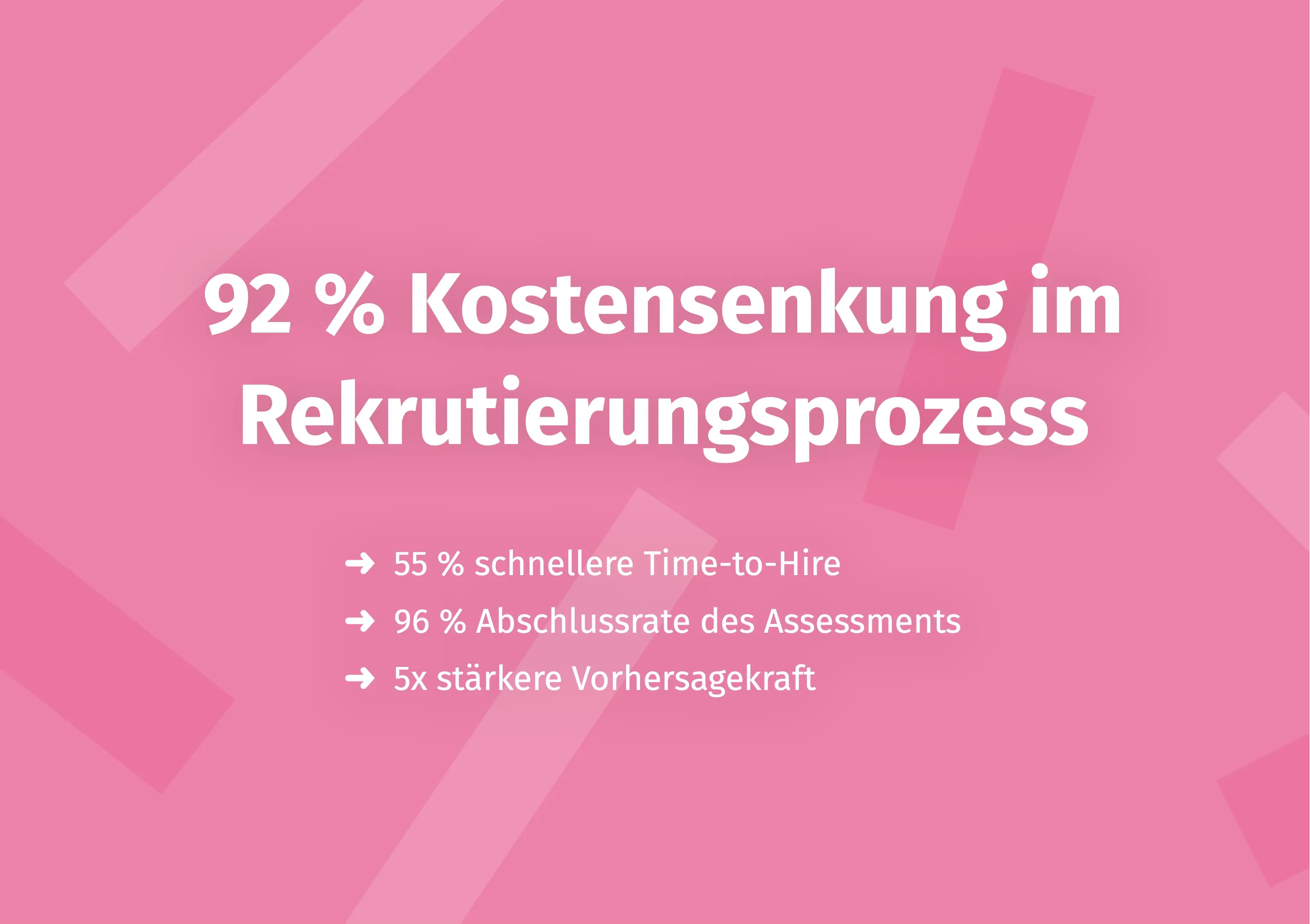
  • 55% faster time-to-hire
  • 92% lower cost-per-hire
  • 96% completion rate in assessments
  • 5x stronger predictive power compared to traditional methods

Matthias Kühne, Director People & Culture at MCI Germany, describes the change: "We had largely digitized our recruiting process for a long time thanks to softgarden. With Aivy, we have now digitized another process step in talent acquisition and strongly professionalized it through a more objective evaluation basis. Since both systems also interact completely seamlessly, the whole thing not only saves time but is also really fun in daily work!"

Lufthansa also relies on objective assessment diagnostics and achieves a hit rate of 96% in predicting candidate suitability – with 81% candidate satisfaction and 100+ minutes of saved testing time per applicant. Find more details in the MCI success story and the Lufthansa success story.

Checklist: Optimizing Your Recruiting Process

Use this checklist to evaluate your current process:

Phases 1-2: Preparation

  • Requirements profile with clear must-haves and nice-to-haves
  • Job posting with realistic job description
  • Defined sourcing channels

Phases 3-4: Selection

  • Structured screening criteria
  • Objective assessment before the interview
  • Documented evaluation criteria

Phases 5-6: Decision

  • Structured interviews with standardized questions
  • Multiple decision-makers involved
  • Quick decision and communication

Phase 7: Onboarding

  • Preboarding measures defined
  • Structured onboarding plan
  • Feedback meetings scheduled

KPIs

  • Time-to-hire is being measured
  • Cost-per-hire is being tracked
  • Quality of hire is being monitored

Frequently Asked Questions (FAQ)

How long should a recruiting process take?
The average time-to-hire in Germany is about 28-35 days. Processes lasting longer than six weeks lead to high dropout rates – 60% of applicants drop out then. At the same time, the process shouldn't be so short that informed decisions become impossible.

What does a bad hire cost?
According to SHRM, a bad hire costs 50-200% of the position's annual salary. For a €60,000 position, that's €30,000-120,000 – through direct costs like re-recruiting and training as well as indirect costs like productivity loss and team morale.

Which KPIs should I measure in recruiting?
The most important KPIs are: Time-to-hire (process duration), cost-per-hire (cost per hire), quality of hire (hire success), candidate satisfaction, offer acceptance rate, and retention rate after 12 months.

What's the difference between structured and unstructured interviews?
In structured interviews, all candidates receive the same questions and are evaluated according to uniform criteria. Unstructured interviews proceed freely and vary from conversation to conversation. Structured interviews have significantly higher predictive validity (r=.51 vs. r=.38).

How can I reduce unconscious bias in recruiting?
Four effective measures: Structured interviews with standardized questions, anonymized applications (blind hiring), objective assessments before personal contact, and diverse selection panels. Training alone shows little long-term effect.

What are game-based assessments?
Game-based assessments are gamified, scientifically validated testing methods that measure cognitive abilities and soft skills. They reduce test anxiety, improve candidate experience, and provide objective data for selection decisions – without candidates being able to prepare.

Conclusion: The Optimal Recruiting Process

A professional recruiting process isn't accidental but the result of deliberate design. The seven phases – from needs analysis through sourcing, screening, assessment, interviews, and decision to onboarding – form the foundation for successful hiring.

The key takeaways:

  • Structure makes the difference: Standardized processes beat gut feeling
  • Objectivity pays off: Scientifically validated methods have the highest predictive validity
  • Bias is real: Only structural measures sustainably reduce unconscious prejudice
  • KPIs create transparency: Measure time-to-hire, cost-per-hire, and quality of hire
  • Candidate experience counts: Every touchpoint shapes your employer brand

Objective assessment tools like Aivy help you make data-based decisions instead of guessing. The results speak for themselves: Companies like MCI achieve 55% faster filling times at 92% lower costs.

The next step? Analyze your current process with the checklist above – and identify where you have the biggest leverage.

Sources

  • Bertrand, M. & Mullainathan, S. (2004). Are Emily and Greg More Employable than Lakisha and Jamal? A Field Experiment on Labor Market Discrimination. American Economic Review, 94(4), 991-1013.
  • CareerBuilder (2022). Candidate Experience Survey.
  • Glassdoor Economic Research (2023). Time to Hire Benchmark Report.
  • Schmidt, F. L. & Hunter, J. E. (1998). The Validity and Utility of Selection Methods in Personnel Psychology. Psychological Bulletin, 124(2), 262-274.
  • Society for Human Resource Management (SHRM). The Cost of a Bad Hire.

Home
-
lexicon
-
Recruiting Process: The 7 Phases for Successful Hiring

You know the problem: Positions remain unfilled for weeks, great candidates drop out, and in the end, the hire still doesn't work out. The recruiting process often feels like a gamble – but it doesn't have to be.

Current research shows that structured selection methods have significantly higher predictive validity than unstructured interviews or gut decisions alone. The meta-analysis by Schmidt and Hunter (1998) demonstrates: While unstructured interviews only achieve a validity of r=.38, structured methods reach r=.51, and aptitude tests even reach r=.54.

In this guide, you'll learn how a professional recruiting process is structured, which seven phases it goes through, and how you can optimize each step. You'll discover which KPIs really matter, how to avoid unconscious bias, and why objective assessment methods can be a game-changer for your talent selection.

What Is the Recruiting Process? Definition and Significance

The recruiting process encompasses all systematic steps a company takes to fill an open position with the right person. It begins with recognizing that a position needs to be filled and ideally ends with successful onboarding of the new employee.

A well-structured process is more than just a sequence of activities – it's a strategic tool that determines the quality of your hires. According to Glassdoor Economic Research (2023), the average time-to-hire in Germany is 28.5 days. Companies whose process takes significantly longer risk losing the best talent to competitors.

Distinction: Recruiting vs. Selection vs. Talent Acquisition

These terms are often used interchangeably but mean different things:

Term Definition Focus
Recruiting Operational process of filling positions Short-term, vacancy-oriented
Selection Phase within recruiting Evaluation and decision-making
Talent Acquisition Strategic, long-term approach Employer branding, talent pools

For this article, we'll focus on the operational recruiting process – the concrete workflow from open position to hire.

The 7 Phases of the Recruiting Process: An Overview

A professional recruiting process can be divided into seven sequential phases. Each phase has its own challenges and success factors.

Phase 1: Needs Analysis and Job Requirements

Before posting a position, you need to know who you're actually looking for. The needs analysis answers two key questions: Is this position really needed? And which competencies are critical for success in this role?

A good job requirements profile distinguishes between:

  • Must-haves: Essential qualifications and competencies
  • Nice-to-haves: Desirable but not mandatory attributes
  • Deal-breakers: Clear boundaries that are non-negotiable

The most common mistake in this phase: The requirements profile becomes a wish list that no candidate can fulfill. Or – even more problematic – it's missing entirely and selection happens based on gut feeling.

Phase 2: Sourcing and Job Posting

With the requirements profile in hand, it's time to search. Sourcing means reaching potential candidates where they are – whether on job boards, social networks, or through active sourcing.

The job posting is your most important tool here. It should:

  • Describe the job realistically and attractively
  • Communicate clear requirements
  • Provide insights into the company culture
  • Show an easy application process

Don't underestimate the power of a good candidate experience: 78% of applicants draw conclusions about company culture from their experience in the application process (CareerBuilder, 2022).

Phase 3: Candidate Screening and Pre-Selection

Now it gets critical: From the mass of applications, you need to identify the most promising candidates. This is where the greatest danger of unconscious bias lurks – unconscious prejudices that distort your decisions.

The groundbreaking study by Bertrand and Mullainathan (2004) showed: Applicants with typically "white-sounding" names like Emily or Greg received 50% more callbacks than those with African-American sounding names – with identical qualifications. This means: Bias effects can already occur during resume screening.

Structured screening criteria help reduce these distortions:

  • Define in advance which criteria you're evaluating
  • Use a standardized rating scheme
  • Separate the evaluation of different criteria
  • Involve multiple people when possible

Phase 4: Assessment and Diagnostics

This phase makes the difference between hoping and knowing. While traditional selection methods rely heavily on subjective impressions, professional assessment delivers objective data about competencies and potential.

Assessment diagnostics encompasses scientifically validated methods for measuring abilities, personality traits, and behavioral tendencies. These include:

  • Cognitive ability tests: Measure logical thinking, problem-solving, learning ability
  • Personality questionnaires: Capture stable behavioral tendencies (e.g., Big Five)
  • Situational judgment tests: Examine reactions in job-relevant scenarios
  • Game-based assessments: Modern, gamified testing methods

According to Schmidt and Hunter (1998), aptitude tests have the highest predictive validity of all selection methods at r=.54 – even higher than structured interviews. The advantage: They measure what candidates can actually do, not what they present in conversation.

Phase 5: Interviews and Selection Meetings

The job interview remains a central element – but it must be done right. Unstructured interviews, where each interviewer asks different questions, have alarmingly low predictive validity.

Structured interviews, however, follow a fixed guide:

  • All candidates receive the same questions
  • Answers are evaluated against defined criteria
  • Behavioral questions ("Tell me about a situation where...") replace hypothetical ones
  • Multiple interviewers evaluate independently

The difference in validity is significant: Structured interviews achieve r=.51, unstructured only r=.38 (Schmidt & Hunter, 1998). That might sound like a small difference, but in practice, it's the difference between chance and informed decision-making.

Phase 6: Decision and Contract Negotiation

With results from assessments and interviews, it's decision time. Ideally, it's based on:

  • Objective data from the assessments
  • Structured interview evaluations
  • A transparent decision process with multiple stakeholders

Contract negotiation should happen quickly. Good candidates have options – and those who wait too long will lose them. Communicate transparently, keep promises, and make the offer competitive.

Phase 7: Preboarding and Onboarding

The recruiting process doesn't end with the signature. The phase between contract signing and the first day (preboarding) and structured orientation (onboarding) determine whether the hire is successful long-term.

Good onboarding includes:

  • Professional training on tasks and tools
  • Social integration into the team
  • Cultural orientation within the company
  • Regular feedback conversations

Studies show: Employees with structured onboarding are more productive, more satisfied, and stay longer with the company.

Optimizing the Recruiting Process: Best Practices

You have a process – but is it working? The following best practices will help you improve each step.

Saving Time: Automation and Tools

Many recruiting tasks can be automated without sacrificing quality:

  • Applicant Tracking Systems (ATS): Automated acknowledgments, status updates, scheduling
  • Screening tools: Pre-filtering based on defined criteria
  • Digital assessments: Online tests instead of complex in-person procedures
  • Interview scheduling: Automatic appointment coordination

The time savings can be substantial: Companies like MCI Germany report 55% faster time-to-hire through integrating digital assessment diagnostics.

Increasing Quality: Objective Assessment Methods

The biggest lever for better hires lies in objectifying the selection. Instead of relying on gut feeling, scientifically validated methods provide reliable data.

What makes a good assessment?

  • Validity: The method measures what it's supposed to measure
  • Reliability: Results are consistent and reproducible
  • Fairness: No disadvantage to certain groups
  • Acceptance: Candidates experience the test as fair and relevant

Game-based assessments meet these criteria while also providing a positive candidate experience – test anxiety decreases, acceptance increases.

Improving Candidate Experience

Every touchpoint in the recruiting process shapes the image candidates have of your company. Small improvements make big differences:

  • Quick responses (maximum 1-2 weeks between steps)
  • Transparent communication about the process and next steps
  • Respectful treatment – even with rejections
  • Appreciative feedback conversations

Avoiding Unconscious Bias in the Recruiting Process

Unconscious bias – unconscious prejudices – is one of the biggest quality killers in recruiting. It leads to hiring not the best candidates, but those who are most similar to the decision-maker.

The Most Common Bias Types in Recruiting

Bias Type Description Example
Affinity Bias Preference for similar people "She also studied at MIT – she'll fit right in!"
Halo Effect One positive trait overshadows everything "He's so articulate – he must be competent."
Confirmation Bias Seeking confirmation of preconceptions "I knew immediately she was perfect."
Stereotype Bias Prejudice based on group membership "For a leadership position, we need someone with more assertiveness."

Learn more about different bias types in the article Overcoming Unconscious Bias in Recruiting.

How Objective Methods Reduce Bias

The good news: Unconscious bias cannot be eliminated, but its effects can be reduced. The key lies in structured, objective methods:

  1. Standardization: Same questions and evaluation criteria for everyone
  2. Objectification: Data-based decisions instead of gut feeling
  3. Diversification: Multiple people in the decision
  4. Blind evaluation: Hiding irrelevant information

Training alone shows little long-term effect according to studies. More effective are structural measures – like introducing objective assessments before the first personal contact.

Recruiting KPIs: Making the Process Measurable

What you don't measure, you can't improve. The following KPIs give you an overview of your recruiting process health.

Time-to-Hire, Cost-per-Hire, Quality of Hire

Time-to-Hire refers to the time span from job posting to contract signature. The benchmark in Germany is about 28-30 days. Longer processes lead to higher dropout rates – 60% of applicants drop out when the process takes longer than six weeks.

Cost-per-Hire captures all costs of a hire: job ads, recruiters, internal time, tools, onboarding. The average cost-per-hire varies greatly by industry and position – more important than the absolute value is the trend over time.

Quality of Hire is the most important but hardest to measure metric. It evaluates the performance and success of new employees, typically measured through:

  • Performance reviews after 6 and 12 months
  • Passing the probation period
  • Retention after 1 and 2 years
  • Feedback from managers

According to SHRM, a bad hire costs 50-200% of the position's annual salary. For a €60,000 position, that's €30,000-120,000 – a strong argument for investing in better selection methods.

Objective Assessment in the Recruiting Process

Objective assessment diagnostics isn't a "nice-to-have" but a strategic advantage. It makes the difference between guessing and knowing.

Game-Based Assessments as a Process Step

A modern form of assessment diagnostics is game-based assessments. These gamified testing methods measure cognitive abilities and soft skills in an engaging environment – without candidates feeling like they're in an exam situation.

The advantages over traditional tests:

  • Lower test anxiety: Gamified environment reduces stress
  • Higher acceptance: Candidates experience the test as fair and interesting
  • Objective data: Scientifically validated measurement of competencies
  • No preparation needed: Captures real abilities, not learned test knowledge

Platforms like Aivy use game-based assessments that have been scientifically validated in collaboration with Freie Universität Berlin. The tests measure competencies like problem-solving ability, attention, and decision-making behavior – independent of the resume.

Case Study: How MCI Reduced Time-to-Hire by 55%

The theory is convincing – but what does it look like in practice? MCI Germany fundamentally optimized its recruiting process by integrating objective assessment diagnostics.

The results speak for themselves:

  • 55% faster time-to-hire
  • 92% lower cost-per-hire
  • 96% completion rate in assessments
  • 5x stronger predictive power compared to traditional methods

Matthias Kühne, Director People & Culture at MCI Germany, describes the change: "We had largely digitized our recruiting process for a long time thanks to softgarden. With Aivy, we have now digitized another process step in talent acquisition and strongly professionalized it through a more objective evaluation basis. Since both systems also interact completely seamlessly, the whole thing not only saves time but is also really fun in daily work!"

Lufthansa also relies on objective assessment diagnostics and achieves a hit rate of 96% in predicting candidate suitability – with 81% candidate satisfaction and 100+ minutes of saved testing time per applicant. Find more details in the MCI success story and the Lufthansa success story.

Checklist: Optimizing Your Recruiting Process

Use this checklist to evaluate your current process:

Phases 1-2: Preparation

  • Requirements profile with clear must-haves and nice-to-haves
  • Job posting with realistic job description
  • Defined sourcing channels

Phases 3-4: Selection

  • Structured screening criteria
  • Objective assessment before the interview
  • Documented evaluation criteria

Phases 5-6: Decision

  • Structured interviews with standardized questions
  • Multiple decision-makers involved
  • Quick decision and communication

Phase 7: Onboarding

  • Preboarding measures defined
  • Structured onboarding plan
  • Feedback meetings scheduled

KPIs

  • Time-to-hire is being measured
  • Cost-per-hire is being tracked
  • Quality of hire is being monitored

Frequently Asked Questions (FAQ)

How long should a recruiting process take?
The average time-to-hire in Germany is about 28-35 days. Processes lasting longer than six weeks lead to high dropout rates – 60% of applicants drop out then. At the same time, the process shouldn't be so short that informed decisions become impossible.

What does a bad hire cost?
According to SHRM, a bad hire costs 50-200% of the position's annual salary. For a €60,000 position, that's €30,000-120,000 – through direct costs like re-recruiting and training as well as indirect costs like productivity loss and team morale.

Which KPIs should I measure in recruiting?
The most important KPIs are: Time-to-hire (process duration), cost-per-hire (cost per hire), quality of hire (hire success), candidate satisfaction, offer acceptance rate, and retention rate after 12 months.

What's the difference between structured and unstructured interviews?
In structured interviews, all candidates receive the same questions and are evaluated according to uniform criteria. Unstructured interviews proceed freely and vary from conversation to conversation. Structured interviews have significantly higher predictive validity (r=.51 vs. r=.38).

How can I reduce unconscious bias in recruiting?
Four effective measures: Structured interviews with standardized questions, anonymized applications (blind hiring), objective assessments before personal contact, and diverse selection panels. Training alone shows little long-term effect.

What are game-based assessments?
Game-based assessments are gamified, scientifically validated testing methods that measure cognitive abilities and soft skills. They reduce test anxiety, improve candidate experience, and provide objective data for selection decisions – without candidates being able to prepare.

Conclusion: The Optimal Recruiting Process

A professional recruiting process isn't accidental but the result of deliberate design. The seven phases – from needs analysis through sourcing, screening, assessment, interviews, and decision to onboarding – form the foundation for successful hiring.

The key takeaways:

  • Structure makes the difference: Standardized processes beat gut feeling
  • Objectivity pays off: Scientifically validated methods have the highest predictive validity
  • Bias is real: Only structural measures sustainably reduce unconscious prejudice
  • KPIs create transparency: Measure time-to-hire, cost-per-hire, and quality of hire
  • Candidate experience counts: Every touchpoint shapes your employer brand

Objective assessment tools like Aivy help you make data-based decisions instead of guessing. The results speak for themselves: Companies like MCI achieve 55% faster filling times at 92% lower costs.

The next step? Analyze your current process with the checklist above – and identify where you have the biggest leverage.

Sources

  • Bertrand, M. & Mullainathan, S. (2004). Are Emily and Greg More Employable than Lakisha and Jamal? A Field Experiment on Labor Market Discrimination. American Economic Review, 94(4), 991-1013.
  • CareerBuilder (2022). Candidate Experience Survey.
  • Glassdoor Economic Research (2023). Time to Hire Benchmark Report.
  • Schmidt, F. L. & Hunter, J. E. (1998). The Validity and Utility of Selection Methods in Personnel Psychology. Psychological Bulletin, 124(2), 262-274.
  • Society for Human Resource Management (SHRM). The Cost of a Bad Hire.

Heading 1

Heading 2

Heading 3

Heading 4

Heading 5
Heading 6

Lorem ipsum dolor sit amet, consectetur adipiscing elit, sed do eiusmod tempor incididunt ut laboratories et dolore magna aliqua. Ut Enim ad Minim Veniam, Quis Nostrud Exercitation Ullamco Laboris Nisi ut Aliquip ex ea Commodo Consequat. Duis aute irure dolor in reprehenderite in voluptate velit eat cillum dolore eu fugiate nulla pariature.

Block quote

Ordered list

  1. Item 1
  2. Item 2
  3. Item 3

Unordered list

  • Item A
  • Item B
  • Item C

Text link

Bold text

Emphasis

Superscript

Subscript

Heading 1

Heading 2

Heading 3

Heading 4

Heading 5
Heading 6

Lorem ipsum dolor sit amet, consectetur adipiscing elit, sed do eiusmod tempor incididunt ut laboratories et dolore magna aliqua. Ut Enim ad Minim Veniam, Quis Nostrud Exercitation Ullamco Laboris Nisi ut Aliquip ex ea Commodo Consequat. Duis aute irure dolor in reprehenderite in voluptate velit eat cillum dolore eu fugiate nulla pariature.

Block quote

Ordered list

  1. Item 1
  2. Item 2
  3. Item 3

Unordered list

  • Item A
  • Item B
  • Item C

Text link

Bold text

Emphasis

Superscript

Subscript

Florian Dyballa

CEO, Co-Founder

About Florian

  • Founder & CEO of Aivy — develops innovative ways of personnel diagnostics and is one of the top 10 HR tech founders in Germany (business punk)
  • More than 500,000 digital aptitude tests successfully used by more than 100 companies such as Lufthansa, Würth and Hermes
  • Three times honored with the HR Innovation Award and regularly featured in leading business media (WirtschaftsWoche, Handelsblatt and FAZ)
  • As a business psychologist and digital expert, combines well-founded tests with AI for fair opportunities in personnel selection
  • Shares expertise as a sought-after thought leader in the HR tech industry — in podcasts, media, and at key industry events
  • Actively shapes the future of the working world — by combining science and technology for better and fairer personnel decisions
success stories

You can expect these results

Discover what successes other companies are achieving by using Aivy. Be inspired and do the same as they do.

Many innovative employers already rely on Aivy

Say that #HeRoes

“Through the very high response rate Persuade and retain We our trainees early in the application process. ”

Tamara Molitor
Training manager at Würth
Tamara Molitor

“That Strengths profile reflects 1:1 our experience in a personal conversation. ”

Wolfgang Böhm
Training manager at DIEHL
Wolfgang Böhm Portrait

“Through objective criteria, we promote equal opportunities and Diversity in recruiting. ”

Marie-Jo Goldmann
Head of HR at Nucao
Marie Jo Goldmann Portrait

Aivy is the bestWhat I've come across so far in the German diagnostics start-up sector. ”

Carl-Christoph Fellinger
Strategic Talent Acquisition at Beiersdorf
Christoph Feillinger Portrait

“Selection process which Make fun. ”

Anna Miels
Learning & Development Manager at apoproject
Anna Miels Portrait

“Applicants find out for which position they have the suitable competencies bring along. ”

Jürgen Muthig
Head of Vocational Training at Fresenius
Jürgen Muthig Fresenius Portrait

“Get to know hidden potential and Develop applicants in a targeted manner. ”

Christian Schütz
HR manager at KU64
Christian Schuetz

Saves time and is a lot of fun doing daily work. ”

Matthias Kühne
Director People & Culture at MCI Germany
Matthias Kühne

Engaging candidate experience through communication on equal terms. ”

Theresa Schröder
Head of HR at Horn & Bauer
Theresa Schröder

“Very solid, scientifically based, innovative even from a candidate's point of view and All in all, simply well thought-out. ”

Dr. Kevin-Lim Jungbauer
Recruiting and HR Diagnostics Expert at Beiersdorf
Kevin Jungbauer
YOUR assistant FOR TALENT ASSESSMENT

Try it for free

Become a HeRo 🦸 and understand candidate fit - even before the first job interview...