
Personality Test: Definition
A personality test is a standardized method for measuring stable patterns in how a person thinks, feels, and behaves, for example how conscientious, outgoing, or emotionally stable someone typically is. In recruiting, it measures job-related traits with a demonstrable link to the role, not personality types.
Alongside cognitive ability tests and interviews, personality tests are among the most widely used tools in aptitude diagnostics. Unlike an ability test, they have no right or wrong answers: they capture not how well someone can do something, but how someone prefers to think, feel, and act. Whether a given level of a trait is favorable always depends on the requirements of the role. High sociability helps in sales; at a quiet desk job focused on deep work, it is simply neutral.
Dimensions, Not Types: The Distinction That Matters Most
Anyone comparing personality tests will encounter two fundamentally different logics. Type models sort people into categories: introverted or extraverted, red, yellow, green, or blue. Dimensional models instead describe how strongly a trait is expressed – as a position on a continuum between two poles.
The evidence clearly favors dimensions. Personality traits are approximately normally distributed in the population: most people fall in the middle range, and extreme scores are rare (Hossiep & Mühlhaus, 2015). A type model draws an artificial line straight through this smooth distribution. Someone just on one side of the cutoff receives a different label than someone just on the other side – even though the two are more alike than two people who share a label but sit at opposite edges of the same category.
This is the main reason type assignments so often flip on retesting. Anyone close to the cutoff can easily land on the other side the second time around – not because their personality changed, but because the category coarsens the measurement. For hiring decisions, this is a serious problem: a method that classifies the same person one way today and another way next month violates basic test quality criteria, above all the reliability of the measurement.
The Big Five: The Best-Supported Model
The five-factor model, known as the Big Five, is the most robustly supported framework in personality research. It has been confirmed over decades across independent studies, languages, and cultures, and it describes personality along five dimensions (Schuler & Kanning, 2014):
- Openness to new experiences: curiosity about ideas, variety, and unfamiliar perspectives
- Conscientiousness: diligence, goal orientation, and dependability
- Extraversion: sociability, assertiveness, and energy
- Agreeableness: cooperativeness, trust, and consideration for others
- Emotional stability: calm and resilience, the opposite pole of neuroticism
Especially relevant for personnel selection: conscientiousness is the most consistent personality predictor of job performance across occupational groups (Barrick & Mount, 1991). The remaining dimensions predict performance only in specific contexts – extraversion, for instance, in sales and leadership roles. That is why any serious use of a personality test starts with a requirement analysis: which traits are demonstrably relevant for this particular role?
Common Instruments at a Glance
Big Five-Based Questionnaires
Scientifically constructed questionnaires such as the NEO Personality Inventory build directly on the five-factor model; occupational instruments like the Business-focused Inventory of Personality follow the same dimensional principles (Hossiep & Mühlhaus, 2015). They are suitable for selection and development, provided that norms, reliability, and validity are documented in a test manual. That is exactly how you recognize them: there is a manual, there are norm samples, and results come as dimensional profiles rather than a type label.
DISC
The DISC model traces back to ideas of the psychologist William Moulton Marston and describes behavior in four fields: dominance, influence, steadiness, and conscientiousness, often presented as colors. Its strength is a simple shared vocabulary: for team workshops and self-reflection, it is accessible and quickly understood. For selection decisions, however, it is barely suitable. The four-field logic coarsens dimensional differences, and independently published evidence that DISC profiles predict job performance is largely absent.
Myers-Briggs Type Indicator (MBTI)
The MBTI was developed by Katharine Cook Briggs and Isabel Briggs Myers, building on C. G. Jung’s theory of psychological types, and assigns people to one of 16 types based on four dichotomies. It is popular worldwide in team development because the types create vivid conversation starters. As a selection instrument, it is unsuitable: the dichotomies cut through normally distributed traits, a substantial share of test takers receive a different type when retested after a few weeks, and evidence that it predicts occupational success is lacking (Pittenger, 2005). The publisher itself positions the instrument for development, not for hiring decisions.
16Personalities
The free online test 16Personalities combines MBTI-style type codes with five dimensional scales. For private self-reflection it is an entertaining entry point, and that is what it is mostly used for. For recruiting decisions, the foundations are missing: no documented job-related validation, no norms suitable for selection contexts, and no control over the conditions under which a result was produced.
One thing matters for perspective: using DISC or the MBTI in team development is not a mistake. Both can spark conversations about collaboration that would otherwise never happen. They simply were not built to decide who gets a job – that is a different task with far higher demands on measurement quality.
Job Relevance Is Mandatory: Fairness and the Legal Frame
Personnel selection follows one clear standard: only traits with a demonstrable link to the role may be assessed. DIN 33430, the German quality standard for job-related aptitude assessment, therefore requires a requirement analysis as the starting point of any procedure. Measuring traits that have nothing to do with the role conflicts with the principle of necessity in employee data protection and makes the hiring decision vulnerable to challenge.
Fairness also means equal conditions for everyone, transparent scoring, and feedback candidates can understand. Candidates have a legitimate interest in knowing what is being measured and why. Methods that treat results as a black box, or that hand back sweeping type verdicts, damage both the candidate experience and the defensibility of the decision.
Self-Report and Faking
The sore spot of almost all personality tests: they rely on self-report. Applicants answer statements about themselves, and in an application setting the temptation to present oneself favorably is obvious. Research confirms both parts: self-report questionnaires can be deliberately embellished, and in selection contexts this actually happens (Viswesvaran & Ones, 1999).
This does not render personality tests worthless, but it does demand countermeasures:
- job-related, neutrally worded items instead of transparently “desirable” answer options
- control scales that flag exaggeratedly positive self-presentation
- formats that make embellishment harder: forced-choice tasks, or behavior-based measurement that draws on what people actually do in tasks rather than on self-description
- embedding the test in a multi-stage process in which results are probed and explored in a structured interview
Limitations: What a Personality Test Cannot Do
Personality explains part of occupational success, not all of it. In meta-analyses, cognitive ability ranks among the strongest single predictors of job performance and outranks personality traits in many occupations (Schmidt & Hunter, 1998). Add expertise, motivation, leadership, and team context – factors no personality test captures.
This leads to the most important rule: a personality test alone cannot carry a hiring decision. It generates hypotheses about typical behavioral patterns that must be combined with other sources of information, such as cognitive ability tests, work samples, and structured interviews. And it measures preferences, not competence: someone low in extraversion can still present brilliantly – it just costs more energy.
Personality Traits at Aivy
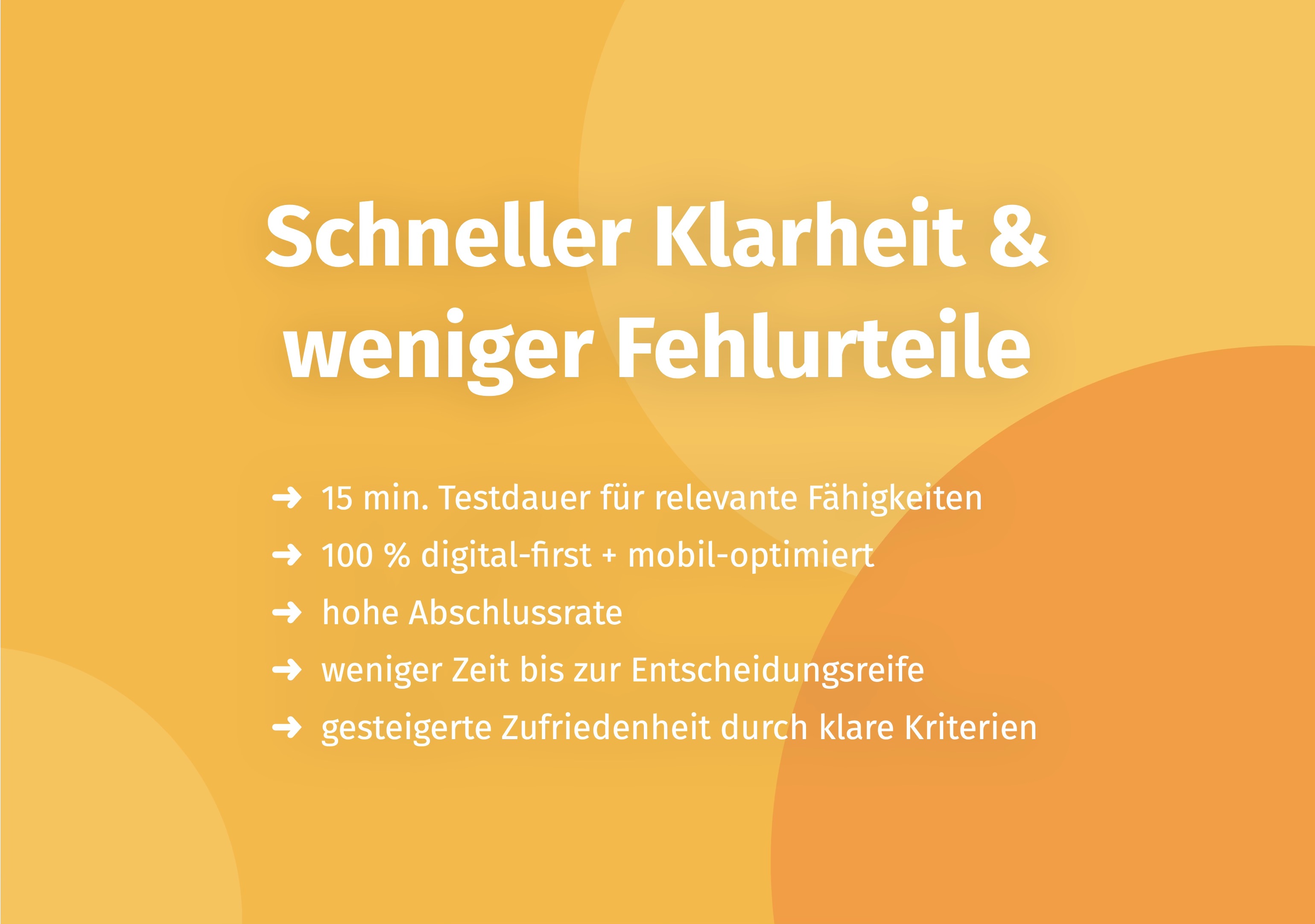
Aivy, a spin-off of Freie Universität Berlin, measures job-relevant personality traits dimensionally rather than in types – using short, game-based tasks that capture behavior instead of relying on self-description alone. Which traits enter an assessment is determined by the requirement profile of the specific role, and candidates receive transparent feedback on their results. For an overview of the scientific foundations, see the assessments page.
Frequently Asked Questions
Is the MBTI scientifically sound?
The MBTI is widely used for self-reflection and team dialogue, but it does not meet core scientific requirements: type assignments are unstable on retesting, and evidence that it predicts job performance is lacking (Pittenger, 2005). It is therefore unsuitable for selection decisions.
Are companies allowed to use personality tests in hiring?
Yes – provided the measured traits have a demonstrable link to the role, participation is communicated transparently, and the data is used for this purpose only. DIN 33430 offers practical guidance.
Can a personality test be faked?
Self-report questionnaires can be embellished (Viswesvaran & Ones, 1999). Sound procedures counter this with control scales, forced-choice formats, or behavior-based measurement, and embed the test in a multi-stage selection process.
Which personality test is suitable for personnel selection?
One that measures dimensionally, builds on an evidence-based model such as the Big Five, uses job-related norms, and documents its quality criteria in a manual. Type-based instruments like DISC or the MBTI are meant for team development, not for selection decisions.
Does a personality test replace the interview?
No. It complements it: test results provide hypotheses that are then probed in a structured interview. Combining several methods clearly increases the accuracy of the hiring decision.
Sources
- Barrick, M. R. & Mount, M. K. (1991). The Big Five Personality Dimensions and Job Performance: A Meta-Analysis. Personnel Psychology, 44(1), 1–26.
- DIN 33430 (2016). Requirements for proficiency assessment procedures and their implementation. Beuth Verlag.
- Hossiep, R. & Mühlhaus, O. (2015). Personalauswahl und -entwicklung mit Persönlichkeitstests (2nd ed.). Hogrefe.
- Kanning, U. P. (2015). Personalauswahl zwischen Anspruch und Wirklichkeit. Springer.
- Pittenger, D. J. (2005). Cautionary Comments Regarding the Myers-Briggs Type Indicator. Consulting Psychology Journal: Practice and Research, 57(3), 210–221.
- Schmidt, F. L. & Hunter, J. E. (1998). The Validity and Utility of Selection Methods in Personnel Psychology. Psychological Bulletin, 124(2), 262–274.
- Schuler, H. & Kanning, U. P. (Eds.) (2014). Lehrbuch der Personalpsychologie (3rd ed.). Hogrefe.
- Viswesvaran, C. & Ones, D. S. (1999). Meta-Analyses of Fakability Estimates: Implications for Personality Measurement. Educational and Psychological Measurement, 59(2), 197–210.
Make a better pre-selection — even before the first interview
In just a few minutes, Aivy shows you which candidates really fit the role. Beyond resumes based on strengths.