
Soft skills are interpersonal, personal and social competencies – such as communication ability, teamwork or problem-solving – that are a decisive factor in long-term career success. Unlike hard skills (measurable technical qualifications), they are harder to learn and closely tied to personality. For HR professionals, they are a central selection criterion – yet in recruiting they are still frequently assessed subjectively, making the process error-prone.
What Are Soft Skills?
Soft skills refer to personal traits, social abilities and behavioural patterns that determine how someone works, communicates and interacts with others. The term has become established in occupational psychology as an umbrella concept for all competencies that cannot be directly inferred from diplomas or certificates.
The contrast is hard skills: technical, clearly measurable qualifications such as programming knowledge, foreign language proficiency or accounting expertise. Both competency areas complement each other – hard skills alone are not a reliable indicator of professional success. Scientific research shows that personality traits and social competencies have a greater long-term influence on work performance and team collaboration than purely technical qualifications.
Psychologically, soft skills are often described using the Big Five model – a scientifically recognised personality framework with five dimensions: openness, conscientiousness, extraversion, agreeableness and neuroticism (emotional stability). Many of the soft skills relevant to recruiting can be mapped to these dimensions.
The Most Important Soft Skills at a Glance
Social Competencies
Social competencies describe the ability to interact successfully with others. These include:
- Communication skills: Expressing thoughts clearly and in an audience-appropriate way – both in writing and verbally
- Teamwork: Working constructively in groups, reaching compromises, sharing responsibility
- Empathy: Understanding and engaging with others' perspectives
- Conflict management: Addressing tensions objectively and resolving them collaboratively
- Assertiveness: Representing one's own position without overriding others
Methodological Competencies
Methodological competencies relate to the structured handling of tasks, information and challenges:
- Problem-solving ability: Analysing complex situations and developing pragmatic solutions
- Time management: Setting priorities and planning efficiently
- Analytical thinking: Recognising connections, evaluating data, drawing conclusions
- Creativity: Developing new approaches and questioning established habits
- Organisational skills: Planning and coordinating tasks in a structured manner
Personality Traits
This category encompasses enduring characteristics that shape work behaviour:
- Resilience: Remaining capable of action even under pressure or after setbacks
- Adaptability: Responding flexibly to change
- Initiative: Proactively approaching tasks without waiting for explicit instruction
- Reliability: Keeping commitments and taking responsibility
- Willingness to learn: Remaining open to new knowledge and constructive feedback
Why Are Soft Skills Crucial in Recruiting?
A shifting labour market makes soft skills an increasingly decisive differentiator: according to the World Economic Forum's Future of Jobs Report (2025), creativity, analytical thinking and resilience rank among the most in-demand competencies of the coming years – well ahead of purely technical skills, which are increasingly being automated.
For HR professionals, this creates a key challenge: soft skills are barely visible in a CV. There is no certificate for empathy. The result: in traditional selection interviews, decisions are often driven by unconscious affinities and biases – so-called unconscious biases – that determine whether someone is perceived as a strong communicator or a team player. This leads to mis-hires and disadvantages candidates who would be highly suitable beyond their credentials and likeability.
A further consideration: soft skills are role-specific. Which competencies are actually relevant depends heavily on the position and the team environment. The ability to conduct a potential analysis helps HR teams move beyond generic requirements like "team player" and instead define specifically which competencies measurably predict success in a given role.
How to Measure Soft Skills Objectively
The good news: soft skills can be measured validly – provided that scientifically grounded methods are used. DIN 33430 (Requirements for Procedures Used in Occupational Aptitude Assessment, DIN 2016) sets clear quality standards for this purpose.
Proven methods at a glance:
- Structured, behavioural-based interviews: Unlike unstructured conversations, standardised questioning techniques (e.g. the STAR method) reduce the influence of personal chemistry and gut feeling.
- Personality tests (e.g. based on the Big Five): Scientifically validated questionnaires measure personality dimensions in a reliable and comparable way.
- Assessment centres: Resource-intensive but valid – candidates demonstrate soft skills in realistic situations.
- Game-based assessments: Game-based procedures capture soft skills implicitly, making them less susceptible to social desirability bias.
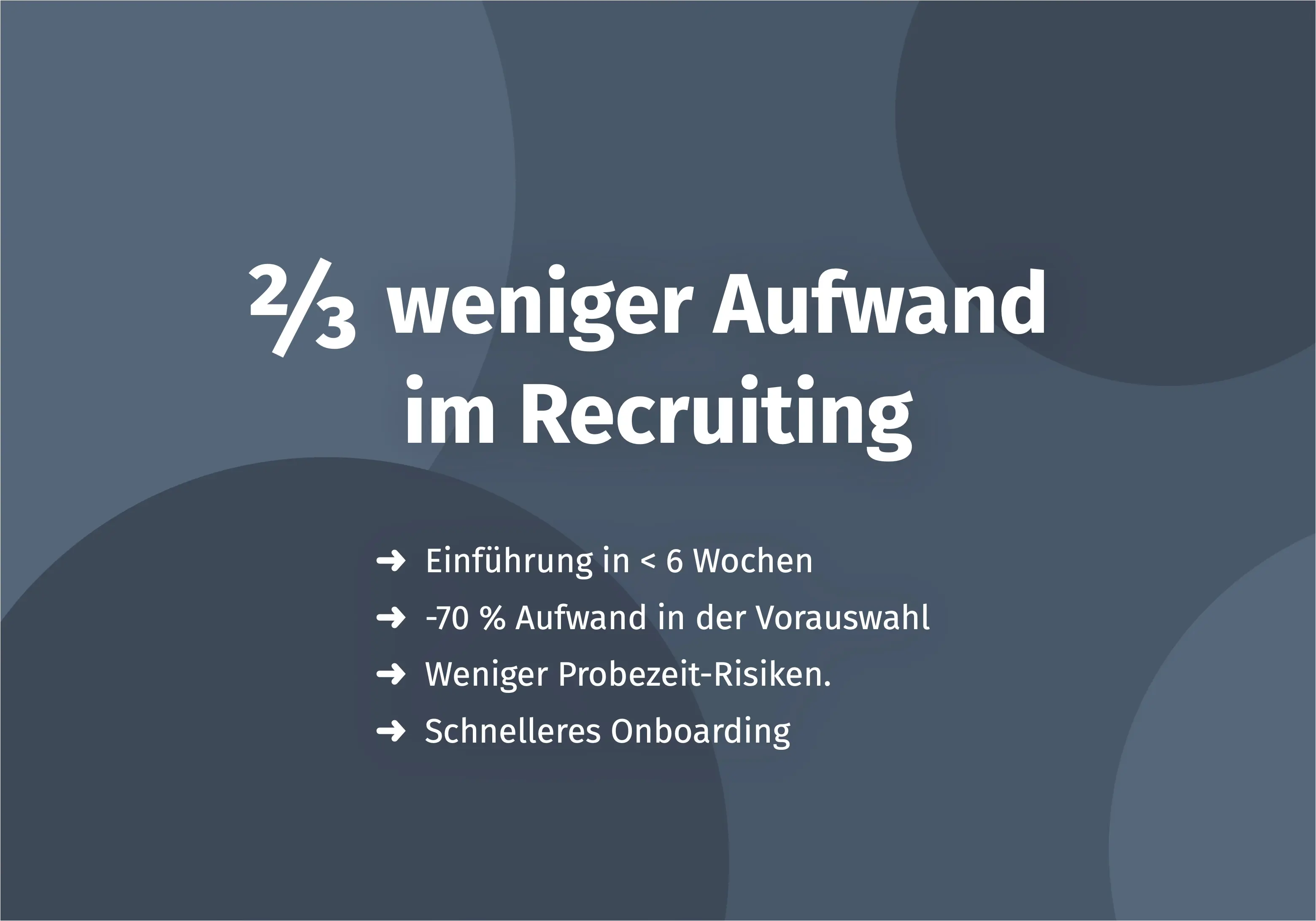
Aivy – a digital aptitude assessment platform and academic spin-off of Freie Universität Berlin – provides scientifically validated game-based assessments that objectively measure soft skills such as problem-solving ability, decision-making behaviour and team orientation. Companies like Callways report that pre-interview competency profiles make their recruiting conversations significantly more focused and productive: "The conversations are much better and more to the point," says Co-CEO Achim Reinhardt. According to Callways, the entire recruiting process was successfully restructured within six weeks.
Cultural fit analysis adds a further dimension to soft skill diagnostics: it evaluates whether a candidate's personality and values align with the team environment and company culture.
Frequently Asked Questions About Soft Skills
What are soft skills?
Soft skills are interpersonal, personal and social competencies – for example communication ability, empathy, problem-solving or resilience. They describe how someone works and interacts with others, and are harder to learn than technical qualifications (hard skills) because they are closely tied to personality.
What is the difference between soft skills and hard skills?
Hard skills are technical, clearly measurable qualifications – such as programming knowledge, language proficiency or commercial expertise. Soft skills, by contrast, describe behavioural and personality traits like teamwork, communication or resilience. Both complement each other: hard skills alone say little about how someone functions in a team or handles challenges.
Which soft skills are most important?
According to the LinkedIn Workplace Learning Report (2023) and the World Economic Forum's Future of Jobs Report (2025), communication skills, analytical thinking, creativity and adaptability rank among the most sought-after competencies. For leadership roles, emotional intelligence, decisiveness and empathy are gaining additional importance.
How can soft skills be measured in recruiting?
Scientifically grounded methods include structured behavioural interviews, validated personality tests (e.g. based on the Big Five model), assessment centres and game-based assessments. The key is selecting a method with demonstrated validity – meaning proven predictive power for professional success. DIN 33430 provides quality standards for such procedures.
Why are soft skills often underestimated in recruiting?
They are difficult to measure and barely visible in a CV – which is why they are frequently overlooked in favour of hard skills or assessed intuitively during interviews. However, this intuitive evaluation is error-prone: unconscious biases – such as personal affinity or perceived similarity to the assessor – influence judgements without those involved being aware of it.
Can soft skills be learned?
Partially. Competencies such as communication, presentation or structured working can be developed through training and feedback. Underlying personality dimensions rooted in the Big Five model – such as emotional stability or openness – are relatively stable, but can be influenced through targeted development, coaching and reflection. For recruiting, this means: those who assess for potential rather than only current capability will access a broader talent pool.
Conclusion
Soft skills are not a "soft" nice-to-have – they are a measurable success factor, both for individual roles and for organisations as a whole. The more work tasks become automated, the more interpersonal competencies such as problem-solving, communication and resilience move to the foreground.
For HR professionals, the crucial question is not whether soft skills are relevant – but how they can be assessed reliably and fairly. Scientifically validated diagnostic methods provide a clear answer: objective measurement over gut feeling reduces mis-hires, minimises bias and promotes equal opportunity in recruiting.
Sources
- DIN 33430 – Requirements for Procedures and Their Application in Occupational Aptitude Assessment. Deutsches Institut für Normung (DIN), 2016. https://www.din.de/de
- DGFP Guide to Aptitude Diagnostics. Deutsche Gesellschaft für Personalführung (DGFP), 2023. https://www.dgfp.de
- LinkedIn Workplace Learning Report. LinkedIn, 2023. https://business.linkedin.com/learn/resources/workplace-learning-report
- Future of Jobs Report. World Economic Forum, 2025. https://www.weforum.org/publications/the-future-of-jobs-report-2025/
- Schuler, H. (2014). Psychologische Personalauswahl. Hogrefe Verlag.

Make a better pre-selection — even before the first interview
In just a few minutes, Aivy shows you which candidates really fit the role. Beyond resumes based on strengths.