
Recruitment measures encompass all activities companies use to attract suitable candidates for open positions – from internal job postings and active sourcing to working with recruitment agencies. The shortage of skilled workers has made structured, efficient recruitment a strategic priority. Organizations that combine the right measures and design their selection process deliberately can reduce time-to-hire and mis-hires significantly.
What Are Recruitment Measures?
Recruitment measures are all the tools and activities HR professionals use to fill vacancies with suitable candidates. They are part of the broader field of human resource management and come into play the moment a staffing need is identified – whether due to turnover, growth, or restructuring.
The fundamental distinction is between internal and external recruitment measures. Both approaches have specific advantages and disadvantages and can be combined depending on the role profile, company size, and time pressure. According to the German Society for Human Resource Management (DGFP), companies are increasingly adopting a hybrid approach that integrates both pathways.
Internal vs. External Recruitment
Internal Recruitment Measures
Internal recruitment meets staffing needs from the existing workforce. Typical measures include:
- Internal job postings (intranet, notice board): Existing employees apply for open positions.
- Promotions and transfers: Talents are intentionally developed for a new role or moved to a different department.
- Employee referral programmes: Employees recommend candidates from their network – often with financial incentives.
- Internal development and succession planning: Apprenticeship and training programmes build in-house expertise over the long term.
Advantages: Lower costs, faster onboarding, familiarity with company culture, higher employee retention.
Disadvantages: Limited talent pool, potential internal conflicts, no fresh external perspectives.
External Recruitment Measures
External measures target candidates outside the organisation and provide access to the full labour market. The most important instruments include external job advertisements, active sourcing, recruitment agencies, and campus recruiting.
Advantages: Large talent pool, fresh ideas, access to specialised expertise.
Disadvantages: Higher costs, longer time-to-hire, more extensive onboarding required.
The Most Important Recruitment Measures at a Glance
Job Postings
Job advertisements on job boards (e.g. Indeed, LinkedIn, Glassdoor) or the company's own careers page remain the most widely used external measure. A clear, honest, and compelling description of the requirements is key to success. Job boards suit most industries but vary considerably in reach and cost.
Active Sourcing
Active sourcing involves recruiters proactively approaching potential candidates – without those candidates having applied. This typically happens via professional networks such as LinkedIn. Active sourcing is particularly effective for specialised or hard-to-fill roles where the passive talent pool (individuals who are not actively job-seeking) needs to be tapped. The effort involved is greater, but the match rate when done well is often considerably higher.
Recruitment Agencies and Headhunters
External recruitment agencies or headhunters take over the search and pre-selection on the company's behalf. This is particularly worthwhile for leadership positions or highly specialised roles. Fees typically range from 15 to 35 per cent of the annual salary of the filled position and should be weighed against the time saved and the quality of the resulting hire.
Employee Referral Programmes
Referral programmes leverage the networks of the existing workforce. Employees who recommend candidates are familiar with the company culture and can realistically assess whether someone is a good fit. Research indicates that employees hired through referrals tend to stay longer and become productive more quickly. Bonus schemes (e.g. 500 to 3,000 euros paid after a successful probationary period) noticeably increase participation rates.
Campus Recruiting and Career Fairs
For early-career talent and recent graduates, direct engagement at universities and career fairs is a well-established measure. Partnerships with universities, internship programmes, and dissertation projects make it possible to identify talent early and build a connection with the company. Potential analysis is playing an increasingly important role in recognising strengths that go beyond academic grades.
Optimising the Selection Process
Choosing the right recruitment measures is only the first step. What happens next – the selection process – is equally critical. Many mis-hires occur not because the wrong people were approached, but because the evaluation was too subjective and influenced by unconscious bias.
Structured interviews, clearly defined requirement profiles, and the use of scientifically validated assessment methods measurably improve selection quality. Game-based assessments, such as those offered by the digital platform Aivy, enable objective pre-screening based on validated psychological constructs – independent of CV or first impressions. The solution was developed as a scientific spin-off of Freie Universität Berlin and has conducted more than 100,000 assessments to date.
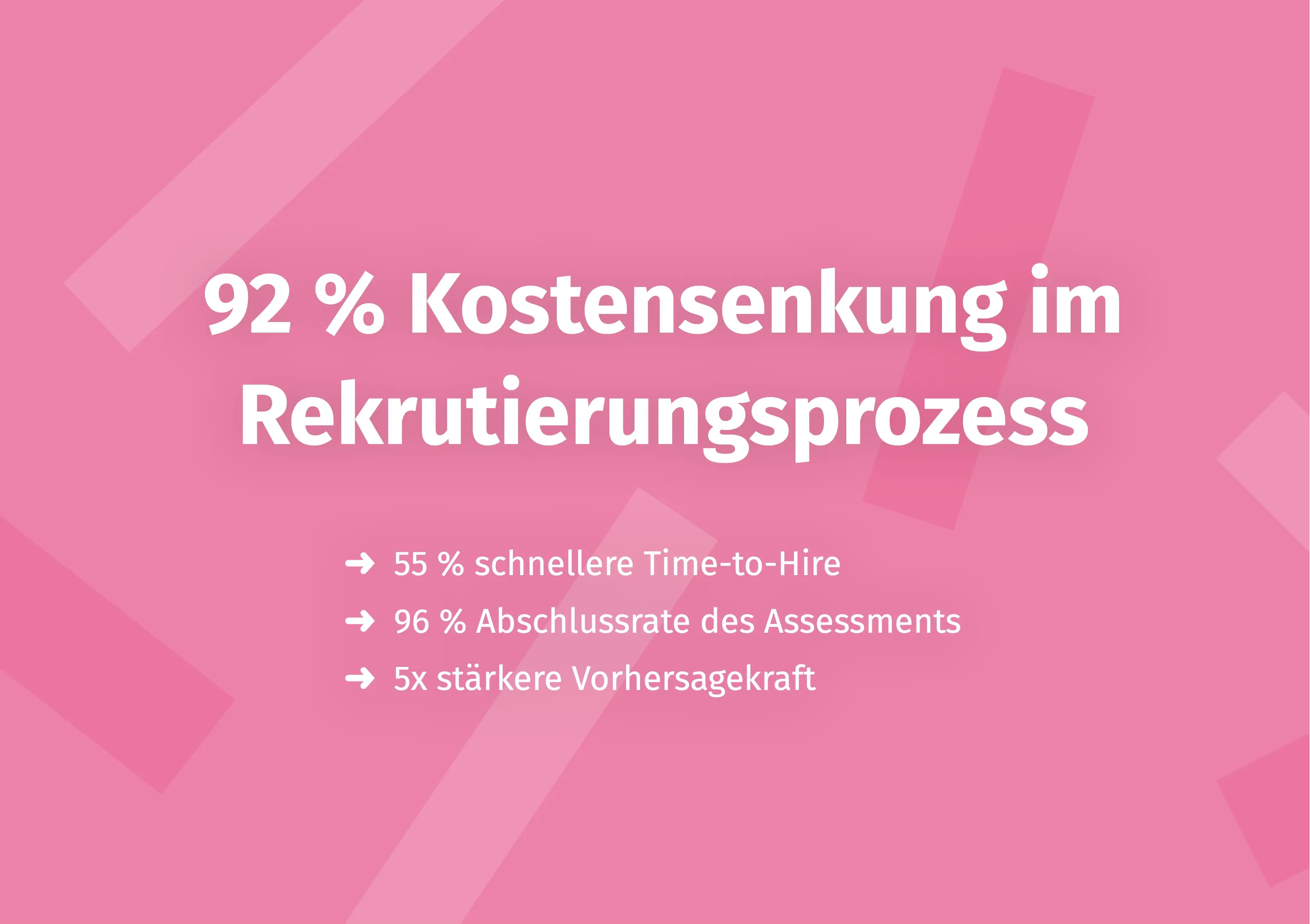
How powerful this kind of integration can be is illustrated by the example of MCI Deutschland: by embedding digital assessment into its recruitment process, the company reduced time-to-hire by 55% and cost-per-hire by 92% – while establishing a significantly more objective basis for evaluation. Further details are available in the MCI success story.
Frequently Asked Questions About Recruitment Measures
What are recruitment measures?
Recruitment measures are all activities a company uses to attract suitable candidates for open positions. They include both internal measures (e.g. promotions, referrals) and external ones (e.g. job postings, active sourcing, headhunting). The goal is to fill vacancies quickly, cost-efficiently, and with the right fit.
What is the difference between internal and external recruitment?
Internal recruitment draws on the existing workforce – through transfers, promotions, or internal job postings. This is more cost-effective and faster but is limited by the available talent pool. External recruitment targets the broader labour market and provides access to new skills and perspectives – but is more expensive and time-consuming. A hybrid approach is often the most sensible option, depending on the role profile.
What internal recruitment measures are available?
The most important internal measures include: internal job postings (intranet, notice board), promotions and transfers, employee referral programmes, and the targeted development of talent through apprenticeships or trainee programmes.
What external recruitment measures are available?
Externally, the following instruments are available: job advertisements on job boards and the company website, active sourcing via professional networks, collaboration with recruitment agencies and headhunters, campus recruiting and career fairs, and social recruiting via social media channels.
How can I make the selection process more objective?
Structured interviews with consistent evaluation criteria significantly reduce subjectivity. It is also advisable to use scientifically validated assessment tools (e.g. psychometric tests, structured assessments), clearly defined requirement profiles, and multiple evaluators to avoid single-person bias. This minimises the influence of unconscious bias in the selection process.
How can time-to-hire be reduced?
Time-to-hire can be shortened considerably through early digital pre-screening (e.g. online assessments instead of manual CV review), targeted active sourcing for hard-to-fill roles, clear process ownership with short decision-making cycles, and well-designed employee referral programmes.
What does external recruitment cost?
Costs vary widely by method. Job boards charge from a few hundred euros per listing. Recruitment agencies typically charge 15 to 30 per cent of the annual salary of the filled position. Headhunters usually charge between 25 and 35 per cent and are most worthwhile for senior or executive roles. Active sourcing primarily requires internal time investment, plus potentially the cost of tools such as LinkedIn Recruiter.
Conclusion
Recruitment measures are not an end in themselves – they are the foundation on which companies attract the right talent over the long term. Relying exclusively on traditional job postings means only partially exploiting the potential of the labour market. A well-considered combination of internal and external measures, tailored to the role profile and the company's specific situation, makes all the difference.
Just as important as the sourcing process is a structured selection phase: objectivity, clear criteria, and validated methods reduce mis-hires and sustainably improve selection quality.
How the digital platform Aivy can support organisations in professionalising their selection process through scientifically grounded assessment is explained at aivy.app.
Sources
- Federal Employment Agency (Bundesagentur für Arbeit): Skilled Labour Shortage Analysis. 2024. https://statistik.arbeitsagentur.de
- Federal Ministry of Labour and Social Affairs (BMAS): Skilled Labour Strategy of the Federal Government. 2022. https://www.bmas.de/DE/Arbeit/Fachkraeftesicherung/fachkraeftesicherung.html
- German Society for Human Resource Management (DGFP): Recruiting Trends. 2023. https://www.dgfp.de
- Hays AG: Hays Skills Index. 2024. https://www.hays.de/fachkraefteindex
- LinkedIn: Global Talent Trends Report. 2024. https://business.linkedin.com/hire/talent-insights
- Aivy GmbH: Success Story MCI Deutschland GmbH. https://www.aivy.app/en/success-stories/mci-deutschland-gmbh

Make a better pre-selection — even before the first interview
In just a few minutes, Aivy shows you which candidates really fit the role. Beyond resumes based on strengths.