
You've found the perfect person for your open position—congratulations! But now comes the part many recruiters dread: Writing rejection letters to everyone else.
You might think: "It's just a formality." But reality tells a different story. A study by Softgarden (2019) reveals that 91% of applicants discuss their application experiences with family and friends. Every unprofessional rejection—or worse, no response at all—can permanently damage your employer brand.
In this guide, you'll learn why rejections matter, what legal requirements you need to consider (particularly regarding anti-discrimination laws), how to communicate respectfully—and why fair selection processes are the key to better rejections. Plus: Four ready-to-use templates you can implement immediately.
Why Professional Rejection Letters Matter
Nobody enjoys writing rejection letters. You're delivering bad news, and applicants are disappointed. Still, you should pay far more attention to this process than most companies do.
Candidate Experience: Every Rejection Shapes Your Employer Image
The candidate experience—meaning all the experiences applicants have with your company—doesn't end with hiring. It doesn't end with rejection either. It ends with the impression someone keeps of your organization.
And here's the problem: Many companies invest significant energy in attractive job postings, quick invitations, and professional interviews—only to send a generic rejection letter at the end. Or worse: no response at all.
So-called "job ghosting"—completely ignoring applications—is unfortunately widespread. Yet companies underestimate how negatively this impacts them:
- Rejected applicants are potential future candidates
- Rejected applicants are potential customers
- Rejected applicants talk to others about their experiences
The Numbers Speak: How Rejections Affect Your Employer Brand
Scientific research on procedural justice clearly shows: People evaluate not just the outcome of a decision, but also the process that led to it. A groundbreaking study by Gilliland (1993) demonstrates that transparent, comprehensible selection processes are rated more positively even when the outcome is negative.
This means: Applicants can accept a rejection—if they feel they were treated fairly. What they cannot accept: feeling arbitrarily dismissed.
Add to this the power of word-of-mouth. In the age of review platforms like Glassdoor and Indeed, poor rejection practices can quickly become public knowledge. And once published, negative reviews remain visible for a long time.
Legal Framework: What You Need to Know About Anti-Discrimination Laws
Beyond moral obligations, there are legal aspects to consider when writing rejections. Anti-discrimination laws (such as the AGG in Germany, the Equality Act in the UK, or Title VII in the US) protect applicants from discrimination—and can prove costly for companies if rejections are poorly worded.
What Anti-Discrimination Laws Mean for Rejection Letters
These laws prohibit discrimination based on:
- Gender
- Age
- Race or ethnic origin
- Religion or belief
- Disability
- Sexual orientation
Important to understand: It's not just about avoiding mentioning these characteristics as rejection reasons. Even indications that suggest discrimination can be sufficient to shift the burden of proof. The company must then prove the rejection wasn't discriminatory.
Keep application documents for at least six months after rejection to be prepared for any potential claims.
Phrases You Should Avoid
Some phrases sound polite but can be legally problematic:
| Problematic Phrase | Why It's Risky | Better Alternative |
|---|---|---|
| "We're looking for someone who fits us better." | Could indicate discrimination based on personality traits | "We have decided on a candidate who better matches the specific requirements of this position." |
| "You're overqualified." | Could be interpreted as age discrimination | Don't provide a reason, or reference missing specific requirements |
| "We need someone for our young, dynamic team." | Age discrimination | Remove entirely |
| "The position requires physical resilience." | Could discriminate against disabled applicants (unless genuinely required) | Use only for demonstrably necessary requirements |
The safest approach: Don't provide any reasons at all. You're not legally required to explain rejections.
Special Case: Rejecting Applicants with Disabilities
An important exception: In many jurisdictions, rejections of applicants with disabilities may require explanation. Ensure that any explanation:
- References objective, job-related criteria
- Doesn't allow conclusions that disability was the reason for rejection
- Is sent via certified mail (for documentation purposes)
When and How to Reject Applicants
Beyond "what" to say, the "how" and "when" are crucial for professional rejections.
Timing: How Long Should a Rejection Take?
Basic rule: As quickly as possible. Ideally, rejections should be sent within 7-14 days. The longer applicants wait, the more negatively they perceive the experience.
Recommended timeline:
- Immediately after application receipt: Send automatic confirmation
- Within 7-14 days: Rejection or interview invitation
- After interview: Reject within 3-5 business days
Applicants are planning their futures. Those left uncertain for weeks can't make informed decisions—and won't view your company favorably.
Written, Phone, or In-Person? Choosing the Right Format
The communication format should match the application stage:
| Stage | Recommended Format | Reasoning |
|---|---|---|
| After reviewing documents | Efficient for many applications, enables quick response | |
| After initial phone screening | Email (with personal touch) | More effort than document review alone |
| After in-person interview | Phone call + written confirmation | Shows appreciation for time invested |
| After assessment center | In-person or phone + feedback | Highest effort deserves highest appreciation |
Tip: For candidates who've invested significant time, a brief phone call before the written rejection shows respect. It doesn't need to be long—five minutes is sufficient.
Rejection After Application vs. After Interview
The further someone progresses in the process, the more personal the rejection should be:
Rejection after document review:
- Can be standardized
- Personal greeting essential
- No explanation needed
- Talent pool mention optional
Rejection after interview:
- More individualized wording
- Reference the conversation
- Constructive feedback optional (but appreciated)
- Keep the door open for the future
Job Application Rejection: Templates for Different Situations
Here are four templates you can adapt to your needs. Make sure to personalize each one—at minimum, the greeting and position reference.
Template 1: Rejection After Reviewing Application Materials
Subject: Your Application for [Position Title]
Dear [Name],
Thank you for your application for the [Position Title] role and your interest in [Company Name].
After careful review of all applications received, we have decided to move forward with a candidate whose qualifications more closely match the specific requirements of this position.
Please don't view this decision as a reflection of your skills or qualifications. When receiving numerous applications, small details often determine the outcome.
We wish you all the best in your career journey and future endeavors.
Best regards,
[Name]
[Title]
[Company Name]
Template 2: Rejection After Interview
Subject: Following Up on Your Interview at [Company Name]
Dear [Name],
Thank you for taking the time to meet with us on [Date]. It was a pleasure getting to know you and learning more about your experience.
After completing our selection process, we have decided to proceed with another candidate. This was not an easy decision.
[Optional: We were particularly impressed by your [positive quality/experience]. For future applications, we'd suggest [constructive feedback].]
We encourage you to apply again for future openings that match your profile.
We wish you all the best in your career.
Best regards,
[Name]
[Title]
[Company Name]
Template 3: Rejection for Unsolicited Application
Subject: Your Unsolicited Application to [Company Name]
Dear [Name],
Thank you for your unsolicited application and your interest in [Company Name].
We truly appreciate your initiative. Unfortunately, we don't currently have an open position that matches your profile.
We would like to add you to our talent pool so we can contact you about suitable future opportunities. If you agree, please confirm via the following link: [Consent Link]
We wish you all the best on your journey.
Best regards,
[Name]
[Title]
[Company Name]
Template 4: Rejection with Talent Pool Invitation
Subject: Your Application for [Position Title] – And an Invitation
Dear [Name],
Thank you for your application for the [Position Title] position. After careful consideration, we have decided to proceed with another candidate for this role.
However, your profile impressed us greatly. We would like to invite you to join our talent pool, allowing us to contact you directly about suitable future positions.
If you're interested, please click the following link and confirm your consent: [Talent Pool Link]
We wish you much success in your career.
Best regards,
[Name]
[Title]
[Company Name]
Turning Rejection into Opportunity: Building Relationships Despite Declining
A rejection doesn't have to end the relationship. Smart recruiters use rejections to build a pool of interesting candidates for the future.
Building a Talent Pool: Staying Connected with Promising Candidates
A talent pool (also known as talent relationship management) is a database of candidates who weren't right for current positions but could be interesting for future ones.
Important for data protection compliance:
- You need explicit consent for data storage
- Consent must be voluntary (not a condition for applying)
- Applicants must be able to withdraw consent at any time
- Inform about storage duration and purpose
How to request consent:
At the end of the rejection: "We would like to add your profile to our talent pool to contact you about suitable future opportunities. If you agree, please follow this link: [Link to consent form]"
Giving Constructive Feedback – When and How
Many applicants want feedback to improve their applications. At the same time, feedback can be legally risky. How do you handle this?
Should you give feedback?
| Situation | Recommendation |
|---|---|
| After reviewing documents | Rather not – risk outweighs benefit |
| After interview | Optional – if you can be constructive |
| After assessment | Yes – if objective data is available |
If you do give feedback:
- Stay factual and specific
- Focus on observable behavior, not personality
- Emphasize development opportunities, not deficits
- Never mention protected characteristics
Example of constructive feedback:
"During the interview, we noticed you seemed uncertain when discussing [topic]. For future interviews, we'd recommend preparing more thoroughly in this area."
Fair Selection = Better Rejections: How Objective Processes Help
Here's the real key to better rejections: They don't start when writing the rejection—they start with the quality of your selection process.
Why Subjective Decisions Make Rejections Harder
Be honest: How often are hiring decisions based on "gut feeling"? On the impression that someone "fits the team"? On subjective sympathies?
The problem: Subjective decisions are nearly impossible to justify. Neither to yourself nor to applicants. And that's exactly what makes rejections so difficult.
Scientific research clearly shows: Unstructured, intuitive selection processes have significantly lower predictive validity than structured, objective methods. The meta-analysis by Schmidt and Hunter (1998) demonstrates that aptitude tests achieve a validity of r=.54, while unstructured interviews only reach r=.38.
Objective Assessment Methods: Making Decisions Transparent
Objective selection processes—such as structured interviews, standardized tests, or game-based assessments—have one decisive advantage: They provide transparent decision-making foundations.
When a rejection is based on objective criteria, it becomes easier to:
- Justify the decision to yourself
- Respond factually to inquiries
- Stay legally compliant
- Give applicants a sense of fairness
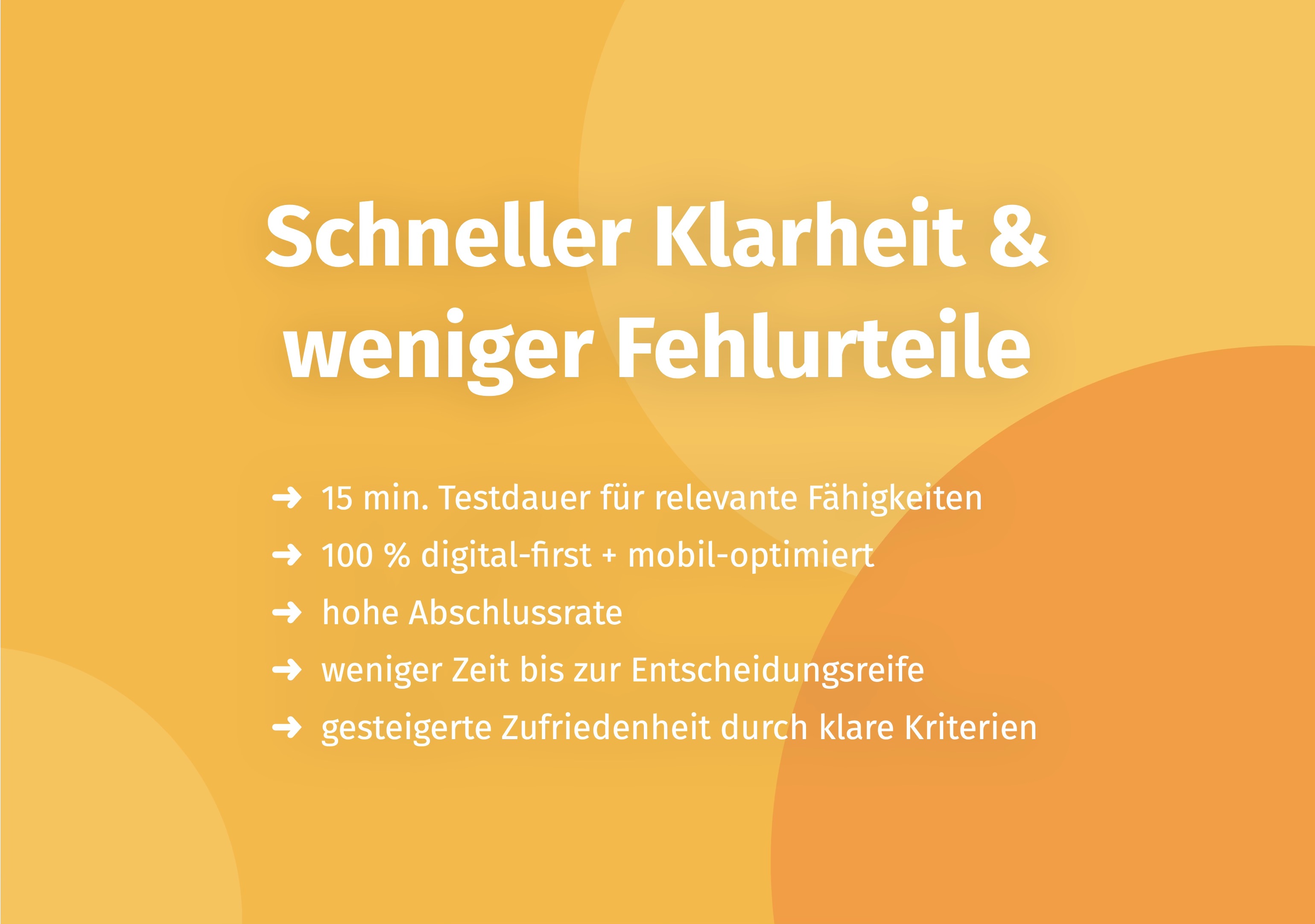
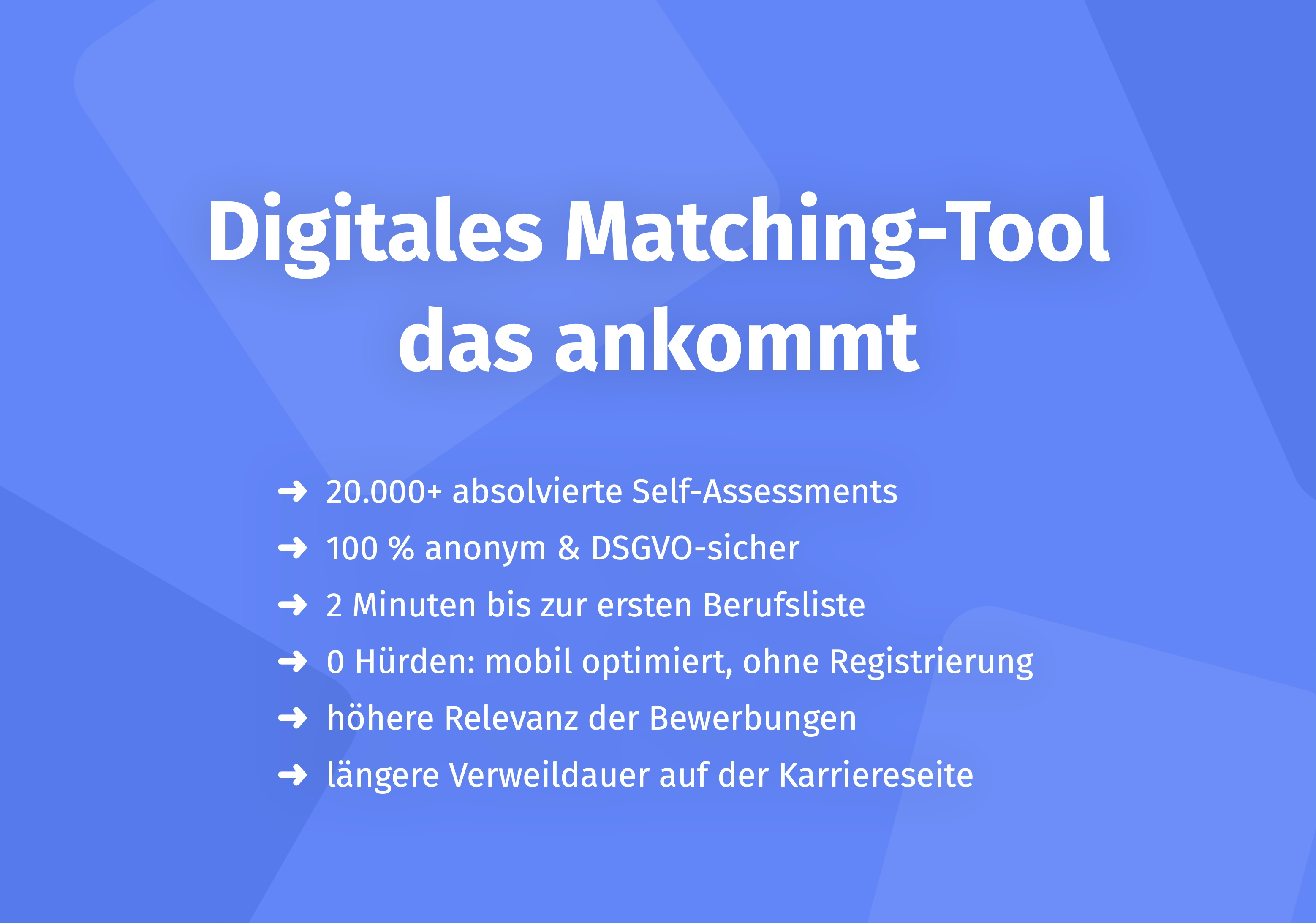
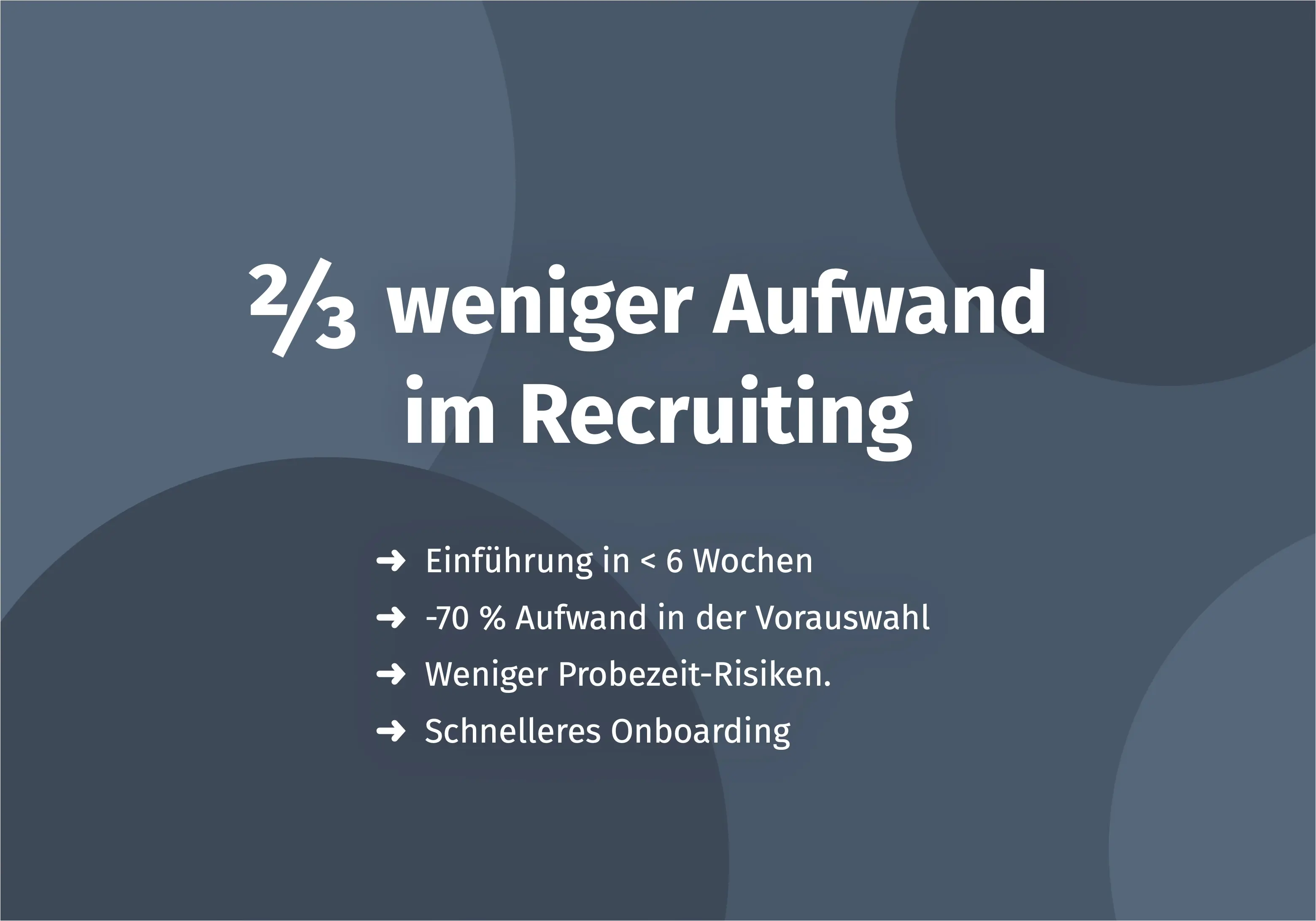
Tools like Aivy use scientifically validated assessment methods that enable data-driven decisions. Instead of "gut feeling," objective competency profiles take center stage—providing clarity for both acceptances and rejections.
Real-World Example: How Companies Win with Fair Processes—Even in Rejections
Practice shows: Companies using objective selection processes achieve not only better hiring decisions but also higher satisfaction among all applicants—including those who receive rejections.
One example: Lufthansa uses game-based assessments to evaluate candidates objectively. The results speak for themselves: 81% applicant satisfaction and a 96% accuracy rate in predicting suitability. Susanne Berthold-Neumann from Lufthansa explains the approach: "We look at application documents late in the process because they only show a small part of the person and say little about whether someone has the competencies for future challenges."
This approach demonstrates: When applicants feel their abilities were evaluated fairly and objectively, they accept rejections more readily. More details in the Lufthansa success story.
Checklist: Professional Rejections in 7 Steps
Here's your roadmap for professional rejections:
1. Respond Promptly
- Confirmation immediately upon receipt
- Rejection within 7-14 days
- After interview: 3-5 business days
2. Address Personally
- Always use the applicant's name
- Reference the position
- Avoid mass-email appearance
3. Ensure Legal Compliance
- Don't mention discriminatory reasons
- When in doubt: No explanation
- For disabled applicants: Check local requirements
4. Communicate Respectfully
- Thank them for applying
- Acknowledge their effort
- Include encouraging words
5. Adapt Communication Format
- Further in process = more personal
- After interview: Phone call
- Always follow up in writing
6. Keep the Future Open
- Talent pool invitation (with consent)
- Encourage future applications
- Don't close doors
7. Document Everything
- Keep documents for 6 months minimum
- Note rejection date
- Be prepared for inquiries
Frequently Asked Questions (FAQ)
Do I have to respond to every application as an employer?
Legally, there's no obligation to reject. However, for professionalism and employer branding, you should always respond—negative experiences spread quickly.
How long can a rejection take?
Ideally, rejections should be sent within 7-14 days. The longer applicants wait, the more negatively they perceive the experience.
Do I have to provide reasons for rejection?
Generally no—and for legal reasons, caution is advised. Exception: In some jurisdictions, rejections of applicants with disabilities require explanation. Constructive feedback is optional but appreciated.
What can't I mention as a rejection reason?
All protected characteristics are off-limits: gender, age, race or ethnic origin, religion, disability, sexual orientation. Even indirect phrases like "doesn't fit the team" can be problematic.
Should I reject by phone after an interview?
Yes, for candidates who've invested time in an interview, a brief call before the written rejection shows appreciation.
How do I write a legally compliant rejection?
Recommended: "We have decided on a candidate who better matches the specific requirements of this position." Avoid phrases like "better cultural fit."
How can I combine rejections with talent pool building?
At the end of the rejection, ask if you may keep their application documents for future positions. This requires explicit consent and must be documented in compliance with data protection regulations.
How do objective selection processes improve my rejections?
When decisions are based on objective criteria (e.g., assessments), rejections are perceived as fairer. Applicants accept transparent decisions more readily than subjective ones.
How long must I keep application documents?
After a rejection, keep documents for at least 6 months—this is typically the statute of limitations for discrimination claims. Then dispose of them in compliance with data protection laws.
What is "discrimination claim farming" and how do I protect against it?
This refers to fake applications aimed at collecting rejections to file discrimination lawsuits. Protection: Formulate rejections as neutrally as possible, don't mention discriminatory reasons, document your selection process.
Conclusion: Professional Rejections as Part of Your Employer Branding Strategy
Rejections are more than a tedious duty—they're an opportunity. An opportunity to appear professional, strengthen your employer image, and maintain relationships.
Key Takeaways:
- Timely, respectful rejections protect your employer brand
- Legal compliance protects against lawsuits
- The further in the process, the more personal the rejection
- A talent pool helps retain interesting candidates for the future
- Fair, objective selection processes make rejections more understandable
The real key to better rejections isn't in the wording—it's in the selection process itself. Those who rely on objective assessment methods make transparent decisions. And transparent decisions are accepted even when the outcome is negative.
Tools like Aivy help you establish fair, scientifically validated selection processes—for better hiring decisions and rejections that treat applicants with respect.
Sources
- Softgarden (2019): Study "Application Processes & Brand Perception"
- Gilliland, S. W. (1993): The Perceived Fairness of Selection Systems: An Organizational Justice Perspective. Academy of Management Review, 18(4), 694-734.
- Schmidt, F. L. & Hunter, J. E. (1998): The Validity and Utility of Selection Methods in Personnel Psychology. Psychological Bulletin, 124(2), 262-274.
- Aivy Success Story Lufthansa: https://www.aivy.app/en/success-stories/lufthansa

Make a better pre-selection — even before the first interview
In just a few minutes, Aivy shows you which candidates really fit the role. Beyond resumes based on strengths.