
Corporate Social Responsibility (CSR) describes the voluntary assumption of societal responsibility by companies – going beyond legal minimum requirements. CSR encompasses three dimensions: environmental (environmental protection), social (working conditions, diversity, equal opportunity) and governance (ethical corporate management). For HR professionals, CSR is a central topic today: fair recruiting, employee retention and reporting obligations under the EU CSRD directive make CSR a task for the entire HR strategy.
What is Corporate Social Responsibility? Definition and Fundamentals
Corporate Social Responsibility refers to the concept by which companies voluntarily integrate social and environmental concerns into their business operations and their relationships with stakeholders. The European Commission defines CSR as "the responsibility of enterprises for their impacts on society." Crucially, CSR goes beyond mere compliance with legal obligations – it represents active, strategic engagement.
The international framework for CSR is ISO 26000, a guidance document from the International Organization for Standardization that provides orientation on social responsibility for organisations of all sizes and sectors. It is not a certifiable standard, but a practical guide covering seven core subjects: organisational governance, human rights, labour practices, the environment, fair operating practices, consumer issues, and community involvement and development.
The Three Dimensions of CSR
CSR is built on the Triple Bottom Line model: companies measure success not solely by economic profit, but by three equally weighted factors:
- People (Social): Working conditions, equal opportunity, diversity, employee health, fair recruiting
- Planet (Environmental): Climate protection, resource conservation, CO₂ reduction, sustainable procurement
- Profit (Economic / Governance): Transparent corporate governance, anti-corruption, fair tax practices, ethical supply chains
For HR departments, the social dimension is the most immediately relevant – it encompasses everything related to work, people and fair treatment.
CSR vs. Corporate Citizenship – What's the Difference?
Corporate Citizenship refers to the civic engagement of companies – for example sponsorships, donations or corporate volunteering programmes. It is a subset of CSR, but not synonymous with it. While Corporate Citizenship describes concrete, externally visible actions, CSR is the overarching strategic concept that permeates the entire business activity.
CSR and ESG – What is the Difference?
The terms CSR and ESG (Environmental, Social, Governance) are frequently used interchangeably, but they differ in their perspective:
CSR is a principle and an attitude: companies voluntarily assume societal responsibility. The concept is more broadly defined and more strongly values-based.
ESG is a measurable framework used primarily by investors and financial institutions to evaluate the sustainability performance of companies. ESG is based on quantifiable metrics – for example CO₂ emissions, the proportion of women in management, or the number of compliance violations.
In short: CSR describes the attitude, ESG provides the measurement tools. Both concepts overlap significantly, but have different origins and target audiences.
Corporate Social Responsibility in HR – What It Means for HR Professionals
CSR is not a topic dealt with exclusively by the sustainability department. HR professionals in particular play a central role in implementing the social CSR dimension – across three core areas:
Fair Recruiting as Part of Social Responsibility
A fair, non-discriminatory hiring process is one of the most important social CSR measures. Unconscious biases – so-called Unconscious Biases – cause candidates to be evaluated not on their actual abilities, but on characteristics such as appearance, name or background. This contradicts the principle of equal treatment and the aspirations of socially responsible companies.
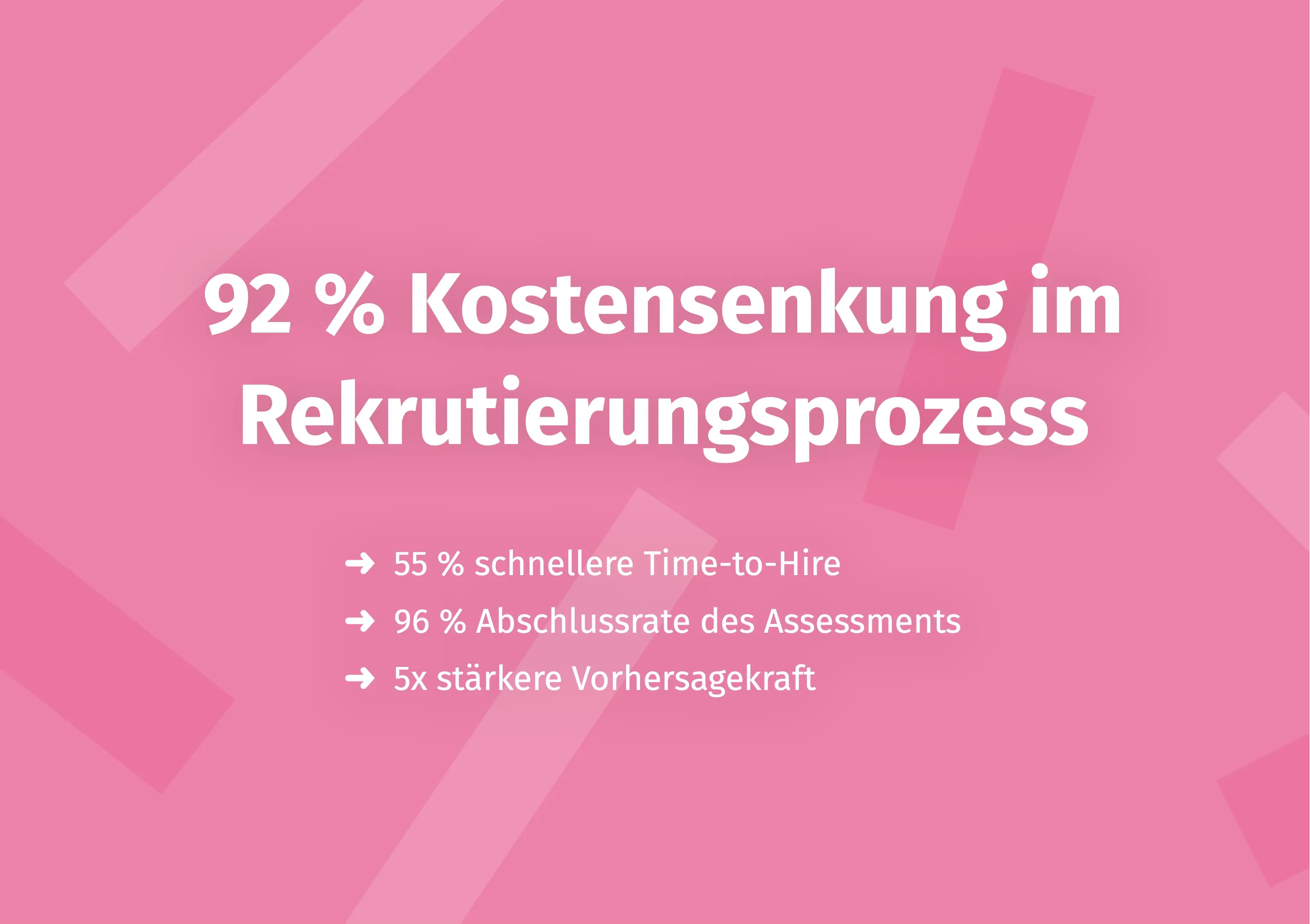
Scientifically validated aptitude diagnostics can make a measurable difference here: the digital platform Aivy – a spin-off from the Freie Universität Berlin – relies on game-based assessments that evaluate candidates independently of their CV or background. Companies such as Lufthansa have seen an increase in diversity (greater gender balance, more international applicants) alongside a 96% accuracy rate in predicting suitability.
Diversity and Equal Opportunity
Diversity in recruiting is not only an ethical goal, but can be reported as a concrete, measurable CSR metric in a sustainability report. Companies that promote diversity regularly report on indicators such as gender distribution at management levels, the proportion of employees with a migration background, or accessible application processes.
The connection is clear: introducing non-discriminatory selection procedures simultaneously strengthens employer branding and attracts a broader pool of applicants.
Employee Retention and Occupational Health Promotion
The social CSR dimension also encompasses responsibility towards existing employees: flexible working time models, occupational health promotion, further training opportunities and psychological support (e.g. Employee Assistance Programs) are typical HR-side CSR measures. They strengthen employee retention and signal societal responsibility externally – an important factor for the candidate experience and employer attractiveness.
Legal Framework: CSRD and Reporting Obligations
With the Corporate Sustainability Reporting Directive (CSRD) of the European Union (Directive 2022/2464/EU), CSR has acquired a new legal dimension. The CSRD requires companies above certain size thresholds to produce detailed sustainability reports – and this explicitly includes social metrics from the HR domain.
CSRD Reporting Timeline:
- From 2025 (reporting year 2024): Large companies with >500 employees already subject to the NFRD
- From 2026 (reporting year 2025): All other large companies (>250 employees or >€40 million turnover)
- From 2027 (reporting year 2026): Listed SMEs (with opt-out option until 2028)
The CSRD requires companies to report in accordance with the European Sustainability Reporting Standards (ESRS) – including ESRS S1, which explicitly addresses the company's own workforce: working conditions, equal treatment, pay equity, health and safety.
For HR professionals, this means: CSR reporting is no longer a voluntary PR exercise, but a legal obligation for many companies in which HR data plays a central role.
CSR Measures for HR – Practical Examples
Concrete CSR measures that HR departments can implement directly:
| Dimension | Measure | CSR Impact |
|---|---|---|
| Social | Anonymised screening / blind recruiting | Equal opportunity, bias reduction |
| Social | Diversity targets in recruiting | Demonstrable inclusion |
| Social | Occupational health promotion | Employee wellbeing |
| Social | Flexible working time models | Work-life balance |
| Social | Corporate volunteering | Community engagement |
| Social | Training budget for all levels | Internal equal opportunity |
| Governance | Transparent pay structure | Pay equity |
| Governance | Whistleblower protection | Ethical corporate culture |
| Environmental | Business travel policy / remote work | CO2 reduction |
A common mistake: companies communicate CSR measures externally without embedding them internally. The risk of greenwashing – presenting sustainability engagement without a substantive foundation – can be avoided by defining measurable targets, carrying out internal reviews, and reporting transparently in accordance with GRI standards or ESRS.
Frequently Asked Questions about Corporate Social Responsibility
What does Corporate Social Responsibility mean?
Corporate Social Responsibility describes the voluntary societal responsibility of companies that goes beyond legal minimum requirements. CSR encompasses three dimensions: environmental, social and governance. The international guidance document ISO 26000 defines seven core subjects, including labour practices, human rights and community involvement.
What is the difference between CSR and ESG?
CSR is a principle and an attitude towards societal responsibility. ESG (Environmental, Social, Governance) is a measurable evaluation system used primarily by investors to compare sustainability performance. CSR is values-based and more broadly defined; ESG provides quantifiable metrics for capital market decisions. Both concepts overlap substantially in content.
Which CSR measures are suitable for HR departments?
The most important HR-side CSR measures include: non-discriminatory recruiting (e.g. through blind screening or validated aptitude diagnostics), diversity and inclusion programmes, occupational health promotion, flexible working time models, corporate volunteering, and training and equal opportunity programmes. The key requirement is that these measures are measurable and embedded internally.
What is the CSRD and who does it affect?
The CSRD (Corporate Sustainability Reporting Directive, EU Directive 2022/2464) requires companies above certain size thresholds to produce sustainability reports in accordance with the European Sustainability Reporting Standards (ESRS). From 2026, all large companies with more than 250 employees or a turnover exceeding €40 million are affected. The reporting obligation also covers HR metrics such as pay equity, working conditions and diversity.
Why is CSR important for employer branding?
According to the Deloitte Global Millennial Survey, Millennials and Gen Z increasingly prefer employers with demonstrable societal engagement. Credible CSR activities increase attractiveness as an employer, improve employee retention and provide differentiation in the competition for skilled workers. The prerequisite: the engagement must be authentic and measurable – not merely communicative.
How do I avoid greenwashing in CSR?
Greenwashing occurs when CSR communication is not backed by substantive action. Countermeasures include: defining measurable targets and KPIs (not just statements of intent), transparent reporting in accordance with recognised standards (GRI, ESRS), internal embedding before external communication, and the use of certifications (e.g. B Corp). The CSRD obligation also requires companies to publish verifiable disclosures.
How are diversity and CSR connected?
Diversity is a core component of the social CSR dimension. Fair, bias-free recruiting is a concrete measure for promoting equal opportunity – and therefore a measurable CSR contribution. Companies can report diversity metrics (e.g. gender distribution, proportion of employees with a migration background) directly in their CSR or CSRD report. Objective personnel selection procedures are therefore not only ethically required, but also strategically and reporting-obligation relevant.
Conclusion
Corporate Social Responsibility is no longer an optional topic for HR professionals. The social dimension – fair recruiting, diversity, employee wellbeing – falls directly within the responsibility of the HR department. At the same time, CSRD reporting obligations make CSR an operational requirement for which HR must provide valid data.
Anyone who wants to implement CSR credibly starts internally: with measurable measures, transparent communication and a personnel selection practice that not only promises equal opportunity, but structurally ensures it.
Would you like to establish fair, scientifically founded personnel selection as a concrete CSR measure in your company? Find out more about objective aptitude diagnostics with the Aivy platform.
Sources
- European Parliament and Council of the EU: Directive 2022/2464/EU – Corporate Sustainability Reporting Directive (CSRD). 2022. https://eur-lex.europa.eu/legal-content/EN/TXT/?uri=CELEX:32022L2464
- International Organization for Standardization: ISO 26000 – Guidance on Social Responsibility. 2010. https://www.iso.org/iso-26000-social-responsibility.html
- Global Reporting Initiative: GRI Standards. 2021. https://www.globalreporting.org/standards/
- Federal Ministry of Labour and Social Affairs (BMAS): CSR in Germany – National CSR Strategy. 2022. https://www.csr-in-deutschland.de/DE/Startseite/start.html

Make a better pre-selection — even before the first interview
In just a few minutes, Aivy shows you which candidates really fit the role. Beyond resumes based on strengths.