
A trial work period is an informal, non-binding introduction between employer and candidate before signing an employment contract, with no mutual work obligations. Legally, it's considered a "familiarization relationship" and is generally unpaid – however, if the boundary to an employment relationship is crossed (e.g., through directives or extended duration), claims for compensation and employer obligations arise. When properly structured, trial work periods provide insight into work reality but carry legal risks and require significant effort.
What is a Trial Work Period?
A trial work period refers to a short phase in which candidates get to know the company before signing an employment contract and can demonstrate their suitability for the advertised position. Unlike a probationary period, trial work takes place before the start of an employment relationship and is also known as "trial days" or "familiarization relationship."
The key difference from a regular employment relationship: During trial work, there are no mutual rights and obligations. Candidates have no work obligation and employers have no right to give directives – both parties simply get to know each other on a non-binding basis. This "familiarization relationship" serves to determine whether the person fits the advertised position, the team, and the company culture.
Distinction from Probationary Period and Employment Relationship
Trial work periods are often confused with probationary periods, although they are two completely different concepts:
Trial Work Period:
- Takes place before contract signing
- No employment relationship
- No mutual rights and obligations
- Generally unpaid
- Duration: Usually 1 day, maximum 1 week
Probationary Period:
- Begins after contract signing
- Existing employment relationship
- Shortened notice period (typically 2 weeks to 1 month)
- Compensation mandatory
- Duration: Usually 3-6 months (varies by jurisdiction)
Case law also distinguishes between a "familiarization relationship" (genuine trial work) and an unintentionally created employment relationship. If the boundary is crossed, all employer obligations suddenly apply – from compensation to written termination.
Legal Framework for Trial Work Periods
Familiarization Relationship vs. Employment Relationship
Case law assumes a familiarization relationship when no mutual rights and obligations are agreed upon. This specifically means:
- Candidates promise no concrete work performance
- Employers issue no directives
- No integration into operational workflows
- Voluntary on both sides
However, the distinction from an employment relationship is not always clear. According to case law, what matters is not the designation ("trial work" or "trial day") but what actually happened.
Case examples from jurisprudence where an employment relationship was assumed:
- Three-day work in a call center for eight hours each according to workflows specified by the employer (Regional Labor Court Düsseldorf)
- Three-day work in the morning shift of a bakery sales counter at a train station in work uniform (Regional Labor Court Baden-Württemberg)
- Two-week activity as a truck driver for a freight company according to route schedules (Regional Labor Court Schleswig-Holstein)
A familiarization relationship was confirmed in the following case:Several days of work in a newly opened bistro with the agreement that aptitude and capability would be practically tested and travel expenses would be reimbursed (Regional Labor Court Rhineland-Palatinate).
Compensation for Trial Work
Generally, there is no compensation obligation for trial work, as it is an unpaid familiarization relationship. However, there are important exceptions:
If economically valuable work performance is provided during trial work that gives the company a concrete advantage, a compensation claim may arise. According to general contract law principles, compensation is considered tacitly agreed upon if the circumstances expect such.
What does this mean in practice?
- Observing and shadowing: No compensation obligation
- Small supporting tasks: Generally no compensation obligation
- Independent completion of productive work: Compensation claim possible
Expense allowance: Employers can voluntarily pay an expense allowance (e.g., for travel costs or meals). Caution: Regular payment can be interpreted as evidence of an employment relationship.
Important: Minimum wage does not apply to genuine trial work (familiarization relationship). However, as soon as an employment relationship arises, minimum wage obligations apply.
Insurance Coverage and Accident Risk
During trial work, there is generally no statutory accident insurance coverage. Insurance carriers argue that trial workers are not considered "employees integrated into the company" and therefore have more of a visitor status.
Exception: If the trial work is arranged by the employment agency (for unemployed candidates), accident insurance coverage exists (Regional Social Court North Rhine-Westphalia).
Liability for damages:
- Damage caused by candidate: Generally covered by candidate's private liability insurance
- Work accident of candidate: No statutory insurance coverage (except when arranged by employment agency)
Recommendation for employers: Only deploy trial workers in low-risk areas and inform them about the lack of insurance coverage.
Duration: No Legal Regulation, But Recommendations
There is no legally defined maximum duration for trial work. Nevertheless: The longer the trial work lasts, the higher the risk that an employment relationship arises.
Recommendations from practice:
- Ideal: 1 day (a few hours in the morning or afternoon)
- Acceptable: 2-3 days
- Gray area: 1 week (only with justified need)
- Risk: More than 1 week
Case law shows: Even three days with fixed working hours and integration into operational processes can be considered an employment relationship (Regional Labor Court Düsseldorf). Therefore, employers should keep the duration as short as possible.
When Does Trial Work Become an Employment Relationship?
The boundary between familiarization relationship and employment relationship is fluid and is assessed by labor courts based on concrete indicators in case of dispute.
Indicators from Case Law
An employment relationship becomes likely when the following factors come together:
1. Right to Give Directives
- Employer issues concrete instructions on workflows
- Candidate must follow specifications on work methods
- Fixed working hours and break regulations
2. Integration into Operational Processes
- Candidate takes over tasks of regular employees
- Work uniform is worn
- Fixed workplace is assigned
- Participation in shift schedules or duty rosters
3. Economically Valuable Work Performance
- Independent completion of productive tasks
- Work has concrete value for the company
- Complete task fulfillment (not just support)
4. Compensation
- Payment is agreed or provided
- Regular remuneration (beyond expense allowance)
5. Extended Duration
- More than 3-5 consecutive days
- Repeated trial work days
Consequences for Employers
If trial work unintentionally becomes an employment relationship, this has significant legal and financial consequences:
- Compensation Claim Candidates can retroactively claim wages for all hours worked.
- Written Termination Required The employment relationship must be terminated in writing according to legal requirements. Verbal agreements are not sufficient.
- Notice Periods Statutory minimum notice periods must be observed – even if the employment relationship only lasted a few days.
- Social Security Obligation Retroactive registration with social security agencies required, including contribution payments.
- Immediate Notification If a trial work relationship involves actual work performance, immediate notification must be submitted to pension insurance.
Legally Compliant Trial Work: Tips for Employers
To minimize legal risks while benefiting from the advantages of trial work, employers should follow these practical tips:
Duration: Maximum 1 Week, Better 1 Day
Best Practice:
- Standard: 1 day (4-8 hours)
- For complex activities: 2-3 days
- Absolute maximum: 1 week (only with clear justification)
The shorter the duration, the lower the risk of an unintended employment relationship.
Tasks: Supporting, Not Independent
What is permitted:
- Shadowing regular activities
- Observing workflows
- Small supporting subtasks
- Exchange with the team
What should be avoided:
- Independent completion of full tasks
- Assignment of economically valuable work
- Tasks assigned to regular employees
- Productive activities without guidance
Example (permitted): Candidate for sales position helps stock shelves under guidance and observes customer consultations.
Example (critical): Candidate independently takes over a shift in sales and serves customers.
Written Agreement: What Should Be Included?
A written agreement is not legally required but strongly recommended. It creates legal certainty for both parties.
Content of trial work agreement:
- Designation: "Agreement on trial work / trial day"
- Time period: Exact start and end (day, time)
- Purpose: "Mutual, non-binding getting acquainted"
- No work obligation: Explicit notice that there is no obligation to work
- No right to give directives: Employer does not exercise right of direction
- Compensation: Clarification that there is no compensation obligation (possibly voluntary expense allowance)
- Insurance: Notice of lack of accident insurance coverage
- Data protection: Consent to data processing (GDPR/privacy regulations)
At the beginning of trial work: Inform the candidate that there is no obligation to work and that breaks can be taken at any time or trial work can be discontinued.
Objective Evaluation: Structured and Fair
Trial work serves not only to get acquainted but also to assess suitability. To make this objective, a structured approach is recommended:
1. Define clear evaluation criteria in advance
- Professional competence
- Work method (e.g., diligence, pace)
- Social competence / teamwork ability
- Communication skills
- Cultural fit
2. Structured observation form
- Uniform rating scale (e.g., 1-5)
- Concrete behavioral anchors (What does "good" mean?)
- Space for qualitative observations
3. Deploy multiple observers
- Reduces unconscious bias
- Different perspectives (e.g., supervisor, colleagues)
- Comparison of assessments
4. Ensure comparability
- All candidates receive similar tasks
- Similar framework conditions (time, support)
- Documented evaluation
Important: According to psychologist Prof. Dr. Martin Kersting, trial work only measures "maximum behavior" – i.e., the best behavior candidates can show. In everyday life, behavior may differ. Trial work should therefore be combined with other selection methods that also capture typical behavior and motivation.
Challenges with Trial Work – and Solutions
Effort vs. Benefit: Is Trial Work Worth It?
Trial work offers valuable practical insights but involves considerable effort:
Costs:
- Time investment for supervision (often 4-8 hours per candidate)
- Personnel costs for accompanying employees
- Possibly expense allowances (travel costs, meals)
- Legal risks with incorrect implementation
Benefits:
- Realistic assessment of work style
- Candidates experience authentic work environment
- Team can assess cultural fit
- Higher validity than pure interview (with correct implementation)
Rule of thumb: Trial work is especially worthwhile for:
- Blue-collar/technical professions
- Positions with direct customer contact
- Career changers without professional experience
- Apprentice recruiting
For highly qualified professionals or leadership positions, trial work can be perceived as a sign of mistrust. Assessment centers or structured case interviews are often better suited here.
Minimizing Legal Risks
Checklist for legally compliant trial work:
✅ Limit duration to maximum 1 day (preferably even shorter)
✅ Written agreement with notice of no employment relationship
✅ Issue no directives, only suggestions
✅ No work uniform or fixed workplaces
✅ No independent completion of economically valuable tasks
✅ No compensation (except voluntary expense allowance)
✅ No integration into shift schedules or duty rosters
✅ Notice of lack of accident insurance coverage
✅ Privacy-compliant consent to data processing
Ensuring Objective Evaluation
A central challenge: Trial work is susceptible to unconscious bias. Candidates who appear likeable or fit the stereotype are often rated better – regardless of their actual performance.
Solution approaches:
- Structured observation forms: Predefined criteria reduce subjectivity
- Multiple observers: Different perspectives balance individual distortions
- Blind evaluation: Assessment takes place independently, comparison only afterward
- Combination with objective tests: Potential assessment through scientifically validated methods
Using Pre-Filters: Digital Talent Assessment
To reduce the number of unsuitable candidates in trial work, modern companies use pre-screening talent assessment. Instead of inviting all candidates to trial work, an objective pre-selection is made.
Advantages of digital talent assessment as a pre-filter:
- Objective potential assessment: Scientifically validated assessments measure competencies independent of résumé or likability
- Time and cost savings: Only the best-fitting candidates are invited to trial work
- Scalability: Many candidates can be tested simultaneously
- Better candidate experience: Faster decisions, less waiting time
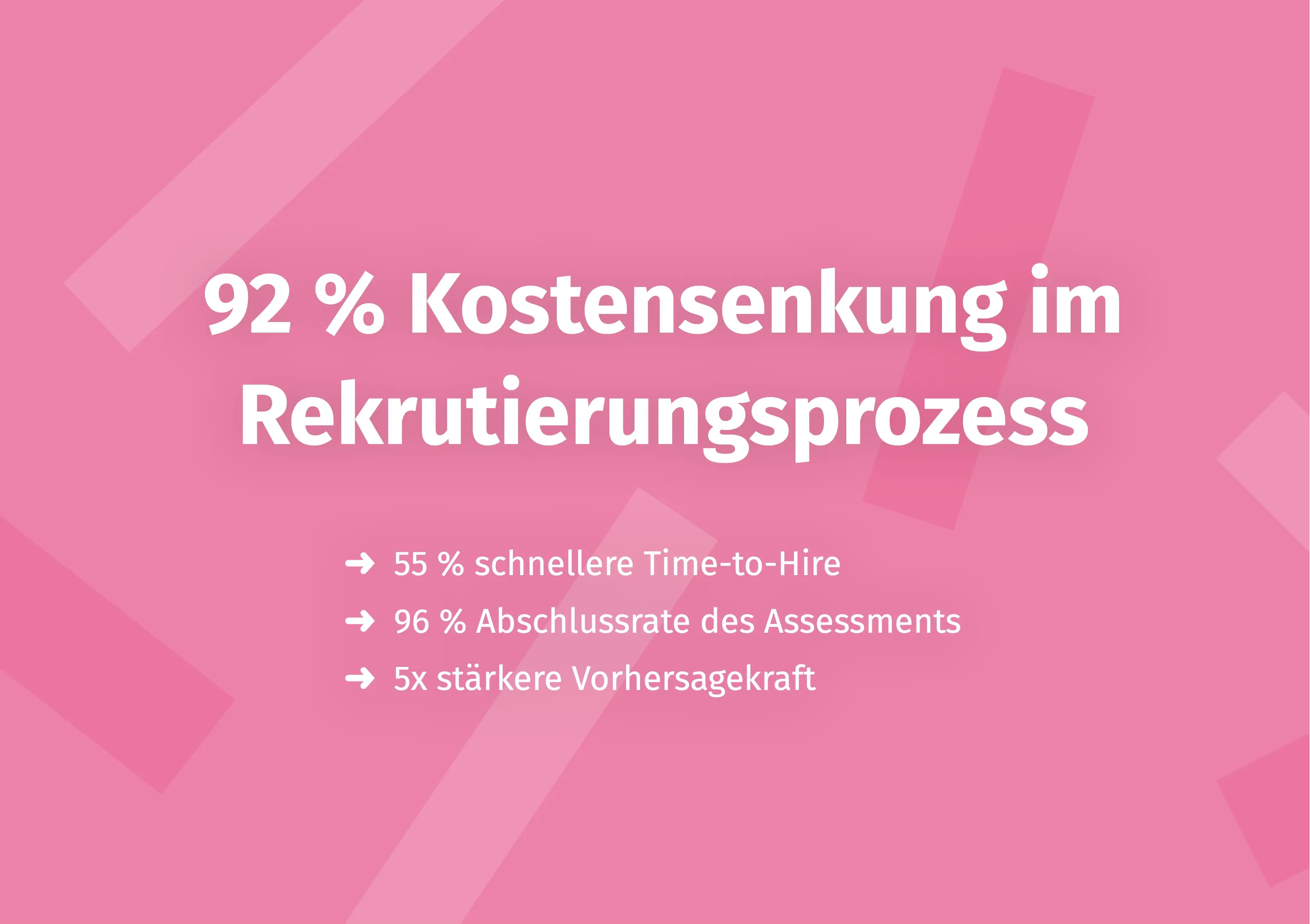
In practice: Companies like MCI use digital talent assessment as a pre-filter in recruiting and only invite the best-fitting candidates to further selection steps – including possible trial work days. The result: 55% faster time-to-hire, 92% lower cost-per-hire, and a 96% completion rate in assessments.
Alternatives and Complements to Trial Work
Trial work is not the only selection method to test candidates' suitability. Depending on the position and objective, other or complementary methods may be more appropriate.
Assessment Centers
Assessment Centers (AC) simulate success-critical work situations over a period of one to three days. Candidates go through various exercises (e.g., role plays, presentations, case studies) and are evaluated by an observer panel.
Advantages:
- Standardized and comparable
- Multiple competencies are tested
- High predictive validity (with correct implementation)
Disadvantages:
- Very elaborate and cost-intensive
- Simulations don't capture the real work environment
- Can be perceived as stressful
Suitability: Leadership positions, trainee programs, larger companies with many candidates
Work Samples
Work samples are concrete tasks that candidates solve under defined test conditions. They are the oldest and most reliable method of personnel selection – similar to trial work but more structured.
Advantages:
- Direct measurement of professional abilities
- High validity for the concrete activity
- More authentic than simulations
Disadvantages:
- Elaborate in preparation
- Difficult to compare with different tasks
- Not suitable for all professions
Suitability: Creative professions (e.g., design, editing), IT development, crafts
Game-Based Assessments
Game-based assessments are digital, gamified tests that conduct scientifically validated potential analyses. They measure competencies like logical thinking, problem-solving ability, or personality traits – independent of the résumé.
Advantages:
- Objective and bias-free: Scientifically validated evaluation reduces unconscious bias
- Scalable: Hundreds of candidates can be tested simultaneously
- High candidate experience: Gamified, mobile-friendly, typically 15-20 minutes
- Pre-filter function: Only suitable candidates are invited to further steps
Disadvantages:
- Don't capture the real work environment
- Technical requirements necessary (smartphone/PC)
- Not suitable for all target groups (e.g., older generations)
Suitability: Modern companies, tech industry, high applicant volumes, apprentice recruiting
Digital talent assessment platforms like Aivy offer game-based assessments that combine scientifically founded potential analyses with high candidate experience. Companies like Lufthansa achieve a 96% prediction accuracy while maintaining 81% candidate satisfaction. Through objective pre-selection, trial work days can be used more strategically – only with the best-fitting candidates.
Structured Interviews with Case Studies
Structured interviews follow a standardized guide with predefined questions. Through hypothetical case studies, candidates' problem-solving abilities and thinking patterns can be tested.
Advantages:
- Comparability across all candidates
- Flexibly adaptable to different positions
- Low effort compared to AC or trial work
Disadvantages:
- Socially desirable answers possible
- Only captures verbal behavior, not actual action
Suitability: All positions as basic selection method, combinable with other methods
Frequently Asked Questions About Trial Work
Must trial work be paid?
Generally no – trial work is an unpaid familiarization relationship. However: If economically valuable work is performed that provides the company with a concrete advantage, a compensation claim arises according to general contract law principles. A voluntary expense allowance for travel costs or meals is possible, but caution: Regular payment can be interpreted as evidence of an employment relationship.
How long may trial work last at maximum?
There is no legal maximum limit, but the recommendation is: Maximum 1 week, ideally 1 day (a few hours). The longer the duration, the higher the risk of an unintended employment relationship. Case law shows: Even 3 days with fixed working hours can be considered an employment relationship (Regional Labor Court Düsseldorf).
What is the difference between trial work and probationary period?
Trial work takes place before contract signing, is non-binding, and generally unpaid. There is no employment relationship. The probationary period, on the other hand, begins after contract signing, typically lasts 3-6 months, and is an existing employment relationship with shortened notice period and compensation obligation.
When does trial work become an employment relationship?
An employment relationship arises when mutual rights and obligations emerge – i.e., when work obligation and right to give directives exist. Indicators are: Fixed working hours, work uniform, integration into workflows, compensation, independent completion of productive tasks. Consequence: Compensation claim and written termination required.
Does insurance coverage exist during trial work?
Generally no – there is no statutory accident insurance coverage. Exception: If the candidate is referred by the employment agency. The candidate's private liability insurance covers damages. Recommendation: Only deploy candidates in low-risk areas and inform them about the lack of insurance coverage.
What tasks may I assign to trial workers?
Only supporting tasks, no independently executable activities. Permitted: Observing, shadowing, small subtasks under guidance. Not permitted: Tasks that are economically valuable, complete task completion, productive activities without accompaniment. Caution: Too complex or independent tasks can be interpreted as evidence of an employment relationship.
How do I evaluate trial work objectively?
Define clear evaluation criteria in advance (e.g., work method, teamwork ability, professional competence) and use structured observation forms with uniform rating scales. Deploy multiple observers to reduce unconscious bias. Ensure comparability by giving all candidates similar tasks. Important: Trial work only measures "maximum behavior" – combine it with other selection methods.
Are there alternatives to trial work?
Yes, several: Assessment centers offer simulated work situations, work samples test concrete tasks under defined conditions, game-based assessments enable digital, gamified potential analyses, and structured interviews with case studies combine flexibility with comparability. Depending on position and objective, these methods can be more appropriate or used as complements to trial work.
Conclusion: Trial Work as Part of a Structured Selection Process
Trial work offers valuable, realistic insight into candidates' work methods and enables both parties to get to know each other authentically. When properly designed – with short duration, clear boundaries, and structured evaluation – it can be a useful component in the recruiting process.
However, trial work carries significant legal risks: If the boundary to an employment relationship is crossed, compensation claims, social security obligations, and termination formalities arise. The effort for legally compliant implementation and supervision is high, and validity varies greatly – because trial work only measures candidates' "maximum behavior," not their typical behavior in everyday life.
Modern, efficient recruiting processes therefore combine trial work with objective pre-filters like digital talent assessment. This way, only the best-fitting candidates are invited to trial work, reducing time, costs, and legal risks – while simultaneously achieving higher success rates.
Want to use objective talent assessment as a complement to trial work? Digital platforms like Aivy offer scientifically validated game-based assessments that enable fair pre-selection and reduce unconscious bias. Learn more about objective talent assessment
Sources
- General contract law principles regarding compensation for services. Various jurisdictions, applicable law varies by country.
- Case law on familiarization relationships vs. employment relationships. Regional Labor Courts (Germany), 2005-2007.
- Regional Labor Court Rhineland-Palatinate, Judgment of 24.5.2007, 2 Sa 87/07.
- Regional Labor Court Baden-Württemberg, Judgment of 25.4.2007, 13 Sa 129/05.
- Regional Labor Court Düsseldorf, Judgment of 6.7.2007, 9 Sa 598/07.
- Regional Labor Court Schleswig-Holstein, Judgment of 17.3.2005, 4 Sa 11/05.
- Regional Social Court North Rhine-Westphalia, Judgment of 16.2.2000, L 17 U 290/99.
- Kersting, M. (2014). Personnel Selection: Trial Work Measures Maximum Behavior (Interview). Haufe Online Editorial Team.
- Haufe Online Editorial Team (2022). Assessment Centers, Work Samples and Trial Work.

Make a better pre-selection — even before the first interview
In just a few minutes, Aivy shows you which candidates really fit the role. Beyond resumes based on strengths.