
The most important tips for more scientific research in your personnel selection
According to DIN 33430, a well-founded requirements analysis forms the basis of a successful and professional staff selection. Within the framework of these, criteria for professional success are defined, on the basis of which a requirement profile is created. The requirement profile, also known as a qualification profile, is a systematic, usually tabular list of all for the advertised position required qualifications and competencies.
It answers a key question: What does an ideal applicant have to bring to the table in order to be successful in the vacant position? This makes it one of the most important personnel selection tools. Because it is clear that only if HR managers know the specific requirements of a position can they evaluate candidates' suitability for the advertised position.
Definition: requirement profile
A requirement profile is a systematic listing of all competencies that applicants must have in order to be successful in a position.
What belongs in a requirement profile?
A requirement profile contains all professional and interdisciplinary requirement groups (also known as qualification groups and characteristic groups) that are placed on applicants. HR managers generally differentiate between four categories:
- Formal requirements (e.g. education, professional experience)
- Technical requirements (e.g. programming skills, Excel skills)
- Methodological skills (e.g. analytical thinking, negotiation skills)
- Social/personal skills (e.g. ability to work in a team, empathy)
Depending on the task at the workplace, further groups of requirements can also be included. Examples include physical and mental demands.
How do you create a requirement profile?
Step 1:
The first step of requirement profiling should always be carried out with a well-founded requirement analysis. Two methods are primarily used in practice:
a) Experience-guided intuitive methods
Experience-guided intuitive methods rely, as the name suggests, on experience-based or intuition-based judgments from experts. These are usually experienced HR managers or managers from the specialist sector. It can often also make sense to include previous employees. The requirement profile represents a compilation of all competencies and characteristics that experts consider necessary for success in the position.
b) Person-empirical methods
Person-empirical methods use statistical relationships between the characteristics of workers and their professional performance to derive requirement profiles.
An example: If you observe that sales employees achieve their sales goals particularly frequently with a high degree of empathy, empathy would be included in the requirement profile.
The aim is that the profile always contains exactly the requirements that best predict professional success.
Comparing the methods
While the advantage of experience-based methods lies in their ease of implementation, empirical methods have the advantage that they are less biased by subjective perceptions that often disadvantage professionals, and can usually adapt more quickly to changes in the working world.
An example: Managers and HR managers tend to name competencies that they believe they themselves have and take changes in the required competencies over time, often only late.
Step 2:
Once the requirements have been analysed and identified at one position, the second step is to use the information to define as specific requirements as possible for applicants. We have 5 secrets of success summarized, with the help of which you can improve the quality of your requirement profiles in the long term.
I. Clear and selective
- Formulate requirement profiles precisely, unequivocally and avoid empty phrases.
- Formulate requirements as far as possible concretely (e.g. ability to listen empathically) and avoid overarching concepts of competence (e.g. social competence)
II. Consensus-based and empirically based
- Integrate different perspectives (e.g. cross-departmental exchange)
- prefer empirical over experience-based intuitive methods, and integrate statistical data about the professional success of previous applicants
III. Current and future-oriented
- Understand requirement profiles as continuous improvement process
- Regularly review developments in the position and the job environment and adapt them
- Integrate potential-related competencies (e.g. ability to change) to meet the challenges of a fast-paced working world
IV. Allows weightings
- Weight criteria according to their importance and differentiate between Required, target and optional criteria
- List requirements in order of importance
- Check whether mandatory criteria are actually essential for success in a position
V. Fair and non-discriminatory
- Avoid discrimination from groups based on gender or culture, for example
- Include requirements (e.g. physical characteristics) that can potentially disadvantage groups only if they are essential for the position (mandatory criteria)
- Use inclusive language that appeals equally to individuals of all genders and cultures
Using the requirement profile correctly in the personnel selection process
The requirement profile is ready — and now? This is where it really gets exciting! This is because the requirement profile plays two central key roles in the personnel selection process.
Recruiting
The request profile is a central element of job advertisements and therefore plays an important role in attracting future talent. Because this is how the requirements laid down therein influence:
- Who regards the position as attractive
- Anyone who feels suitable for this
The requirement profile that you set influences the candidates you attract and find.
Staff selection
The requirement profile also plays a central role in the aptitude diagnostic selection process. On the one hand, it determines which competencies are measured in the personnel selection process and, on the other hand, enables a structured assessment of the suitability of applicants for the position. The criteria defined in the requirement profile are used to create a target profile with which the actual competencies of applicants can be compared (Target/actual reconciliation). This enables HR managers to identify in which areas applicants meet the requirements or fall short of them.
Case studies from HR practice
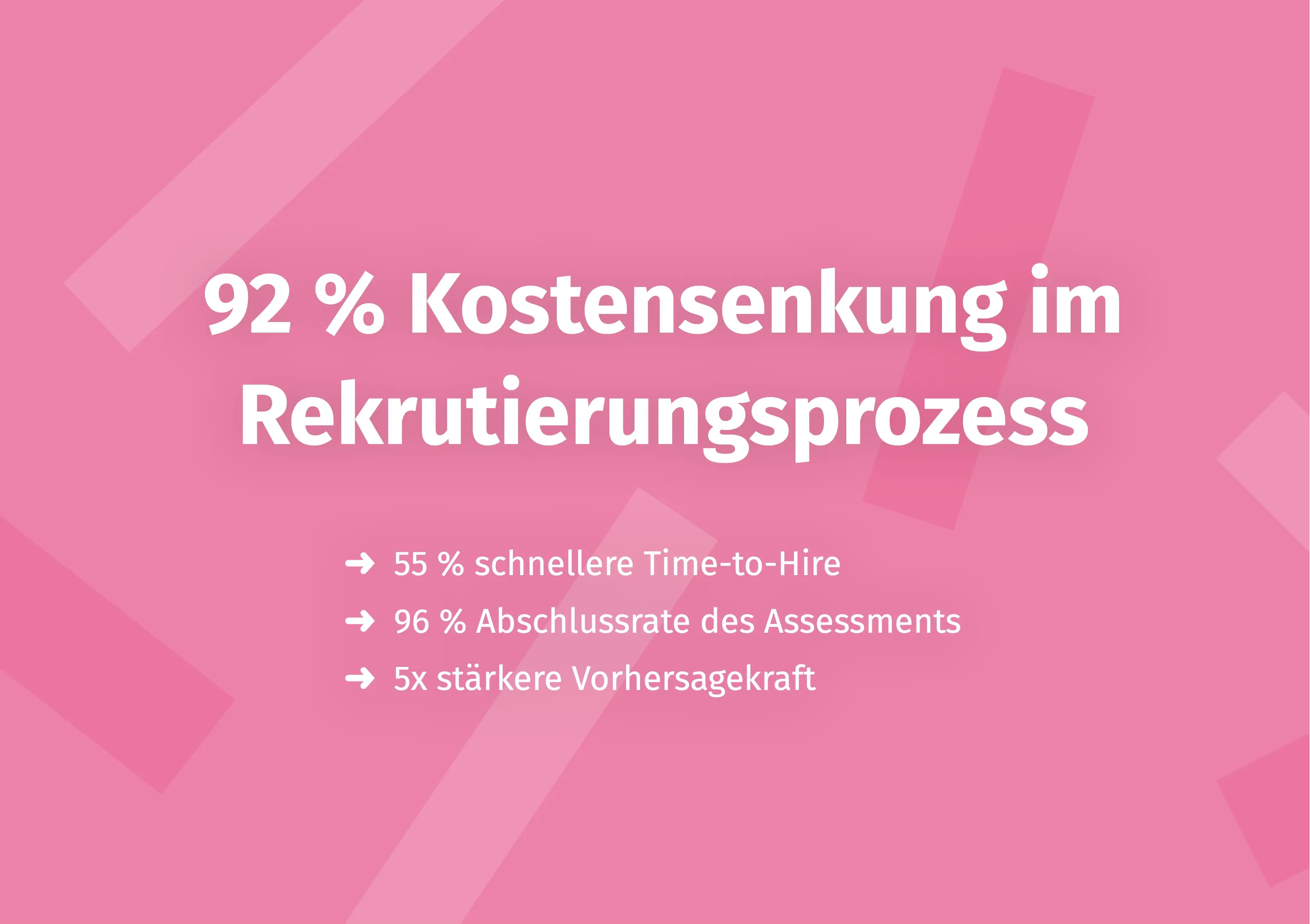
Deutsche Lufthansa AG provides a current practical example of the effectiveness of scientifically based requirement profiles. Through the use of scientifically validated psychometric testing methods from Aivy, a remarkable hit rate of 96% is achieved when pre-selecting trainees — even before the first personal interview.
The implementation of aptitude diagnostics within 15 minutes Online assessments The existing application process led to:
- An overall success rate of 96% for candidate suitability
- A time saving of over 100 minutes per application
- A high level of acceptance among applicants with 86% completion rate
The high predictive accuracy of the process was demonstrated by a sample of over 1,200 applicants.
Over 1,200 companies already rely on Aivy's requirement profiles
... and use them to successfully avoid wrong decisions in personnel selection — even before the initial interview!
→ Get non-binding advice now!
Testimonials from HR managers
“We get a better look at the person and recognize their strengths. So we can select by fit.” confirms Susanne Berthold Neumann, responsible for innovative young talent programs at Deutsche Lufthansa AG.
The combination of scientific background and positive candidate experience makes modern requirement profiles particularly valuable for companies. More about this here...
Quality Standards
When carrying out aptitude diagnostic procedures, the Scientificity of the methods used as well as the Protection of personal data in focus:
- Processing on ISO 27001-certified servers in Germany (Frankfurt am Main)
- Pseudonymized data collection to ensure anonymity
- Regular review by independent auditors (GDPR and BDSG)
As a scientific spin-off of Freie Universität Berlin, Aivy developed aptitude diagnostic methods that are based on DIN 33430 and have been validated in over 1 million assessments at over 1,200 companies of various sizes and industries. The development is carried out in close cooperation with leading experts, including Harald Ackerschott, co-author of DIN 33430 and head of the ISO Recruitment Working Group.

Make a better pre-selection — even before the first interview
In just a few minutes, Aivy shows you which candidates really fit the role. Beyond resumes based on strengths.