You want to explore your strengths as a talent?

This way

Login

Recruiting Challenges: 7 Obstacles & Solutions

Home
-
Lexicon
-
Recruiting Challenges: 7 Obstacles & Solutions

You know the feeling: a position remains unfilled for months, application quality declines, and pressure from leadership increases. You're not alone. According to the XING Labor Market Report 2025, 91% of HR professionals in Germany state that the talent shortage makes filling positions significantly more difficult. At the same time, 54% of HR managers feel highly emotionally burdened—an increase from 35% the previous year.

The recruiting landscape has fundamentally changed. Demographic shifts, technological disruption, and evolving employee expectations present you with new challenges. But with the right strategy, you can not only overcome these obstacles but turn them into opportunities.

In this guide, you'll learn which seven recruiting challenges dominate in 2025, what they cost your company, and how you can counteract them with scientifically validated methods. Current studies and practical examples show you concrete solutions.

Why Recruiting Has Become So Difficult in 2025/2026

The current recruiting situation results from several interconnected factors. To master these challenges, you first need to understand what's behind them.

Demographic Change and Talent Shortage in Numbers

The baby boomer generation is retiring—leaving a gap that younger generations cannot fill. According to a ManpowerGroup study, the talent shortage in Germany has doubled over the past ten years and now exceeds the global average.

While the talent gap decreased from 480,000 unfilled positions in May 2024 to around 360,000 at the beginning of 2025 according to Statista, experts agree: this relief is only temporary. Demographic change will intensify the shortage in the long term.

Changed Employee Expectations

The working world has fundamentally transformed since the pandemic. Flexibility, remote work, and work-life balance are no longer nice-to-haves but basic requirements. Generation Z and Millennials—together comprising over 69% of the workforce—expect inspiration, purpose, and communication at eye level from employers.

The problem: While many companies offer hybrid work models as a compromise, data from the Recruitee Report 2025 shows that time-to-hire—the period from job posting to hiring—is 17% longer for hybrid positions compared to remote jobs. The dropout rate during the application process even increases by 14%.

Technological Disruption and New Requirements

Artificial intelligence is rapidly changing the working world. New jobs emerge while others disappear. Companies need professionals with future skills—digital competence, creativity, adaptability. Yet these profiles are particularly scarce on the market.

Simultaneously, using AI in recruiting itself presents a challenge: 62% of HR professionals say AI tools could simplify the process—but only 37% actually use them.

The 7 Biggest Recruiting Challenges at a Glance

From current studies and market analyses, seven central challenges can be identified that shape recruiting in 2025.

1. Talent Shortage and War for Talent

The competition for top talent is more intense than ever. In specialized areas like IT, healthcare, or engineering, qualified applicants are simply scarce. The paradox: even with rising unemployment numbers, many positions cannot be filled because qualifications don't match—experts call this a labor market mismatch.

The consequence for you: You need to become more creative. Instead of just fishing in the open job market, active sourcing—proactively approaching candidates who aren't actively looking—pays off.

2. Long Time-to-Hire and Inefficient Processes

Every day a position remains unfilled costs money and productivity. But reality often looks like this: complicated application forms, slow decision-making processes, and poor communication cause top talent to drop out—on average, the best candidates are only available on the market for 10 days.

Cost-per-hire—all costs for a single hire—is often underestimated. It includes not only advertising costs but also recruiter time, tools, and onboarding.

3. Poor Candidate Experience

Candidate experience describes the overall experience of applicants throughout the selection process—from the job posting to acceptance or rejection. And this is where things often go wrong: generic communication, missing feedback, and impersonal processes deter talent.

The problem extends further: a negative experience spreads. Applicants share their experiences on social networks, damaging your employer brand.

4. Bad Hires and High Turnover

A bad hire is expensive—not just financially. When new employees leave within the first few months, it burdens the team, damages morale, and forces you to start the process over.

The cause often lies in subjective selection decisions. The classic job interview is frequently based on gut feeling rather than objective criteria. The meta-analysis by Schmidt and Hunter (1998) demonstrates: unstructured interviews have a validity of only r=.38, while structured interviews achieve r=.51 and aptitude tests reach r=.54—meaning they predict job performance significantly better.

5. Unconscious Bias in Personnel Selection

Unconscious bias—unconscious prejudices—influences hiring decisions without us noticing. Affinity bias leads us to prefer people who are similar to us. Confirmation bias makes us look for confirmation of judgments already made. The halo effect causes single positive traits to overshadow the overall assessment.

The result: qualified candidates are overlooked, homogeneous teams form, and the company misses valuable perspectives.

6. Outdated Recruiting Methods

Many companies still rely on methods that worked 20 years ago: job postings in print media, standardized application forms, one-dimensional selection interviews. But expectations have changed—especially among younger generations.

Modern recruiting approaches like gamification, mobile-first applications, and data-driven decision-making are gaining ground—but not everywhere yet.

7. Lack of Data-Driven Decision Making and Objectivity

Recruiting decisions are often made from the gut. Which channel brings the best applicants? Which selection method best predicts success? Without data, it remains speculation.

The solution lies in aptitude diagnostics—scientifically validated methods for measuring competencies and potential. They provide objective data for better decisions.

What These Challenges Cost Your Company

Recruiting problems aren't just annoying—they have concrete financial impacts.

Direct Costs of Unfilled Positions

A Stepstone analysis (2024) puts the average cost per unfilled position at €29,000. In large companies with more than 250 employees, this figure rises to over €73,000.

Costs vary by industry:

Indirect Costs from Bad Hires

Even more expensive than an unfilled position is a bad hire. Beyond the direct recruiting costs that recur, add: onboarding time, productivity losses, declining team morale, and in the worst case, resignation waves due to team dissatisfaction.

Frankfurt School was able to reduce wrong decisions by 30% through objective pre-selection methods—even before the first interview. The result: a 4x ROI in the first year alone.

Solutions: How to Master Recruiting Challenges

The good news: there are proven solutions for every challenge. The key lies in combining strategic measures.

Optimize Employer Branding and Candidate Experience

Your company must be perceived as an attractive employer—authentically. Show what you stand for, what values you live by, and what employees can expect. Use various channels: career page, social media, employee testimonials.

Equally important is candidate experience. Concrete measures:

  • Fast responses (maximum 48 hours)
  • Transparent communication about the process
  • Mobile-optimized application options
  • Respectful, personalized rejections
  • Innovative selection methods that are enjoyable

Active Sourcing and Modern Recruiting Channels

Don't wait for applications to arrive—actively approach talent. Active sourcing means identifying suitable profiles on LinkedIn and other platforms and reaching out directly. This requires time and tact but pays off.

Complement classic job postings with:

  • Social media recruiting (LinkedIn, Instagram, TikTok)
  • Employee referral programs
  • Talent pool building for future positions
  • University partnerships

Structured Interviews and Objective Selection Processes

Switching from unstructured to structured interviews is one of the biggest levers for better hiring decisions. Structured interviews mean: all candidates receive the same questions, and answers are evaluated according to defined criteria.

The science is clear: The meta-analysis by Schmidt and Hunter (1998) shows that structured interviews with r=.51 have significantly higher validity than unstructured interviews with r=.38.

Implement Scientifically Validated Aptitude Diagnostics

The most effective way to objectify subjective decisions is using scientifically validated tests. According to Schmidt and Hunter, aptitude tests achieve a validity of r=.54—higher than any other single method.

Modern approaches like game-based assessments combine the best of both worlds: they measure cognitive abilities and competencies in a playful, objective way, reducing test anxiety while improving candidate experience. Studies by Lievens and Sackett (2017) confirm that game-based assessments reduce test anxiety without losing validity.

Objective Aptitude Diagnostics as a Game Changer

Why do traditional selection processes fail—and how can modern aptitude diagnostics change that?

Why Traditional Selection Processes Fail

Traditional recruiting is based on a process prone to bias: screen resumes, read cover letters, make gut-feeling decisions, conduct unstructured interviews. At each of these points, unconscious biases can distort the decision.

The problem starts with the resume. It shows the past, not potential. It says little about whether someone has the competencies for future challenges.

How Game-Based Assessments Objectify Selection

Objective aptitude diagnostic tools like Aivy take a different approach: instead of subjective impressions, scientifically validated tests provide measurable data on competencies, cognitive abilities, and personality traits.

The platform uses game-based assessments—playful, scientifically validated tests developed and validated at the Free University of Berlin. The advantage: candidates experience the process as innovative and fair, while companies receive objective data for their decisions.

Specifically, this means:

  • Standardized competency assessment
  • Reduction of unconscious bias through data-driven evaluation
  • Improved candidate experience through innovative, game-based tests
  • Shorter time-to-hire through efficient pre-selection
  • Higher accuracy in personnel selection

Case Study: How Companies Optimized Their Recruiting Process

Practice shows that objective aptitude diagnostics delivers measurable results.

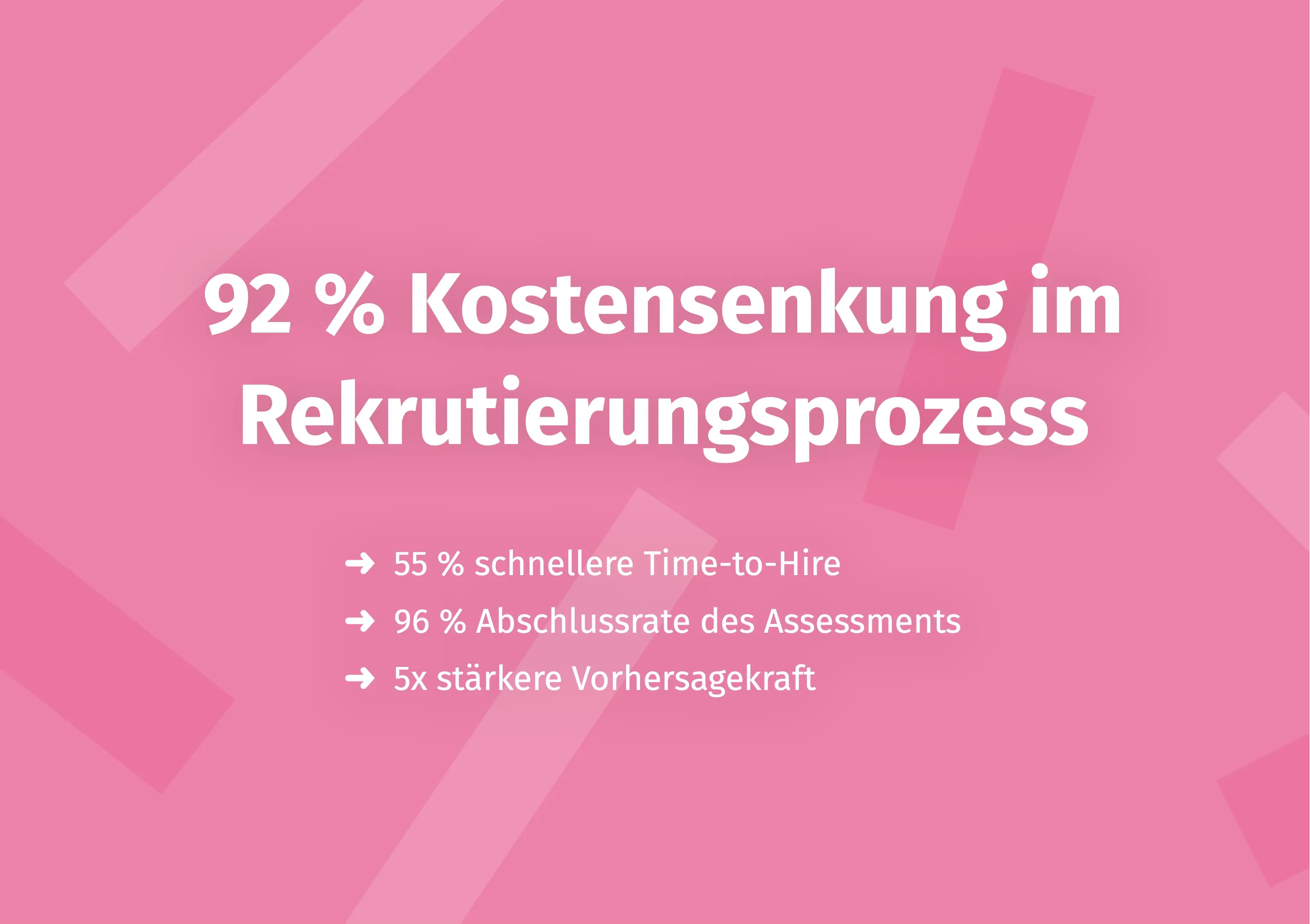
MCI Deutschland GmbH was able to reduce time-to-hire by 55% and simultaneously cut cost-per-hire by 92% through game-based assessments. The completion rate in the assessment is 96%, and predictive power is 5x stronger than traditional methods. Matthias Kühne, Director People & Culture at MCI, summarizes: "We had largely digitized the recruiting process for a long time thanks to softgarden. With Aivy, we have now digitized another process step in personnel procurement and significantly professionalized it through a more objective assessment basis."

Lufthansa also relies on objective aptitude diagnostics—with impressive results: 96% accuracy in predicting candidate suitability compared to in-house assessment, 81% candidate satisfaction, and 100+ minutes of saved testing time per applicant. Susanne Berthold-Neumann from Lufthansa explains the approach: "We look at the documents late because they only show a small part of the person and say little about whether someone has the competencies for future challenges."

More details can be found in the Lufthansa Success Story and the MCI Success Story.

Frequently Asked Questions (FAQ)

What are the biggest recruiting challenges in 2025?
The top 7 challenges are: 1) Talent shortage—91% of HR professionals are affected, 2) Long time-to-hire, 3) Poor candidate experience, 4) Bad hires and turnover, 5) Unconscious bias in selection, 6) Outdated methods, 7) Lack of data-driven decision making.

How can I reduce time-to-hire?
Through automation of routine tasks, objective pre-selection with aptitude diagnostics, fast communication with candidates, and streamlining decision-making processes. MCI was able to reduce time-to-hire by 55% with game-based assessments.

What does an unfilled position cost?
On average €29,000 per unfilled position, over €73,000 in large companies. In IT, costs are around €37,300, in healthcare €37,700 per position.

Why don't anti-bias trainings often work long-term?
Studies show that trainings create short-term awareness but rarely lead to lasting behavioral change. Structural measures like objective selection processes and standardized procedures are more sustainable.

What's the difference between active sourcing and recruiting?
Recruiting encompasses all activities for talent acquisition, while active sourcing refers to proactively approaching candidates directly—actively searching rather than waiting for applications.

How does AI affect recruiting?
AI can automate routine tasks, pre-screen applications, and reduce bias. However, HR professionals must clarify ethical questions and ensure algorithms don't reproduce discrimination.

What are game-based assessments?
Playful, scientifically validated tests that measure competencies and cognitive abilities—without causing test anxiety. They reduce bias, improve candidate experience, and provide objective data for hiring decisions.

How do I improve candidate experience?
Through fast feedback, transparent communication, mobile-optimized application processes, respectful rejections, and innovative selection methods like game-based assessments that are enjoyable.

Conclusion: Turn Recruiting Challenges into Opportunities

The recruiting landscape is challenging—but not hopeless. The key insights:

  • The talent shortage requires creative approaches like active sourcing and strong employer branding
  • Subjective selection methods lead to bad hires and high costs
  • Scientifically validated aptitude diagnostics measurably objectify decisions
  • Candidate experience is a decisive competitive factor
  • Data-driven processes shorten time-to-hire and reduce costs

Companies that invest in modern recruiting methods now secure a decisive advantage in the war for talent. Objective aptitude diagnostic tools like Aivy support you in reducing bias, making better decisions, and simultaneously providing a positive candidate experience.

The first step? Analyze your current recruiting process: Where are you losing candidates? Which decisions are based on gut feeling rather than data? Where can you objectify?

Sources

  • Schmidt, F. L., & Hunter, J. E. (1998). The validity and utility of selection methods in personnel psychology. Psychological Bulletin, 124(2), 262-274.
  • XING Labor Market Report 2025, Appinio. https://www.xing.com
  • Stepstone Cost Analysis of Unfilled Positions (2024). https://www.stepstone.de
  • ManpowerGroup Talent Shortage Survey. https://www.manpowergroup.de
  • Lievens, F., & Sackett, P. R. (2017). The effects of predictor method factors on selection outcomes. Journal of Applied Psychology.
  • Recruitee Recruiting Report 2025. https://recruitee.com

Home
-
lexicon
-
Recruiting Challenges: 7 Obstacles & Solutions

You know the feeling: a position remains unfilled for months, application quality declines, and pressure from leadership increases. You're not alone. According to the XING Labor Market Report 2025, 91% of HR professionals in Germany state that the talent shortage makes filling positions significantly more difficult. At the same time, 54% of HR managers feel highly emotionally burdened—an increase from 35% the previous year.

The recruiting landscape has fundamentally changed. Demographic shifts, technological disruption, and evolving employee expectations present you with new challenges. But with the right strategy, you can not only overcome these obstacles but turn them into opportunities.

In this guide, you'll learn which seven recruiting challenges dominate in 2025, what they cost your company, and how you can counteract them with scientifically validated methods. Current studies and practical examples show you concrete solutions.

Why Recruiting Has Become So Difficult in 2025/2026

The current recruiting situation results from several interconnected factors. To master these challenges, you first need to understand what's behind them.

Demographic Change and Talent Shortage in Numbers

The baby boomer generation is retiring—leaving a gap that younger generations cannot fill. According to a ManpowerGroup study, the talent shortage in Germany has doubled over the past ten years and now exceeds the global average.

While the talent gap decreased from 480,000 unfilled positions in May 2024 to around 360,000 at the beginning of 2025 according to Statista, experts agree: this relief is only temporary. Demographic change will intensify the shortage in the long term.

Changed Employee Expectations

The working world has fundamentally transformed since the pandemic. Flexibility, remote work, and work-life balance are no longer nice-to-haves but basic requirements. Generation Z and Millennials—together comprising over 69% of the workforce—expect inspiration, purpose, and communication at eye level from employers.

The problem: While many companies offer hybrid work models as a compromise, data from the Recruitee Report 2025 shows that time-to-hire—the period from job posting to hiring—is 17% longer for hybrid positions compared to remote jobs. The dropout rate during the application process even increases by 14%.

Technological Disruption and New Requirements

Artificial intelligence is rapidly changing the working world. New jobs emerge while others disappear. Companies need professionals with future skills—digital competence, creativity, adaptability. Yet these profiles are particularly scarce on the market.

Simultaneously, using AI in recruiting itself presents a challenge: 62% of HR professionals say AI tools could simplify the process—but only 37% actually use them.

The 7 Biggest Recruiting Challenges at a Glance

From current studies and market analyses, seven central challenges can be identified that shape recruiting in 2025.

1. Talent Shortage and War for Talent

The competition for top talent is more intense than ever. In specialized areas like IT, healthcare, or engineering, qualified applicants are simply scarce. The paradox: even with rising unemployment numbers, many positions cannot be filled because qualifications don't match—experts call this a labor market mismatch.

The consequence for you: You need to become more creative. Instead of just fishing in the open job market, active sourcing—proactively approaching candidates who aren't actively looking—pays off.

2. Long Time-to-Hire and Inefficient Processes

Every day a position remains unfilled costs money and productivity. But reality often looks like this: complicated application forms, slow decision-making processes, and poor communication cause top talent to drop out—on average, the best candidates are only available on the market for 10 days.

Cost-per-hire—all costs for a single hire—is often underestimated. It includes not only advertising costs but also recruiter time, tools, and onboarding.

3. Poor Candidate Experience

Candidate experience describes the overall experience of applicants throughout the selection process—from the job posting to acceptance or rejection. And this is where things often go wrong: generic communication, missing feedback, and impersonal processes deter talent.

The problem extends further: a negative experience spreads. Applicants share their experiences on social networks, damaging your employer brand.

4. Bad Hires and High Turnover

A bad hire is expensive—not just financially. When new employees leave within the first few months, it burdens the team, damages morale, and forces you to start the process over.

The cause often lies in subjective selection decisions. The classic job interview is frequently based on gut feeling rather than objective criteria. The meta-analysis by Schmidt and Hunter (1998) demonstrates: unstructured interviews have a validity of only r=.38, while structured interviews achieve r=.51 and aptitude tests reach r=.54—meaning they predict job performance significantly better.

5. Unconscious Bias in Personnel Selection

Unconscious bias—unconscious prejudices—influences hiring decisions without us noticing. Affinity bias leads us to prefer people who are similar to us. Confirmation bias makes us look for confirmation of judgments already made. The halo effect causes single positive traits to overshadow the overall assessment.

The result: qualified candidates are overlooked, homogeneous teams form, and the company misses valuable perspectives.

6. Outdated Recruiting Methods

Many companies still rely on methods that worked 20 years ago: job postings in print media, standardized application forms, one-dimensional selection interviews. But expectations have changed—especially among younger generations.

Modern recruiting approaches like gamification, mobile-first applications, and data-driven decision-making are gaining ground—but not everywhere yet.

7. Lack of Data-Driven Decision Making and Objectivity

Recruiting decisions are often made from the gut. Which channel brings the best applicants? Which selection method best predicts success? Without data, it remains speculation.

The solution lies in aptitude diagnostics—scientifically validated methods for measuring competencies and potential. They provide objective data for better decisions.

What These Challenges Cost Your Company

Recruiting problems aren't just annoying—they have concrete financial impacts.

Direct Costs of Unfilled Positions

A Stepstone analysis (2024) puts the average cost per unfilled position at €29,000. In large companies with more than 250 employees, this figure rises to over €73,000.

Costs vary by industry:

Indirect Costs from Bad Hires

Even more expensive than an unfilled position is a bad hire. Beyond the direct recruiting costs that recur, add: onboarding time, productivity losses, declining team morale, and in the worst case, resignation waves due to team dissatisfaction.

Frankfurt School was able to reduce wrong decisions by 30% through objective pre-selection methods—even before the first interview. The result: a 4x ROI in the first year alone.

Solutions: How to Master Recruiting Challenges

The good news: there are proven solutions for every challenge. The key lies in combining strategic measures.

Optimize Employer Branding and Candidate Experience

Your company must be perceived as an attractive employer—authentically. Show what you stand for, what values you live by, and what employees can expect. Use various channels: career page, social media, employee testimonials.

Equally important is candidate experience. Concrete measures:

  • Fast responses (maximum 48 hours)
  • Transparent communication about the process
  • Mobile-optimized application options
  • Respectful, personalized rejections
  • Innovative selection methods that are enjoyable

Active Sourcing and Modern Recruiting Channels

Don't wait for applications to arrive—actively approach talent. Active sourcing means identifying suitable profiles on LinkedIn and other platforms and reaching out directly. This requires time and tact but pays off.

Complement classic job postings with:

  • Social media recruiting (LinkedIn, Instagram, TikTok)
  • Employee referral programs
  • Talent pool building for future positions
  • University partnerships

Structured Interviews and Objective Selection Processes

Switching from unstructured to structured interviews is one of the biggest levers for better hiring decisions. Structured interviews mean: all candidates receive the same questions, and answers are evaluated according to defined criteria.

The science is clear: The meta-analysis by Schmidt and Hunter (1998) shows that structured interviews with r=.51 have significantly higher validity than unstructured interviews with r=.38.

Implement Scientifically Validated Aptitude Diagnostics

The most effective way to objectify subjective decisions is using scientifically validated tests. According to Schmidt and Hunter, aptitude tests achieve a validity of r=.54—higher than any other single method.

Modern approaches like game-based assessments combine the best of both worlds: they measure cognitive abilities and competencies in a playful, objective way, reducing test anxiety while improving candidate experience. Studies by Lievens and Sackett (2017) confirm that game-based assessments reduce test anxiety without losing validity.

Objective Aptitude Diagnostics as a Game Changer

Why do traditional selection processes fail—and how can modern aptitude diagnostics change that?

Why Traditional Selection Processes Fail

Traditional recruiting is based on a process prone to bias: screen resumes, read cover letters, make gut-feeling decisions, conduct unstructured interviews. At each of these points, unconscious biases can distort the decision.

The problem starts with the resume. It shows the past, not potential. It says little about whether someone has the competencies for future challenges.

How Game-Based Assessments Objectify Selection

Objective aptitude diagnostic tools like Aivy take a different approach: instead of subjective impressions, scientifically validated tests provide measurable data on competencies, cognitive abilities, and personality traits.

The platform uses game-based assessments—playful, scientifically validated tests developed and validated at the Free University of Berlin. The advantage: candidates experience the process as innovative and fair, while companies receive objective data for their decisions.

Specifically, this means:

  • Standardized competency assessment
  • Reduction of unconscious bias through data-driven evaluation
  • Improved candidate experience through innovative, game-based tests
  • Shorter time-to-hire through efficient pre-selection
  • Higher accuracy in personnel selection

Case Study: How Companies Optimized Their Recruiting Process

Practice shows that objective aptitude diagnostics delivers measurable results.

MCI Deutschland GmbH was able to reduce time-to-hire by 55% and simultaneously cut cost-per-hire by 92% through game-based assessments. The completion rate in the assessment is 96%, and predictive power is 5x stronger than traditional methods. Matthias Kühne, Director People & Culture at MCI, summarizes: "We had largely digitized the recruiting process for a long time thanks to softgarden. With Aivy, we have now digitized another process step in personnel procurement and significantly professionalized it through a more objective assessment basis."

Lufthansa also relies on objective aptitude diagnostics—with impressive results: 96% accuracy in predicting candidate suitability compared to in-house assessment, 81% candidate satisfaction, and 100+ minutes of saved testing time per applicant. Susanne Berthold-Neumann from Lufthansa explains the approach: "We look at the documents late because they only show a small part of the person and say little about whether someone has the competencies for future challenges."

More details can be found in the Lufthansa Success Story and the MCI Success Story.

Frequently Asked Questions (FAQ)

What are the biggest recruiting challenges in 2025?
The top 7 challenges are: 1) Talent shortage—91% of HR professionals are affected, 2) Long time-to-hire, 3) Poor candidate experience, 4) Bad hires and turnover, 5) Unconscious bias in selection, 6) Outdated methods, 7) Lack of data-driven decision making.

How can I reduce time-to-hire?
Through automation of routine tasks, objective pre-selection with aptitude diagnostics, fast communication with candidates, and streamlining decision-making processes. MCI was able to reduce time-to-hire by 55% with game-based assessments.

What does an unfilled position cost?
On average €29,000 per unfilled position, over €73,000 in large companies. In IT, costs are around €37,300, in healthcare €37,700 per position.

Why don't anti-bias trainings often work long-term?
Studies show that trainings create short-term awareness but rarely lead to lasting behavioral change. Structural measures like objective selection processes and standardized procedures are more sustainable.

What's the difference between active sourcing and recruiting?
Recruiting encompasses all activities for talent acquisition, while active sourcing refers to proactively approaching candidates directly—actively searching rather than waiting for applications.

How does AI affect recruiting?
AI can automate routine tasks, pre-screen applications, and reduce bias. However, HR professionals must clarify ethical questions and ensure algorithms don't reproduce discrimination.

What are game-based assessments?
Playful, scientifically validated tests that measure competencies and cognitive abilities—without causing test anxiety. They reduce bias, improve candidate experience, and provide objective data for hiring decisions.

How do I improve candidate experience?
Through fast feedback, transparent communication, mobile-optimized application processes, respectful rejections, and innovative selection methods like game-based assessments that are enjoyable.

Conclusion: Turn Recruiting Challenges into Opportunities

The recruiting landscape is challenging—but not hopeless. The key insights:

  • The talent shortage requires creative approaches like active sourcing and strong employer branding
  • Subjective selection methods lead to bad hires and high costs
  • Scientifically validated aptitude diagnostics measurably objectify decisions
  • Candidate experience is a decisive competitive factor
  • Data-driven processes shorten time-to-hire and reduce costs

Companies that invest in modern recruiting methods now secure a decisive advantage in the war for talent. Objective aptitude diagnostic tools like Aivy support you in reducing bias, making better decisions, and simultaneously providing a positive candidate experience.

The first step? Analyze your current recruiting process: Where are you losing candidates? Which decisions are based on gut feeling rather than data? Where can you objectify?

Sources

  • Schmidt, F. L., & Hunter, J. E. (1998). The validity and utility of selection methods in personnel psychology. Psychological Bulletin, 124(2), 262-274.
  • XING Labor Market Report 2025, Appinio. https://www.xing.com
  • Stepstone Cost Analysis of Unfilled Positions (2024). https://www.stepstone.de
  • ManpowerGroup Talent Shortage Survey. https://www.manpowergroup.de
  • Lievens, F., & Sackett, P. R. (2017). The effects of predictor method factors on selection outcomes. Journal of Applied Psychology.
  • Recruitee Recruiting Report 2025. https://recruitee.com

Heading 1

Heading 2

Heading 3

Heading 4

Heading 5
Heading 6

Lorem ipsum dolor sit amet, consectetur adipiscing elit, sed do eiusmod tempor incididunt ut laboratories et dolore magna aliqua. Ut Enim ad Minim Veniam, Quis Nostrud Exercitation Ullamco Laboris Nisi ut Aliquip ex ea Commodo Consequat. Duis aute irure dolor in reprehenderite in voluptate velit eat cillum dolore eu fugiate nulla pariature.

Block quote

Ordered list

  1. Item 1
  2. Item 2
  3. Item 3

Unordered list

  • Item A
  • Item B
  • Item C

Text link

Bold text

Emphasis

Superscript

Subscript

Heading 1

Heading 2

Heading 3

Heading 4

Heading 5
Heading 6

Lorem ipsum dolor sit amet, consectetur adipiscing elit, sed do eiusmod tempor incididunt ut laboratories et dolore magna aliqua. Ut Enim ad Minim Veniam, Quis Nostrud Exercitation Ullamco Laboris Nisi ut Aliquip ex ea Commodo Consequat. Duis aute irure dolor in reprehenderite in voluptate velit eat cillum dolore eu fugiate nulla pariature.

Block quote

Ordered list

  1. Item 1
  2. Item 2
  3. Item 3

Unordered list

  • Item A
  • Item B
  • Item C

Text link

Bold text

Emphasis

Superscript

Subscript

Florian Dyballa

CEO, Co-Founder

About Florian

  • Founder & CEO of Aivy — develops innovative ways of personnel diagnostics and is one of the top 10 HR tech founders in Germany (business punk)
  • More than 500,000 digital aptitude tests successfully used by more than 100 companies such as Lufthansa, Würth and Hermes
  • Three times honored with the HR Innovation Award and regularly featured in leading business media (WirtschaftsWoche, Handelsblatt and FAZ)
  • As a business psychologist and digital expert, combines well-founded tests with AI for fair opportunities in personnel selection
  • Shares expertise as a sought-after thought leader in the HR tech industry — in podcasts, media, and at key industry events
  • Actively shapes the future of the working world — by combining science and technology for better and fairer personnel decisions
success stories

You can expect these results

Discover what successes other companies are achieving by using Aivy. Be inspired and do the same as they do.

Many innovative employers already rely on Aivy

Say that #HeRoes

“Through the very high response rate Persuade and retain We our trainees early in the application process. ”

Tamara Molitor
Training manager at Würth
Tamara Molitor

“That Strengths profile reflects 1:1 our experience in a personal conversation. ”

Wolfgang Böhm
Training manager at DIEHL
Wolfgang Böhm Portrait

“Through objective criteria, we promote equal opportunities and Diversity in recruiting. ”

Marie-Jo Goldmann
Head of HR at Nucao
Marie Jo Goldmann Portrait

Aivy is the bestWhat I've come across so far in the German diagnostics start-up sector. ”

Carl-Christoph Fellinger
Strategic Talent Acquisition at Beiersdorf
Christoph Feillinger Portrait

“Selection process which Make fun. ”

Anna Miels
Learning & Development Manager at apoproject
Anna Miels Portrait

“Applicants find out for which position they have the suitable competencies bring along. ”

Jürgen Muthig
Head of Vocational Training at Fresenius
Jürgen Muthig Fresenius Portrait

“Get to know hidden potential and Develop applicants in a targeted manner. ”

Christian Schütz
HR manager at KU64
Christian Schuetz

Saves time and is a lot of fun doing daily work. ”

Matthias Kühne
Director People & Culture at MCI Germany
Matthias Kühne

Engaging candidate experience through communication on equal terms. ”

Theresa Schröder
Head of HR at Horn & Bauer
Theresa Schröder

“Very solid, scientifically based, innovative even from a candidate's point of view and All in all, simply well thought-out. ”

Dr. Kevin-Lim Jungbauer
Recruiting and HR Diagnostics Expert at Beiersdorf
Kevin Jungbauer
YOUR assistant FOR TALENT ASSESSMENT

Try it for free

Become a HeRo 🦸 and understand candidate fit - even before the first job interview...