
You know the scenario: 150 applications land on your desk for a single position. Screening documents, comparing resumes, inviting candidates for interviews – and in the end, it turns out that the seemingly perfect candidate doesn't fit the team after all. According to studies, bad hires cost companies 1.5 to 3 times an annual salary.
Pre-employment tests promise to help: They're designed to objectively show who is truly suited for a position – beyond gut feelings and polished resumes. But how do pre-employment tests actually work? What types are there? And what should you pay attention to so that a test actually delivers meaningful results?
In this guide, you'll learn everything you need to know about pre-employment tests as an HR professional. You'll discover what test types exist, what the scientific quality criteria mean, and how modern Game-Based Assessments are revolutionizing traditional tests. We'll draw on current research findings and show you through practical examples how companies are measurably improving their hiring processes.
What Is a Pre-Employment Test? Definition and Distinctions
A pre-employment test is a standardized assessment procedure that companies use to evaluate candidates on professional knowledge, cognitive abilities, and personality traits. The goal: an objective, comparable assessment of suitability for a specific position.
Unlike traditional job interviews, which are heavily influenced by subjective impressions, pre-employment tests provide measurable data. This data allows candidates to be fairly compared with each other – regardless of how likeable they appear at first glance or how well they can sell themselves.
Definition: Pre-Employment Test vs. Aptitude Test
The terms pre-employment test and aptitude test are often used interchangeably. Strictly speaking, however, there is a difference:
- Aptitude test: Examines basic suitability for a professional field (e.g., police, pilot). Often includes medical and physical examinations.
- Pre-employment test: Serves the specific selection for a particular position. It selects among candidates who are fundamentally qualified.
In practice, these boundaries blur. What matters for you as an HR professional: Both test forms belong to personnel diagnostics and should meet scientific quality standards.
Goals of Pre-Employment Tests in Personnel Selection
Why do companies use pre-employment tests in the first place? Research shows: Grades and resumes say surprisingly little about future job success. The landmark meta-analysis by Schmidt and Hunter (1998), which summarized over 85 years of research, came to a clear conclusion: Standardized cognitive ability tests have a validity of r=.54 for predicting job performance – significantly higher than unstructured interviews (r=.38) or work experience (r=.18).
Pre-employment tests pursue several goals:
- Objectification: Decisions are based on measurable data, not gut feelings
- Comparability: All candidates are evaluated according to the same criteria
- Efficiency: With many applications, tests enable a well-founded pre-selection
- Quality assurance: The probability of bad hires decreases
- Fairness: Standardized procedures reduce the influence of unconscious bias
Legal Framework: What Is Permitted?
Pre-employment tests are legally permissible if they meet certain requirements. Anti-discrimination laws prohibit discrimination based on gender, age, ethnic origin, religion, or disability. For pre-employment tests, this means:
- The test must be job-related – it may only assess characteristics relevant to the position
- Administration must be standardized – all candidates receive the same tasks under the same conditions
- Evaluation must be traceable and documented
- Candidates must be informed about the use of tests
Scientifically validated tests developed according to DIN 33430 generally meet these requirements. Self-made questionnaires without empirical validation, however, pose a legal risk.
What Types of Pre-Employment Tests Are There?
There's no one-size-fits-all solution: Depending on the position, industry, and requirements profile, different test types are used. Here's an overview of the most common methods.
Cognitive Ability Tests (Logic, Numerical Reasoning)
Cognitive ability tests measure general mental performance – often referred to as "intelligence." They assess how quickly and accurately candidates process information, draw logical conclusions, and solve problems.
Typical task types:
- Completing number sequences
- Recognizing figure patterns
- Forming analogies
- Solving word problems
Research shows that cognitive ability tests are among the best predictors of job success. Schmidt, Oh, and Shaffer confirmed in an updated meta-analysis in 2016: The combination of cognitive tests and structured interviews provides the best prediction of future job performance.
Personality Tests and Questionnaires
Personality tests capture typical behaviors, preferences, and attitudes. They are often based on the scientifically established Big Five model with the dimensions:
- Extraversion: How sociable and energetic is someone?
- Conscientiousness: How organized and reliable does someone work?
- Agreeableness: How cooperative and team-oriented is someone?
- Neuroticism/Emotional Stability: How stress-resistant is someone?
- Openness to Experience: How creative and willing to learn is someone?
Unlike performance tests, personality tests have no "right" or "wrong" answers. The focus is on whether the personality fits the position and the team – the so-called cultural fit.
Knowledge Tests (General Knowledge, Professional Knowledge)
Knowledge tests assess existing knowledge – either general knowledge (politics, history, economics) or job-specific knowledge for the advertised position.
While professional knowledge tests can be useful for experienced candidates, they are less meaningful for career starters or trainees. Here, potential counts more than existing knowledge.
Situational Judgment Tests (SJT)
Situational Judgment Tests present realistic work situations and ask how candidates would respond. Example: "A customer complains loudly in front of other customers. What do you do?"
SJTs measure practical judgment and are particularly useful for assessing how someone will act in daily work. They work well as a complement to cognitive tests.
Game-Based Assessments: The Modern Alternative
Game-Based Assessments are an innovative evolution of traditional tests. Instead of questionnaires or multiple-choice tasks, candidates solve playful challenges – often on a smartphone or tablet.
A study by Lievens and Sackett (2017) showed: Gamified test formats reduce test anxiety among candidates without compromising validity. The results are just as meaningful as traditional tests – but the candidate experience is significantly better.
Game-Based Assessments don't evaluate the game result itself, but rather analyze behavior during the game: How does someone handle time pressure? How risk-tolerant are the decisions? How does someone react to unexpected turns?
When Are Pre-Employment Tests Useful?
Not every position requires an elaborate pre-employment test. But in many situations, their use pays off.
With High Application Volume
When a position receives 100 or more applications, individual review of all documents is barely possible. Pre-employment tests enable a well-founded pre-selection, so you can focus on the most promising candidates in the job interview.
For Trainee and Graduate Selection
Career starters have no track record yet. Grades say little about actual potential. Tests help identify hidden strengths – regardless of grades or social background.
When Grades Say Little
A top GPA doesn't guarantee job success. Studies show that school grades only weakly correlate with later job performance. Tests measure more relevant factors like cognitive flexibility, problem-solving ability, or stress resistance.
For Objectifying Decisions
Unconscious bias influences hiring decisions more than most would admit. The famous study by Bertrand and Mullainathan (2004) showed: Candidates with "white-sounding" names like Emily or Greg received 50% more callbacks than candidates with African-American names like Lakisha or Jamal – with identical qualifications.
Standardized tests with algorithm-based evaluation can reduce this bias. They assess competencies and potential, not names or photos.
What Makes a Good Pre-Employment Test? Quality Criteria
Not every test that calls itself a "pre-employment test" is actually meaningful. Many freely available online tests have no scientific basis. The results are random at best, and at worst lead to systematic poor decisions.
The Three Quality Criteria: Validity, Reliability, Objectivity
Science defines three central quality criteria for psychological tests:
Validity - A test is valid if it actually measures what it claims to measure – and if the results predict job success. The so-called predictive validity indicates how well a test result predicts future job performance.
Reliability - A test is reliable if it delivers consistent results. If the same person takes the test under similar conditions again, they should achieve a comparable result. Fluctuating results indicate an unreliable test.
Objectivity - A test is objective if the result is independent of who administers and evaluates the test. Algorithm-based evaluation is more objective than subjective assessment by recruiters.
DIN 33430: The Quality Standard
DIN 33430 is the German quality standard for job-related aptitude diagnostics. It was developed jointly by the German Psychological Society (DGPs) and the Professional Association of German Psychologists (BDP).
The standard defines requirements for:
- The procedures used (must be scientifically validated)
- The people administering them (must be appropriately qualified)
- The entire process (from requirements analysis to documentation)
A DIN 33430-compliant test gives you the assurance that it meets scientific standards and is legally sound.
Requirements Analysis: The Foundation of Every Good Test
Before selecting a test, you need to know what you actually want to measure. The requirements analysis is the first step: Which competencies, abilities, and characteristics are actually relevant for the position?
Only when you've answered this question can you select a test that captures exactly these characteristics. A test for sales representatives should have different emphases than a test for software developers.
Create or Buy a Pre-Employment Test? A Comparison
Should you develop your own test or rely on professional providers? Both options have advantages and disadvantages.
Self-Developed Tests: Opportunities and Risks
Advantages:
- Can be tailored precisely to your company
- No ongoing license costs
Risks:
- Without psychometric expertise, scientific foundation is lacking
- Validation is complex and expensive
- Legal risk with non-standardized procedures
- Often only knowledge quizzes are created, not real competency tests
A study by Lang-von Wins (Professor of Work and Organizational Psychology) found: In 90% of self-developed pre-employment tests, the design was questionable from a scientific perspective.
External Test Providers: What to Look For
Professional providers offer scientifically validated tests that are immediately usable. When selecting, pay attention to:
- Scientific foundation: Are the quality criteria documented? Are there validation studies?
- DIN 33430 compliance: Does the procedure meet the German quality standard?
- Requirements fit: Can the test be adapted to your requirements profile?
- Candidate experience: How do candidates experience the test?
- Integration: Can the test be integrated into your existing applicant tracking system?
- Data protection: Is the solution GDPR-compliant?
Cost-Benefit Analysis
The costs for external test procedures may seem high at first glance. But consider: A bad hire quickly costs 30,000 to 100,000 euros – recruiting costs, onboarding, productivity loss, renewed search.
If a validated pre-employment test reduces the bad hire rate by just 10%, the investment has paid for itself many times over.
Pre-Employment Tests in Practice: How to Do It Right
You've decided to use pre-employment tests? Here's a proven five-step process.
Step 1: Conduct Requirements Analysis
First, define the requirements profile for the position. Which competencies are critical for success? Distinguish between:
- Must-have criteria: The position cannot be performed without these skills
- Nice-to-have criteria: These skills are desirable but trainable
Involve subject matter experts and current job holders. They know best what really matters in daily work.
Step 2: Select Appropriate Test Procedures
Choose test procedures that measure exactly the defined requirements. Usually a combination makes sense – for example:
- Cognitive ability test for general problem-solving ability
- Personality questionnaire for cultural fit
- Situational judgment test for job-specific behavior
Make sure all procedures are scientifically validated.
Step 3: Invite and Inform Candidates Fairly
Communicate transparently that a test is part of the selection process. Inform about:
- The purpose of the test
- The approximate duration
- How results will be used
- That data will be treated confidentially
This transparency builds trust and improves the candidate experience.
Step 4: Evaluate and Interpret Results
Use test results as one of several building blocks in your decision – not as the sole criterion. Put results in relation to the requirements profile:
- What strengths does the person bring?
- Where are there development areas?
- How do the results fit with insights from the interview?
Step 5: Provide Feedback and Document
Give candidates feedback on their test results upon request. This shows appreciation – even with rejections. Document all results and decisions traceably. This is important not only for internal quality assurance but also in case of legal inquiries.
Modern Alternatives: Game-Based Assessments
Traditional pre-employment tests have a disadvantage: They feel like an exam situation for candidates. This can trigger test anxiety and distort results. Modern Game-Based Assessments solve this problem.
What Are Game-Based Assessments?
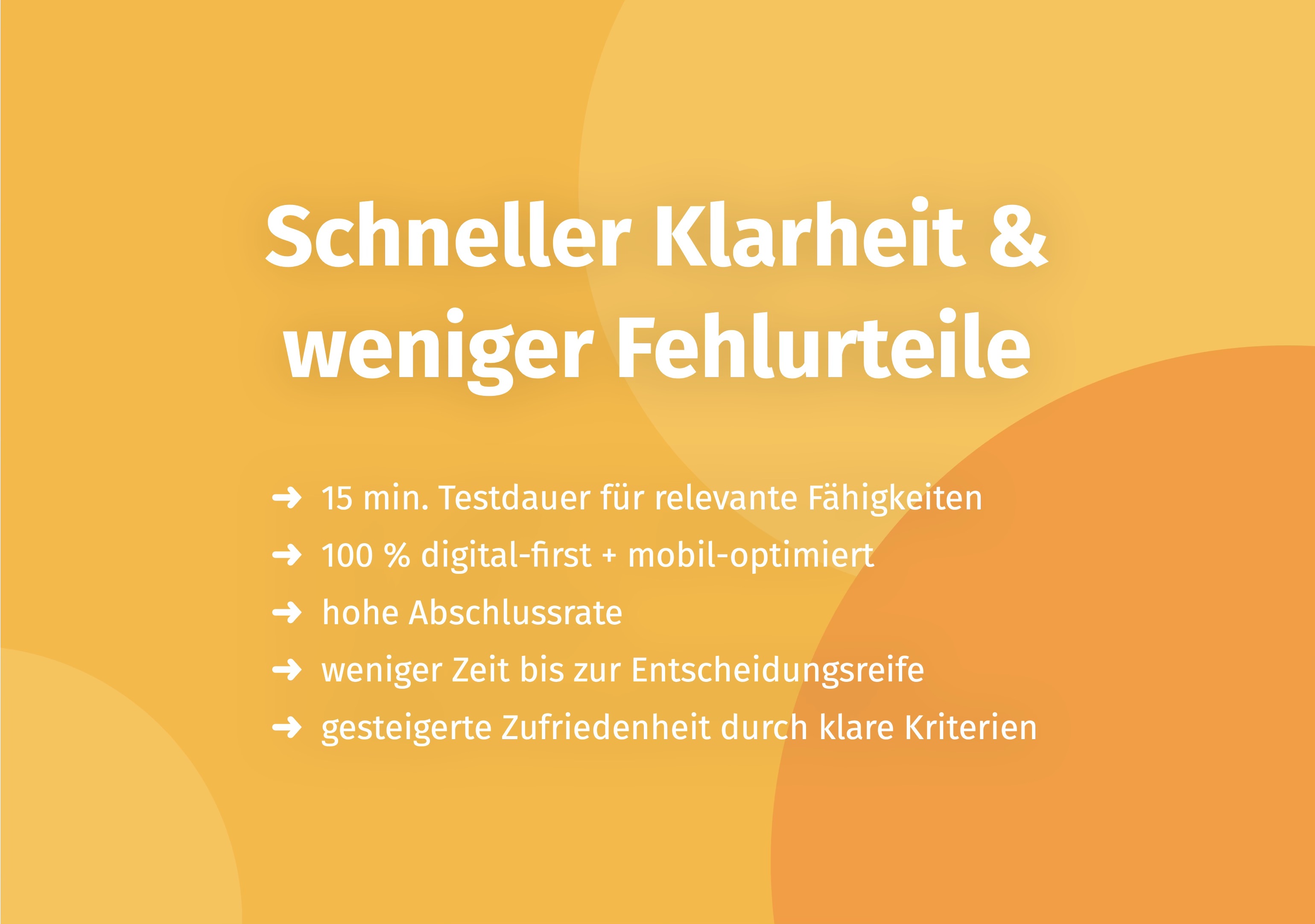
Game-Based Assessments are playful test procedures that measure cognitive abilities and personality traits through interactive tasks. Instead of filling out questionnaires, candidates solve short challenges – often on a smartphone.
It's not the game result that's evaluated, but the behavior during the game: reaction times, decision patterns, handling of uncertainty. This behavioral data is evaluated with psychometric models.
Benefits for Candidates and Companies
For candidates:
- Lower test anxiety due to playful character
- Modern, engaging experience
- Shorter completion time
- Mobile-friendly (smartphone)
For companies:
- Better candidate experience strengthens employer brand
- Higher completion rates in the assessment
- Objective, algorithm-based evaluation
- Less distortion from "socially desirable" answers
Scientific Foundation
Are Game-Based Assessments as meaningful as traditional tests? Research says: Yes. The aforementioned study by Lievens and Sackett (2017) showed that playful formats reduce test anxiety without compromising validity.
What's crucial is that Game-Based Assessments are also based on psychometric models and scientifically validated. Not every game is automatically a good assessment – it depends on the scientific development.
Case Study: How Companies Like Lufthansa and MCI Benefit
Practice shows: Companies that rely on scientifically validated aptitude diagnostics achieve measurable results.
Lufthansa uses Game-Based Assessments in candidate selection – with impressive results: 96% accuracy rate in correctly predicting suitability (compared to the internal assessment center), 81% satisfaction among applicants, and 100+ minutes saved in testing time per candidate. Susanne Berthold-Neumann from Lufthansa emphasizes: "We look at the documents late because they only show a small part of the person and say little about whether someone has the competencies for future challenges."
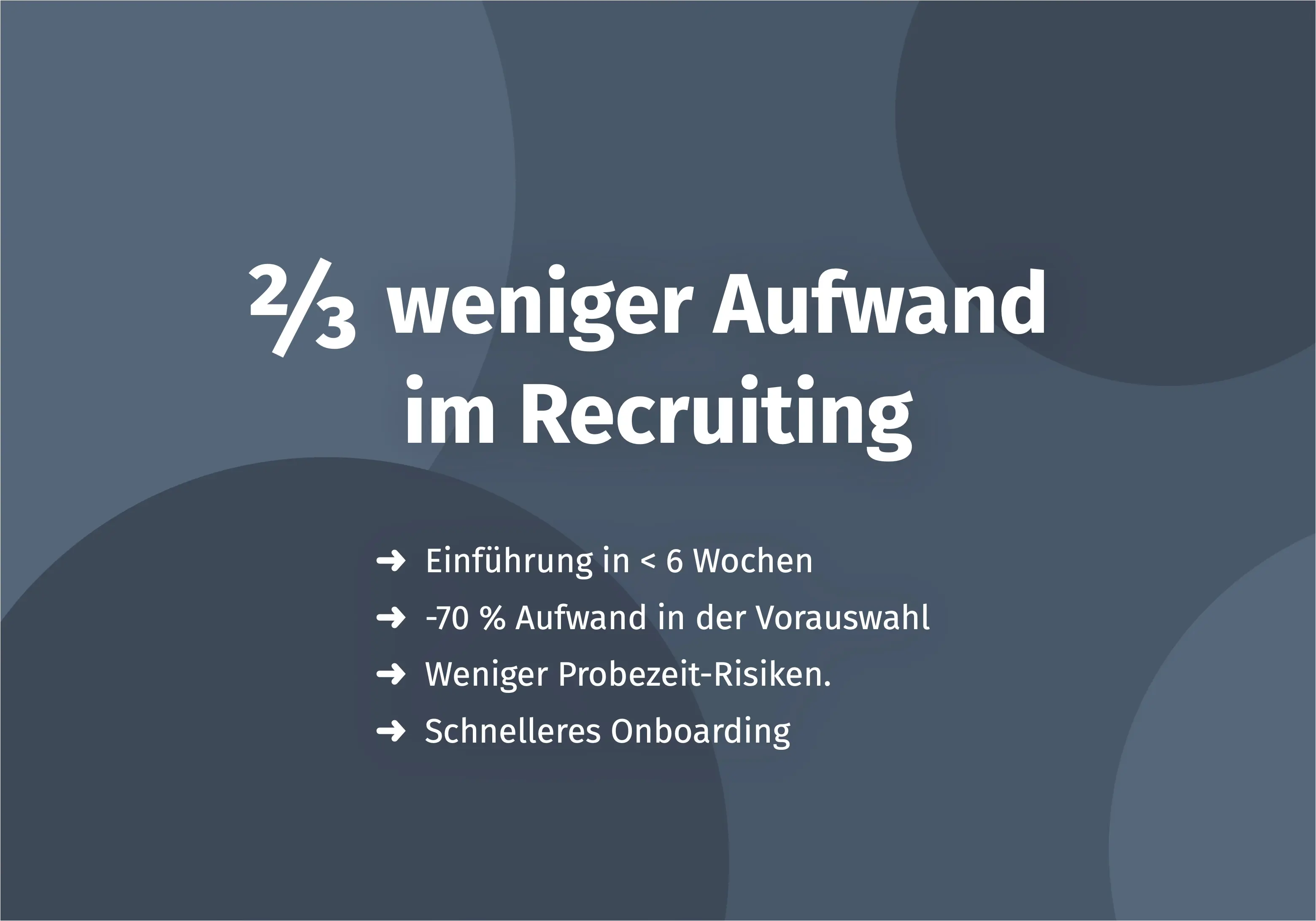
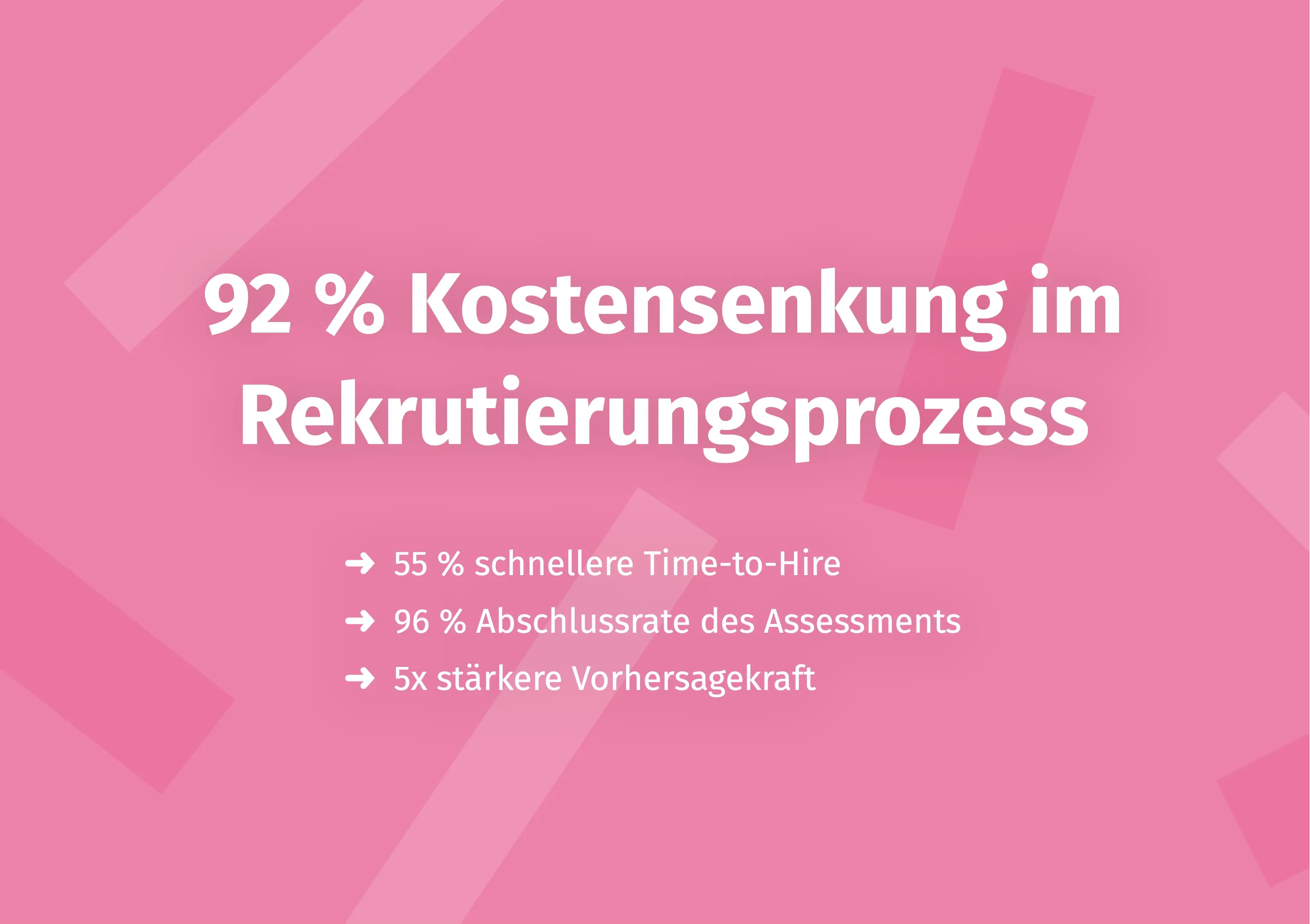
MCI Germany was able to reduce time-to-hire by 55% and cost-per-hire by 92% through the use of objective aptitude diagnostics – with a 96% completion rate in the assessment. Director People & Culture Matthias Kühne highlights the "more objective evaluation basis" that has "strongly professionalized" the process.
Success is also evident in trainee recruiting: Wolfgang Böhm, Training Manager at Diehl, reports: "We want to select talents with matching strengths and potential, instead of just judging by top grades. With Aivy, this works great – the results in the strengths profile match 1:1 with our experience in the personal interview!"
More details can be found in the Lufthansa success story and the MCI success story.
Common Mistakes with Pre-Employment Tests – And How to Avoid Them
Even good tests can fail if used incorrectly. Here are the most common mistakes – and how to avoid them.
Mistake 1: No Requirements Analysis
The problem: The test is used without first defining what should actually be measured. The result: The test measures characteristics that aren't even relevant for the position.
The solution: Conduct a systematic requirements analysis before selecting a test. This is the only way to ensure the test captures the right competencies.
Mistake 2: Using Non-Validated Tests
The problem: Self-made questionnaires or free online tests often have no scientific basis. The results are not meaningful.
The solution: Only use scientifically validated procedures, ideally DIN 33430-compliant. Ask the provider for validation studies.
Mistake 3: Ignoring Poor Candidate Experience
The problem: Lengthy, outdated tests deter good candidates. They abandon the process or develop a negative image of the company.
The solution: Pay attention to appealing test design. Communicate transparently about duration and purpose. Modern formats like Game-Based Assessments can significantly improve the candidate experience.
Mistake 4: Misinterpreting Results
The problem: Test results are taken as absolute truth or viewed in isolation from other information.
The solution: Use test results as one building block among several. Put them in relation to the requirements profile and other insights (interview, work sample). When uncertain: Ask follow-up questions in the interview.
Frequently Asked Questions (FAQ)
What is the difference between a pre-employment test and an assessment center?A pre-employment test is usually a single procedure (e.g., a cognitive test) lasting 30 minutes to a few hours. An assessment center combines multiple methods (tests, role plays, group exercises, interviews) over a longer period – often half a day to a full day.
Are pre-employment tests legally permissible?Yes, if they are job-related, standardized, and non-discriminatory. Scientifically validated tests generally meet these criteria. Self-developed tests without empirical validation pose a legal risk.
How can I avoid bias in pre-employment tests?Rely on scientifically validated, standardized procedures with algorithm-based evaluation. These assess competencies and potential – not names, photos, or likeability. Game-Based Assessments can additionally help as they measure potential rather than background.
How long should a pre-employment test take?This depends on the position. For a well-founded assessment, a cognitive test should last at least 20-30 minutes. Modern procedures manage to deliver meaningful results in 15-30 minutes. Longer tests (60+ minutes) often lead to dropouts.
Can candidates practice for pre-employment tests?In principle, yes – and this is legitimate. However: With well-constructed tests, practice leads to limited improvements. The tests measure abilities that cannot be trained in the short term. Game-Based Assessments are particularly hard to "practice for" as they capture spontaneous behavior.
How much does a professional pre-employment test cost?Costs vary widely – from a few euros per test to several hundred euros for comprehensive assessment packages. But consider: An avoided bad hire quickly saves 30,000 to 100,000 euros.
Can I use test results for employee development?Yes, many modern procedures provide strength profiles that are valuable even after hiring – e.g., for designing onboarding, for feedback conversations, or for assembling teams.
What does DIN 33430 mean?DIN 33430 is the German quality standard for job-related aptitude diagnostics. It defines standards for test procedures and the qualification of users. A DIN 33430-compliant test meets scientific quality standards.
Conclusion: Pre-Employment Tests as the Key to Better Hiring Decisions
Pre-employment tests are no cure-all – but they are an effective tool for objectifying hiring decisions and improving the quality of your selection. The key takeaways:
- Scientific foundation is a must: Only validated tests with proven quality deliver meaningful results.
- DIN 33430 provides guidance: The German quality standard is your compass for serious aptitude diagnostics.
- Requirements analysis is the foundation: First define what you want to measure before selecting a test.
- Modern formats improve candidate experience: Game-Based Assessments offer validity without exam atmosphere.
- Tests are one building block, not the whole decision: Combine test results with interviews and other insights.
Objective aptitude diagnostics tools like Aivy support you in recognizing potential, reducing bias, and making informed decisions. Scientifically validated procedures, developed as a spin-off from Freie Universität Berlin, make the difference.
Sources
- Schmidt, F. L., & Hunter, J. E. (1998). The Validity and Utility of Selection Methods in Personnel Psychology. Psychological Bulletin, 124(2), 262-274.
- Schmidt, F. L., Oh, I.-S., & Shaffer, J. A. (2016). The Validity and Utility of Selection Methods in Personnel Psychology: Practical and Theoretical Implications of 100 Years of Research Findings. Working Paper.
- Lievens, F., & Sackett, P. R. (2017). The Effects of Predictor Method Factors on Selection Outcomes: A Modular Approach to Personnel Selection Procedures. Journal of Applied Psychology, 102(1), 43-66.
- Bertrand, M., & Mullainathan, S. (2004). Are Emily and Greg More Employable Than Lakisha and Jamal? A Field Experiment on Labor Market Discrimination. American Economic Review, 94(4), 991-1013.
- Hausknecht, J. P., Day, D. V., & Thomas, S. C. (2004). Applicant Reactions to Selection Procedures: An Updated Model and Meta-Analysis. Personnel Psychology, 57(3), 639-683.
- DIN 33430:2016-07 – Requirements for Job-Related Aptitude Diagnostics. German Institute for Standardization.
Make a better pre-selection — even before the first interview
In just a few minutes, Aivy shows you which candidates really fit the role. Beyond resumes based on strengths.