You want to explore your strengths as a talent?

This way

Login

HR Controlling – Definition, Metrics & Best Practices

Home
-
Lexicon
-
HR Controlling – Definition, Metrics & Best Practices

HR Controlling is the systematic planning, management, and monitoring of all human resources processes and metrics. It provides data-driven decision-making foundations for strategic and operational HR topics such as personnel costs, recruiting efficiency, turnover, and employee retention. The goal is to make the value contribution of HR work measurable and position HR as a strategic partner in the organization.

What is HR Controlling? Definition and Differentiation

HR Controlling refers to the systematic collection, analysis, and management of all human resources processes based on key performance indicators. At its core, it's about making HR decisions based on solid data – rather than gut feeling. According to the German Society for Human Resource Management (DGFP), HR Controlling encompasses "the planning, management, and monitoring of HR measures to achieve organizational goals."

HR Controlling is more than just collecting numbers. It includes interpreting data, deriving action recommendations, and continuously optimizing HR processes. This involves both quantitative metrics (e.g., personnel costs, turnover rate) and qualitative factors (e.g., employee satisfaction, employer brand).

Differentiation: HR Controlling vs. Workforce Planning vs. People Analytics

Although these terms are often used synonymously, there are important differences:

Workforce Planning focuses on forecasting personnel needs. It answers questions like: How many employees will we need in 12 months? What skills will be required? HR Controlling uses this planning data and monitors its implementation.

People Analytics (or HR Analytics) is the data-analytical arm of human resources. It uses advanced analytical methods such as predictive models or machine learning to identify patterns and make forecasts. People Analytics can be a tool of HR Controlling but often goes beyond the classic control function.

HR Controlling is the framework that connects planning, controlling, and analytics. It ensures that HR measures are strategically aligned, efficiently implemented, and continuously improved.

Why is HR Controlling Important? 5 Key Benefits

The importance of HR Controlling has increased significantly in recent years. According to Deloitte's Human Capital Trends 2024, 78% of companies state that data-driven HR decisions are a high priority. The reasons are clear:

1. Transparency About Personnel Costs and Efficiency
Personnel costs account for 30-40% of total costs in many industries. HR Controlling shows where these costs arise, whether they're justified, and where optimization potential exists. The personnel cost ratio (share of personnel costs in total revenue) is a key metric for management.

2. Data-Driven Decisions Instead of Gut Feeling
HR professionals can argue with solid data: Should we invest in employer branding? Is a new recruiting software worthwhile? HR Controlling provides the facts to answer these questions.

3. ROI Proof for HR Measures
Management wants to know: What does HR bring to the organization? HR Controlling quantifies the value contribution of HR measures. Example: An investment in employee retention reduces turnover by 15%, saving €200,000 per year.

4. Strategic Positioning of HR
HR evolves from an administrative cost center to a strategic partner. Those who speak in numbers are heard – HR Controlling makes HR a business partner on equal footing with sales, finance, and production.

5. Early Warning System for HR Risks
Suddenly rising turnover rates, declining employee satisfaction, or high sick leave – HR Controlling identifies such problems early before they escalate.

Strategic vs. Operational HR Controlling: The Difference

HR Controlling can be divided into two levels with different time horizons and objectives:

Strategic HR Controlling: Long-term and Future-oriented

Strategic HR Controlling aligns with long-term organizational goals. It answers questions like: What skills will we need in 3-5 years? How do we ensure our competitiveness through the right personnel structure? It works with scenarios, forecasts, and strategic metrics.

Typical Topics:

  • Workforce planning
  • Skill gap analyses
  • Succession planning
  • Diversity & Inclusion metrics
  • Employer branding ROI

Audience: C-level, HR leadership, strategy department

Time Horizon: 3-5 years

Operational HR Controlling: Short-term and Past-oriented

Operational HR Controlling focuses on daily management and monitoring of HR processes. It provides answers to questions like: What's the current sick leave rate? Did we stay within the recruiting budget? It primarily uses past-oriented metrics for efficiency management.

Typical Topics:

  • Sick leave, absenteeism
  • Overtime, time tracking
  • Recruiting budget (cost-per-hire)
  • Personnel cost monitoring
  • Turnover rate (short-term)

Audience: HR managers, team leaders, HR specialists

Time Horizon: Monthly to quarterly

Comparison Table: Strategic vs. Operational

Criterion Strategic HR Controlling Operational HR Controlling
Time Horizon Long-term (3-5 years) Short-term (month/quarter)
Orientation Future-oriented Past-oriented
Metrics Qualitative & quantitative Primarily quantitative
Goal Strategic decisions Efficiency management
Examples Skill gap analysis, succession planning Sick leave, overtime
Audience C-level, HR leadership HR managers, team leaders

In practice, both levels should work hand in hand: Strategic goals are monitored and implemented through operational controlling.

The Most Important Metrics in HR Controlling

HR Controlling thrives on key performance indicators (KPIs). But which ones are truly relevant? The answer depends on company size, industry, and strategic priorities. Nevertheless, there are some standard metrics that make sense in almost every organization:

Personnel Cost Metrics: Personnel Cost Ratio, Cost per Employee

Personnel Cost Ratio = (Personnel Costs / Total Revenue) × 100

The personnel cost ratio shows what percentage of revenue is spent on personnel. Benchmark: In knowledge-intensive industries (IT, consulting), 40-50% is normal; in manufacturing, more like 20-30%.

Personnel Costs per Employee = Total Personnel Costs / Number of Employees

This metric shows the average cost per head. It's useful for budget planning and benchmarking with other companies.

Best Practice Tip: Personnel costs should not be viewed in isolation but in relation to productivity (e.g., revenue per employee).

Recruiting Metrics: Time-to-Hire, Cost-per-Hire, Quality-of-Hire

Time-to-Hire = Average time between job posting and contract signing

This metric measures the speed of the recruiting process. According to Bitkom, the benchmark in Germany is 50-60 days. An excessively long time-to-hire leads to lost candidates and higher costs.

Cost-per-Hire = (Internal Recruiting Costs + External Recruiting Costs) / Number of New Hires

Example: A company has internal costs of €50,000 (recruiting team personnel costs, software) and external costs of €30,000 (job ads, headhunters). With 20 new hires:
Cost-per-Hire = (€50,000 + €30,000) / 20 = €4,000 per hire

Quality-of-Hire = Quality of new hires (measured by performance, retention, cultural fit)

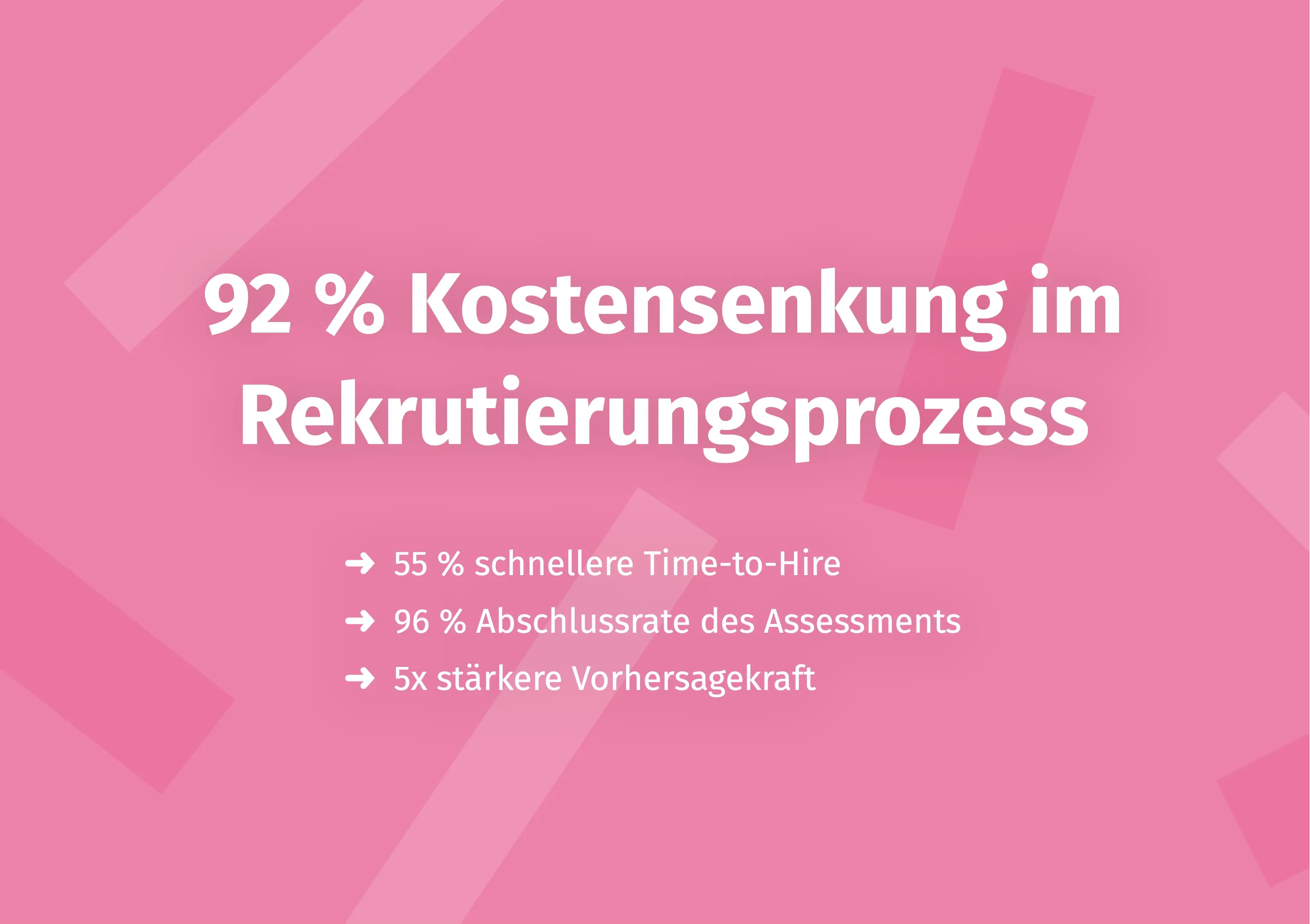
This metric is difficult to measure but central to sustainable recruiting success. A high turnover rate among new hires indicates low quality-of-hire. Objective talent assessment can help here: Companies like MCI were able to reduce time-to-hire by 55% while simultaneously improving selection quality through scientifically validated assessments.

Best Practice Tip: The digital platform Aivy enables objective measurement of quality-of-hire by using scientifically validated game-based assessments. These reduce unconscious bias and increase accuracy in personnel selection.

Turnover & Retention: Turnover Rate, Retention Rate, Early Turnover

Turnover Rate = (Number of Departures per Year / Average Number of Employees) × 100

The turnover rate shows how many employees leave the organization. Benchmark: In Germany, the average turnover rate is 10-15%; in the IT industry often higher (20-30%).

Retention Rate = (Number of Employees at Year End / Number of Employees at Year Start) × 100

The retention rate is the counterpart to turnover and shows how well the organization succeeds in retaining employees.

Early Turnover = Proportion of employees who leave during the probation period (usually 6 months)

High early turnover indicates problems in the recruiting process or onboarding.

Productivity Metrics: Revenue per Employee, Absenteeism Rate

Revenue per Employee = Total Revenue / Number of Employees

This metric measures organizational productivity. It varies greatly by industry: In consulting, it can be €200,000+; in manufacturing, significantly lower.

Absenteeism Rate = (Sick Days / Total Working Days) × 100

The absenteeism rate shows how many working days are lost to illness. Benchmark: In Germany, it's 4-5% (approximately 10-12 sick days per year). A high absenteeism rate may indicate overwork, poor work climate, or health issues.

Employee Experience: Employee Satisfaction, eNPS

eNPS (Employee Net Promoter Score) = Percentage of Promoters - Percentage of Detractors

The eNPS is based on the question: "Would you recommend us as an employer?" (scale 0-10). Responses 9-10 = Promoters, 7-8 = Passive, 0-6 = Detractors. An eNPS above +20 is considered good, above +50 as excellent.

Employee Satisfaction is often measured through regular surveys (e.g., quarterly pulse surveys). It correlates strongly with productivity and retention.

HR Controlling in Practice: Implementation in 5 Steps

HR Controlling sounds complex – but getting started is easier than you think. Here are five proven steps for implementation:

Step 1: Define Goals

Question: What do we want to achieve with HR Controlling?

Before collecting metrics, you need to know what for. Possible goals:

  • Create transparency about personnel costs
  • Make recruiting processes more efficient
  • Reduce turnover
  • Increase employee satisfaction
  • Prove ROI of HR measures

Best Practice Tip: Start with 1-2 concrete goals. Too many goals at once lead to overwhelm and data chaos.

Step 2: Select Relevant Metrics

Question: Which metrics best measure our goals?

Choose 5-10 starting metrics that directly contribute to your goals. Example:

  • Goal "More efficient recruiting" → Metrics: Time-to-Hire, Cost-per-Hire, Quality-of-Hire
  • Goal "Reduce turnover" → Metrics: Turnover Rate, Retention Rate, eNPS

Avoid Mistakes: Too many metrics lead to "analysis paralysis." Focus on what matters.

Step 3: Identify Data Sources and Ensure Data Quality

Question: Where does our data come from?

Typical data sources:

  • HR software (e.g., Personio, HiBob)
  • Time tracking
  • Payroll
  • Applicant tracking system (ATS)
  • Employee surveys

Critical: Data quality is crucial! Garbage-in-garbage-out. Ensure data is current, complete, and correctly captured.

Step 4: Implement Software/Tools

Question: Which software supports us?

There are three categories:

  1. All-in-One HR Systems with integrated controlling (e.g., Personio, HiBob, Workday)
  2. Specialized People Analytics Tools (e.g., Visier, Orgvue)
  3. BI Tools for HR (e.g., Power BI, Tableau) – flexible but technically more demanding

Best Practice Tip: Start with what you have. Many HR systems already offer standard reports. Use these before investing in expensive specialized tools.

Step 5: Establish Reporting Routine

Question: How often and for whom do we report?

Establish fixed reporting cycles:

  • Operational: Monthly (e.g., sick leave, overtime)
  • Strategic: Quarterly (e.g., turnover rate, eNPS)
  • C-Level: Annually (e.g., personnel cost ratio, ROI of HR measures)

Best Practice Tip: Visualize data! A clear dashboard is better than 20-page Excel spreadsheets. Use charts, trend lines, and traffic light logic (green/yellow/red).

Software & Tools for HR Controlling: 5 Leading Solutions

The right software can greatly facilitate HR Controlling. Here's an overview of the main categories:

All-in-One HR Systems: Personio, HiBob, Workday

Personio (for SMEs, 10-2,000 employees)
Integrated HR platform with standard reports on sick leave, turnover, recruiting metrics. Advantage: All-in-one solution. Disadvantage: Individual analyses limited.

HiBob (for mid-sized companies, 50-1,000 employees)
People analytics module with customizable dashboards. Focus on employee experience. Advantage: Modern UX, flexible. Disadvantage: More expensive than Personio.

Workday (for large enterprises, 1,000+ employees)
Enterprise solution with comprehensive analytics functions. Advantage: Highly scalable. Disadvantage: Complex, long implementation, high costs.

Specialized People Analytics Tools: Orgvue, Visier, SAP SuccessFactors

Orgvue – Focus on organizational design and workforce planning
Visier – Cloud-based people analytics with predictive models
SAP SuccessFactors – Part of SAP suite, for large companies with complex HR structures

Advantage: Deep analyses, predictive models. Disadvantage: High costs, requires data expertise.

BI Tools for HR: Power BI, Tableau, Qlik Sense

Power BI (Microsoft) – Flexible business intelligence tool, integrated with Microsoft 365
Tableau – Visualization tool for complex data analyses
Qlik Sense – Self-service BI with AI-supported insights

Advantage: Maximum flexibility, individual dashboards. Disadvantage: Requires technical know-how, no HR-specific functions out-of-the-box.

What to Consider When Selecting Software?

Checklist:

  • Company Size: Does the solution fit our size?
  • Budget: Cost vs. benefit realistic?
  • Data Sources: Which systems need to be integrated?
  • User-Friendliness: Can the HR team use the software without IT support?
  • Scalability: Does the solution grow with our company?
  • Data Privacy: Is the solution GDPR-compliant?

Best Practice Tip: Start with a free trial or demo. Most providers offer 14-30 day trial versions.

Frequently Asked Questions About HR Controlling

What is meant by HR Controlling?

HR Controlling is the systematic planning, management, and monitoring of all human resources processes based on key performance indicators. It includes the collection, analysis, and management of HR metrics such as personnel costs, recruiting efficiency, and employee retention. The goal is to create transparency about personnel costs and HR efficiency and provide data-driven decision-making foundations for HR and management.

What is the difference between strategic and operational HR Controlling?

Strategic HR Controlling is long-term and future-oriented. It focuses on topics like workforce planning, skill gap analyses, and succession planning. The time horizon is 3-5 years. Operational HR Controlling is short-term and past-oriented. It monitors metrics like sick leave, overtime, and recruiting budget on a monthly or quarterly basis. Strategic controlling is directed at management, operational controlling at HR managers and team leaders.

Which metrics are most important in HR Controlling?

The most important metrics are: Personnel Costs (personnel cost ratio, cost per employee), Recruiting (time-to-hire, cost-per-hire, quality-of-hire), Turnover (turnover rate, retention rate), Productivity (revenue per employee, absenteeism rate), and Employee Experience (employee satisfaction, eNPS). The selection depends on strategic priorities and industry.

How do you calculate Cost-per-Hire?

The formula is: Cost-per-Hire = (Internal Recruiting Costs + External Recruiting Costs) / Number of New Hires. Internal costs include recruiting team personnel costs, software costs, and internal assessments. External costs include job ads, headhunters, and recruiting events. Example: (€50,000 + €30,000) / 20 hires = €4,000 per hire.

How do you implement HR Controlling in an organization?

Implementation follows 5 steps: Step 1: Define goals (What do we want to measure and why?). Step 2: Select relevant metrics (5-10 starting metrics). Step 3: Identify data sources (HR software, time tracking, etc.). Step 4: Implement software/tools (HR analytics dashboard). Step 5: Establish reporting routine (monthly/quarterly). Start with few metrics and gradually build the system.

Which software is suitable for HR Controlling?

There are three categories: All-in-One HR Systems like Personio, HiBob, or Workday with integrated analytics functions. Specialized People Analytics Tools like Orgvue, Visier, or SAP SuccessFactors for in-depth analyses. BI Tools for HR like Power BI, Tableau, or Qlik Sense, which are flexible and individually customizable. The selection depends on company size, budget, data sources, and integration needs.

Why is HR Controlling important?

HR Controlling creates transparency about personnel costs and HR efficiency, enables data-driven decisions instead of gut feeling, and provides ROI proof for HR measures. It positions HR strategically as a management partner and serves as an early warning system to identify problems like high turnover in time. In times of skills shortage and increasing cost pressure, HR Controlling is indispensable.

What are typical mistakes in HR Controlling?

Common mistakes include: Capturing too many metrics, leading to data chaos and loss of focus. Using poor data foundation (garbage-in-garbage-out due to bad data quality). No action derivation – collecting metrics but not learning from them. Lack of acceptance from leadership because they're not involved. Only looking backward with too little focus on predictive analytics.

Conclusion: HR Controlling as a Strategic Success Factor

HR Controlling is not an end in itself but a strategic tool to make HR work measurable, efficient, and value-creating. In times of skills shortage, increasing cost pressure, and advancing digitalization, it becomes indispensable for companies of all sizes.

The most important success factors: Start with clear goals, choose few but relevant metrics, ensure data quality, and establish fixed reporting routines. Use software that fits your organization – whether all-in-one solution or specialized analytics tool. And above all: Derive concrete actions from the data. HR Controlling is not dashboard monitoring but continuous optimization.

A special focus should be on recruiting metrics, as this is often where long-term success is determined. The quality of new hires (quality-of-hire) is at least as important as speed (time-to-hire). Objective talent assessment, as offered by the digital platform Aivy, can make a decisive contribution here: Through scientifically validated assessments, unconscious bias is reduced and accuracy is increased – measurably and provably for your HR Controlling.

Want to objectively measure recruiting metrics and sustainably improve quality-of-hire? Learn more about Aivy's scientific talent assessment.

Sources

Home
-
lexicon
-
HR Controlling – Definition, Metrics & Best Practices

HR Controlling is the systematic planning, management, and monitoring of all human resources processes and metrics. It provides data-driven decision-making foundations for strategic and operational HR topics such as personnel costs, recruiting efficiency, turnover, and employee retention. The goal is to make the value contribution of HR work measurable and position HR as a strategic partner in the organization.

What is HR Controlling? Definition and Differentiation

HR Controlling refers to the systematic collection, analysis, and management of all human resources processes based on key performance indicators. At its core, it's about making HR decisions based on solid data – rather than gut feeling. According to the German Society for Human Resource Management (DGFP), HR Controlling encompasses "the planning, management, and monitoring of HR measures to achieve organizational goals."

HR Controlling is more than just collecting numbers. It includes interpreting data, deriving action recommendations, and continuously optimizing HR processes. This involves both quantitative metrics (e.g., personnel costs, turnover rate) and qualitative factors (e.g., employee satisfaction, employer brand).

Differentiation: HR Controlling vs. Workforce Planning vs. People Analytics

Although these terms are often used synonymously, there are important differences:

Workforce Planning focuses on forecasting personnel needs. It answers questions like: How many employees will we need in 12 months? What skills will be required? HR Controlling uses this planning data and monitors its implementation.

People Analytics (or HR Analytics) is the data-analytical arm of human resources. It uses advanced analytical methods such as predictive models or machine learning to identify patterns and make forecasts. People Analytics can be a tool of HR Controlling but often goes beyond the classic control function.

HR Controlling is the framework that connects planning, controlling, and analytics. It ensures that HR measures are strategically aligned, efficiently implemented, and continuously improved.

Why is HR Controlling Important? 5 Key Benefits

The importance of HR Controlling has increased significantly in recent years. According to Deloitte's Human Capital Trends 2024, 78% of companies state that data-driven HR decisions are a high priority. The reasons are clear:

1. Transparency About Personnel Costs and Efficiency
Personnel costs account for 30-40% of total costs in many industries. HR Controlling shows where these costs arise, whether they're justified, and where optimization potential exists. The personnel cost ratio (share of personnel costs in total revenue) is a key metric for management.

2. Data-Driven Decisions Instead of Gut Feeling
HR professionals can argue with solid data: Should we invest in employer branding? Is a new recruiting software worthwhile? HR Controlling provides the facts to answer these questions.

3. ROI Proof for HR Measures
Management wants to know: What does HR bring to the organization? HR Controlling quantifies the value contribution of HR measures. Example: An investment in employee retention reduces turnover by 15%, saving €200,000 per year.

4. Strategic Positioning of HR
HR evolves from an administrative cost center to a strategic partner. Those who speak in numbers are heard – HR Controlling makes HR a business partner on equal footing with sales, finance, and production.

5. Early Warning System for HR Risks
Suddenly rising turnover rates, declining employee satisfaction, or high sick leave – HR Controlling identifies such problems early before they escalate.

Strategic vs. Operational HR Controlling: The Difference

HR Controlling can be divided into two levels with different time horizons and objectives:

Strategic HR Controlling: Long-term and Future-oriented

Strategic HR Controlling aligns with long-term organizational goals. It answers questions like: What skills will we need in 3-5 years? How do we ensure our competitiveness through the right personnel structure? It works with scenarios, forecasts, and strategic metrics.

Typical Topics:

  • Workforce planning
  • Skill gap analyses
  • Succession planning
  • Diversity & Inclusion metrics
  • Employer branding ROI

Audience: C-level, HR leadership, strategy department

Time Horizon: 3-5 years

Operational HR Controlling: Short-term and Past-oriented

Operational HR Controlling focuses on daily management and monitoring of HR processes. It provides answers to questions like: What's the current sick leave rate? Did we stay within the recruiting budget? It primarily uses past-oriented metrics for efficiency management.

Typical Topics:

  • Sick leave, absenteeism
  • Overtime, time tracking
  • Recruiting budget (cost-per-hire)
  • Personnel cost monitoring
  • Turnover rate (short-term)

Audience: HR managers, team leaders, HR specialists

Time Horizon: Monthly to quarterly

Comparison Table: Strategic vs. Operational

Criterion Strategic HR Controlling Operational HR Controlling
Time Horizon Long-term (3-5 years) Short-term (month/quarter)
Orientation Future-oriented Past-oriented
Metrics Qualitative & quantitative Primarily quantitative
Goal Strategic decisions Efficiency management
Examples Skill gap analysis, succession planning Sick leave, overtime
Audience C-level, HR leadership HR managers, team leaders

In practice, both levels should work hand in hand: Strategic goals are monitored and implemented through operational controlling.

The Most Important Metrics in HR Controlling

HR Controlling thrives on key performance indicators (KPIs). But which ones are truly relevant? The answer depends on company size, industry, and strategic priorities. Nevertheless, there are some standard metrics that make sense in almost every organization:

Personnel Cost Metrics: Personnel Cost Ratio, Cost per Employee

Personnel Cost Ratio = (Personnel Costs / Total Revenue) × 100

The personnel cost ratio shows what percentage of revenue is spent on personnel. Benchmark: In knowledge-intensive industries (IT, consulting), 40-50% is normal; in manufacturing, more like 20-30%.

Personnel Costs per Employee = Total Personnel Costs / Number of Employees

This metric shows the average cost per head. It's useful for budget planning and benchmarking with other companies.

Best Practice Tip: Personnel costs should not be viewed in isolation but in relation to productivity (e.g., revenue per employee).

Recruiting Metrics: Time-to-Hire, Cost-per-Hire, Quality-of-Hire

Time-to-Hire = Average time between job posting and contract signing

This metric measures the speed of the recruiting process. According to Bitkom, the benchmark in Germany is 50-60 days. An excessively long time-to-hire leads to lost candidates and higher costs.

Cost-per-Hire = (Internal Recruiting Costs + External Recruiting Costs) / Number of New Hires

Example: A company has internal costs of €50,000 (recruiting team personnel costs, software) and external costs of €30,000 (job ads, headhunters). With 20 new hires:
Cost-per-Hire = (€50,000 + €30,000) / 20 = €4,000 per hire

Quality-of-Hire = Quality of new hires (measured by performance, retention, cultural fit)

This metric is difficult to measure but central to sustainable recruiting success. A high turnover rate among new hires indicates low quality-of-hire. Objective talent assessment can help here: Companies like MCI were able to reduce time-to-hire by 55% while simultaneously improving selection quality through scientifically validated assessments.

Best Practice Tip: The digital platform Aivy enables objective measurement of quality-of-hire by using scientifically validated game-based assessments. These reduce unconscious bias and increase accuracy in personnel selection.

Turnover & Retention: Turnover Rate, Retention Rate, Early Turnover

Turnover Rate = (Number of Departures per Year / Average Number of Employees) × 100

The turnover rate shows how many employees leave the organization. Benchmark: In Germany, the average turnover rate is 10-15%; in the IT industry often higher (20-30%).

Retention Rate = (Number of Employees at Year End / Number of Employees at Year Start) × 100

The retention rate is the counterpart to turnover and shows how well the organization succeeds in retaining employees.

Early Turnover = Proportion of employees who leave during the probation period (usually 6 months)

High early turnover indicates problems in the recruiting process or onboarding.

Productivity Metrics: Revenue per Employee, Absenteeism Rate

Revenue per Employee = Total Revenue / Number of Employees

This metric measures organizational productivity. It varies greatly by industry: In consulting, it can be €200,000+; in manufacturing, significantly lower.

Absenteeism Rate = (Sick Days / Total Working Days) × 100

The absenteeism rate shows how many working days are lost to illness. Benchmark: In Germany, it's 4-5% (approximately 10-12 sick days per year). A high absenteeism rate may indicate overwork, poor work climate, or health issues.

Employee Experience: Employee Satisfaction, eNPS

eNPS (Employee Net Promoter Score) = Percentage of Promoters - Percentage of Detractors

The eNPS is based on the question: "Would you recommend us as an employer?" (scale 0-10). Responses 9-10 = Promoters, 7-8 = Passive, 0-6 = Detractors. An eNPS above +20 is considered good, above +50 as excellent.

Employee Satisfaction is often measured through regular surveys (e.g., quarterly pulse surveys). It correlates strongly with productivity and retention.

HR Controlling in Practice: Implementation in 5 Steps

HR Controlling sounds complex – but getting started is easier than you think. Here are five proven steps for implementation:

Step 1: Define Goals

Question: What do we want to achieve with HR Controlling?

Before collecting metrics, you need to know what for. Possible goals:

  • Create transparency about personnel costs
  • Make recruiting processes more efficient
  • Reduce turnover
  • Increase employee satisfaction
  • Prove ROI of HR measures

Best Practice Tip: Start with 1-2 concrete goals. Too many goals at once lead to overwhelm and data chaos.

Step 2: Select Relevant Metrics

Question: Which metrics best measure our goals?

Choose 5-10 starting metrics that directly contribute to your goals. Example:

  • Goal "More efficient recruiting" → Metrics: Time-to-Hire, Cost-per-Hire, Quality-of-Hire
  • Goal "Reduce turnover" → Metrics: Turnover Rate, Retention Rate, eNPS

Avoid Mistakes: Too many metrics lead to "analysis paralysis." Focus on what matters.

Step 3: Identify Data Sources and Ensure Data Quality

Question: Where does our data come from?

Typical data sources:

  • HR software (e.g., Personio, HiBob)
  • Time tracking
  • Payroll
  • Applicant tracking system (ATS)
  • Employee surveys

Critical: Data quality is crucial! Garbage-in-garbage-out. Ensure data is current, complete, and correctly captured.

Step 4: Implement Software/Tools

Question: Which software supports us?

There are three categories:

  1. All-in-One HR Systems with integrated controlling (e.g., Personio, HiBob, Workday)
  2. Specialized People Analytics Tools (e.g., Visier, Orgvue)
  3. BI Tools for HR (e.g., Power BI, Tableau) – flexible but technically more demanding

Best Practice Tip: Start with what you have. Many HR systems already offer standard reports. Use these before investing in expensive specialized tools.

Step 5: Establish Reporting Routine

Question: How often and for whom do we report?

Establish fixed reporting cycles:

  • Operational: Monthly (e.g., sick leave, overtime)
  • Strategic: Quarterly (e.g., turnover rate, eNPS)
  • C-Level: Annually (e.g., personnel cost ratio, ROI of HR measures)

Best Practice Tip: Visualize data! A clear dashboard is better than 20-page Excel spreadsheets. Use charts, trend lines, and traffic light logic (green/yellow/red).

Software & Tools for HR Controlling: 5 Leading Solutions

The right software can greatly facilitate HR Controlling. Here's an overview of the main categories:

All-in-One HR Systems: Personio, HiBob, Workday

Personio (for SMEs, 10-2,000 employees)
Integrated HR platform with standard reports on sick leave, turnover, recruiting metrics. Advantage: All-in-one solution. Disadvantage: Individual analyses limited.

HiBob (for mid-sized companies, 50-1,000 employees)
People analytics module with customizable dashboards. Focus on employee experience. Advantage: Modern UX, flexible. Disadvantage: More expensive than Personio.

Workday (for large enterprises, 1,000+ employees)
Enterprise solution with comprehensive analytics functions. Advantage: Highly scalable. Disadvantage: Complex, long implementation, high costs.

Specialized People Analytics Tools: Orgvue, Visier, SAP SuccessFactors

Orgvue – Focus on organizational design and workforce planning
Visier – Cloud-based people analytics with predictive models
SAP SuccessFactors – Part of SAP suite, for large companies with complex HR structures

Advantage: Deep analyses, predictive models. Disadvantage: High costs, requires data expertise.

BI Tools for HR: Power BI, Tableau, Qlik Sense

Power BI (Microsoft) – Flexible business intelligence tool, integrated with Microsoft 365
Tableau – Visualization tool for complex data analyses
Qlik Sense – Self-service BI with AI-supported insights

Advantage: Maximum flexibility, individual dashboards. Disadvantage: Requires technical know-how, no HR-specific functions out-of-the-box.

What to Consider When Selecting Software?

Checklist:

  • Company Size: Does the solution fit our size?
  • Budget: Cost vs. benefit realistic?
  • Data Sources: Which systems need to be integrated?
  • User-Friendliness: Can the HR team use the software without IT support?
  • Scalability: Does the solution grow with our company?
  • Data Privacy: Is the solution GDPR-compliant?

Best Practice Tip: Start with a free trial or demo. Most providers offer 14-30 day trial versions.

Frequently Asked Questions About HR Controlling

What is meant by HR Controlling?

HR Controlling is the systematic planning, management, and monitoring of all human resources processes based on key performance indicators. It includes the collection, analysis, and management of HR metrics such as personnel costs, recruiting efficiency, and employee retention. The goal is to create transparency about personnel costs and HR efficiency and provide data-driven decision-making foundations for HR and management.

What is the difference between strategic and operational HR Controlling?

Strategic HR Controlling is long-term and future-oriented. It focuses on topics like workforce planning, skill gap analyses, and succession planning. The time horizon is 3-5 years. Operational HR Controlling is short-term and past-oriented. It monitors metrics like sick leave, overtime, and recruiting budget on a monthly or quarterly basis. Strategic controlling is directed at management, operational controlling at HR managers and team leaders.

Which metrics are most important in HR Controlling?

The most important metrics are: Personnel Costs (personnel cost ratio, cost per employee), Recruiting (time-to-hire, cost-per-hire, quality-of-hire), Turnover (turnover rate, retention rate), Productivity (revenue per employee, absenteeism rate), and Employee Experience (employee satisfaction, eNPS). The selection depends on strategic priorities and industry.

How do you calculate Cost-per-Hire?

The formula is: Cost-per-Hire = (Internal Recruiting Costs + External Recruiting Costs) / Number of New Hires. Internal costs include recruiting team personnel costs, software costs, and internal assessments. External costs include job ads, headhunters, and recruiting events. Example: (€50,000 + €30,000) / 20 hires = €4,000 per hire.

How do you implement HR Controlling in an organization?

Implementation follows 5 steps: Step 1: Define goals (What do we want to measure and why?). Step 2: Select relevant metrics (5-10 starting metrics). Step 3: Identify data sources (HR software, time tracking, etc.). Step 4: Implement software/tools (HR analytics dashboard). Step 5: Establish reporting routine (monthly/quarterly). Start with few metrics and gradually build the system.

Which software is suitable for HR Controlling?

There are three categories: All-in-One HR Systems like Personio, HiBob, or Workday with integrated analytics functions. Specialized People Analytics Tools like Orgvue, Visier, or SAP SuccessFactors for in-depth analyses. BI Tools for HR like Power BI, Tableau, or Qlik Sense, which are flexible and individually customizable. The selection depends on company size, budget, data sources, and integration needs.

Why is HR Controlling important?

HR Controlling creates transparency about personnel costs and HR efficiency, enables data-driven decisions instead of gut feeling, and provides ROI proof for HR measures. It positions HR strategically as a management partner and serves as an early warning system to identify problems like high turnover in time. In times of skills shortage and increasing cost pressure, HR Controlling is indispensable.

What are typical mistakes in HR Controlling?

Common mistakes include: Capturing too many metrics, leading to data chaos and loss of focus. Using poor data foundation (garbage-in-garbage-out due to bad data quality). No action derivation – collecting metrics but not learning from them. Lack of acceptance from leadership because they're not involved. Only looking backward with too little focus on predictive analytics.

Conclusion: HR Controlling as a Strategic Success Factor

HR Controlling is not an end in itself but a strategic tool to make HR work measurable, efficient, and value-creating. In times of skills shortage, increasing cost pressure, and advancing digitalization, it becomes indispensable for companies of all sizes.

The most important success factors: Start with clear goals, choose few but relevant metrics, ensure data quality, and establish fixed reporting routines. Use software that fits your organization – whether all-in-one solution or specialized analytics tool. And above all: Derive concrete actions from the data. HR Controlling is not dashboard monitoring but continuous optimization.

A special focus should be on recruiting metrics, as this is often where long-term success is determined. The quality of new hires (quality-of-hire) is at least as important as speed (time-to-hire). Objective talent assessment, as offered by the digital platform Aivy, can make a decisive contribution here: Through scientifically validated assessments, unconscious bias is reduced and accuracy is increased – measurably and provably for your HR Controlling.

Want to objectively measure recruiting metrics and sustainably improve quality-of-hire? Learn more about Aivy's scientific talent assessment.

Sources

Heading 1

Heading 2

Heading 3

Heading 4

Heading 5
Heading 6

Lorem ipsum dolor sit amet, consectetur adipiscing elit, sed do eiusmod tempor incididunt ut laboratories et dolore magna aliqua. Ut Enim ad Minim Veniam, Quis Nostrud Exercitation Ullamco Laboris Nisi ut Aliquip ex ea Commodo Consequat. Duis aute irure dolor in reprehenderite in voluptate velit eat cillum dolore eu fugiate nulla pariature.

Block quote

Ordered list

  1. Item 1
  2. Item 2
  3. Item 3

Unordered list

  • Item A
  • Item B
  • Item C

Text link

Bold text

Emphasis

Superscript

Subscript

Heading 1

Heading 2

Heading 3

Heading 4

Heading 5
Heading 6

Lorem ipsum dolor sit amet, consectetur adipiscing elit, sed do eiusmod tempor incididunt ut laboratories et dolore magna aliqua. Ut Enim ad Minim Veniam, Quis Nostrud Exercitation Ullamco Laboris Nisi ut Aliquip ex ea Commodo Consequat. Duis aute irure dolor in reprehenderite in voluptate velit eat cillum dolore eu fugiate nulla pariature.

Block quote

Ordered list

  1. Item 1
  2. Item 2
  3. Item 3

Unordered list

  • Item A
  • Item B
  • Item C

Text link

Bold text

Emphasis

Superscript

Subscript

Florian Dyballa

CEO, Co-Founder

About Florian

  • Founder & CEO of Aivy — develops innovative ways of personnel diagnostics and is one of the top 10 HR tech founders in Germany (business punk)
  • More than 500,000 digital aptitude tests successfully used by more than 100 companies such as Lufthansa, Würth and Hermes
  • Three times honored with the HR Innovation Award and regularly featured in leading business media (WirtschaftsWoche, Handelsblatt and FAZ)
  • As a business psychologist and digital expert, combines well-founded tests with AI for fair opportunities in personnel selection
  • Shares expertise as a sought-after thought leader in the HR tech industry — in podcasts, media, and at key industry events
  • Actively shapes the future of the working world — by combining science and technology for better and fairer personnel decisions
success stories

You can expect these results

Discover what successes other companies are achieving by using Aivy. Be inspired and do the same as they do.

Many innovative employers already rely on Aivy

Say that #HeRoes

“Through the very high response rate Persuade and retain We our trainees early in the application process. ”

Tamara Molitor
Training manager at Würth
Tamara Molitor

“That Strengths profile reflects 1:1 our experience in a personal conversation. ”

Wolfgang Böhm
Training manager at DIEHL
Wolfgang Böhm Portrait

“Through objective criteria, we promote equal opportunities and Diversity in recruiting. ”

Marie-Jo Goldmann
Head of HR at Nucao
Marie Jo Goldmann Portrait

Aivy is the bestWhat I've come across so far in the German diagnostics start-up sector. ”

Carl-Christoph Fellinger
Strategic Talent Acquisition at Beiersdorf
Christoph Feillinger Portrait

“Selection process which Make fun. ”

Anna Miels
Learning & Development Manager at apoproject
Anna Miels Portrait

“Applicants find out for which position they have the suitable competencies bring along. ”

Jürgen Muthig
Head of Vocational Training at Fresenius
Jürgen Muthig Fresenius Portrait

“Get to know hidden potential and Develop applicants in a targeted manner. ”

Christian Schütz
HR manager at KU64
Christian Schuetz

Saves time and is a lot of fun doing daily work. ”

Matthias Kühne
Director People & Culture at MCI Germany
Matthias Kühne

Engaging candidate experience through communication on equal terms. ”

Theresa Schröder
Head of HR at Horn & Bauer
Theresa Schröder

“Very solid, scientifically based, innovative even from a candidate's point of view and All in all, simply well thought-out. ”

Dr. Kevin-Lim Jungbauer
Recruiting and HR Diagnostics Expert at Beiersdorf
Kevin Jungbauer
YOUR assistant FOR TALENT ASSESSMENT

Try it for free

Become a HeRo 🦸 and understand candidate fit - even before the first job interview...