
OKR (Objectives and Key Results) is an agile goal management framework that links qualitative goals (Objectives) with measurable outcomes (Key Results). In HR, OKR helps make strategic goals like reducing time-to-hire or improving employee retention measurable. The cycle typically runs on a quarterly basis.
What is OKR? – Definition and Meaning
OKR stands for "Objectives and Key Results" and describes an agile framework for goal management. It connects ambitious, qualitative goals (Objectives) with concrete, measurable outcomes (Key Results). Unlike traditional goal-setting systems, OKR relies on short cycles, transparency, and involvement across all hierarchy levels.
The OKR Formula
John Doerr, one of the most well-known OKR experts, summarizes the method in a simple formula:
"We will [Objective] as measured by [Key Results]."
The principle: An Objective describes the "what" – an inspiring, qualitative goal. The Key Results describe the "how" – measurable milestones along the way.
Objectives Explained
An Objective is a qualitative goal that provides direction and motivation. It should be ambitious, understandable, and inspiring. Typically, 3-5 Objectives are defined per team or person per cycle.
Example of an HR Objective:"Establish a world-class recruiting process that excites top talent."
Key Results Explained
Key Results are measurable outcomes that show whether an Objective has been achieved. They follow the SMART principle: specific, measurable, achievable, relevant, and time-bound. 3-5 Key Results are defined per Objective.
Example Key Results for the above Objective:
- Reduce time-to-hire from 45 to 30 days
- Increase candidate satisfaction score to at least 85%
- Reduce application process dropout rate by 20%
History: From Intel to Google
The OKR method was developed in the 1970s by Andrew Grove, then CEO of Intel. He built on Peter Drucker's "Management by Objectives" (MBO) concept but separated goals and results for the first time.
The breakthrough came in the late 1990s: John Doerr, a former Intel employee, introduced OKR at Google. The then-young company used the method to stay focused despite rapid growth. Today, companies like Intel, Google, BMW, Zalando, and Spotify use OKR.
OKR vs. KPI – The Key Difference
A common question: What distinguishes OKR from KPIs? Both measure success but serve different purposes.
Important: Key Results can contain KPIs, but OKR is more than just metrics. It's about focus, alignment, and ambitious goals.
The OKR Cycle: How It Works
OKR follows a regular rhythm called the OKR cycle. This typically lasts three months and consists of several phases.
OKR Planning
At the beginning of each cycle, OKRs are defined collaboratively. About 40% of goals flow top-down from management, while 60% come bottom-up from teams and employees. This bidirectional goal-setting ensures ownership and alignment.
Weekly Check-ins
During the cycle, weekly check-ins take place. Teams discuss progress on their Key Results, identify obstacles, and adjust their activities as needed. The Objectives and Key Results themselves, however, remain stable.
OKR Review and Scoring
At the end of the cycle, results are evaluated. Typical scoring uses a scale from 0 to 1.0. For ambitious stretch goals: A score of 0.7 (70% goal achievement) is already a success. Full achievement (1.0) may indicate the goal wasn't ambitious enough.
OKR in HR: Practical Examples
HR departments particularly benefit from OKR because the method helps make often intangible goals measurable. Here are concrete examples for various HR areas.
Recruiting OKRs
Objective: Optimize the recruiting process so that open positions are filled faster and with better matches.
Key Results:
- Reduce time-to-hire from 45 to 30 days
- Increase quality of hire score to 8/10 (assessed after 6 months)
- Increase offer acceptance rate from 70% to 85%
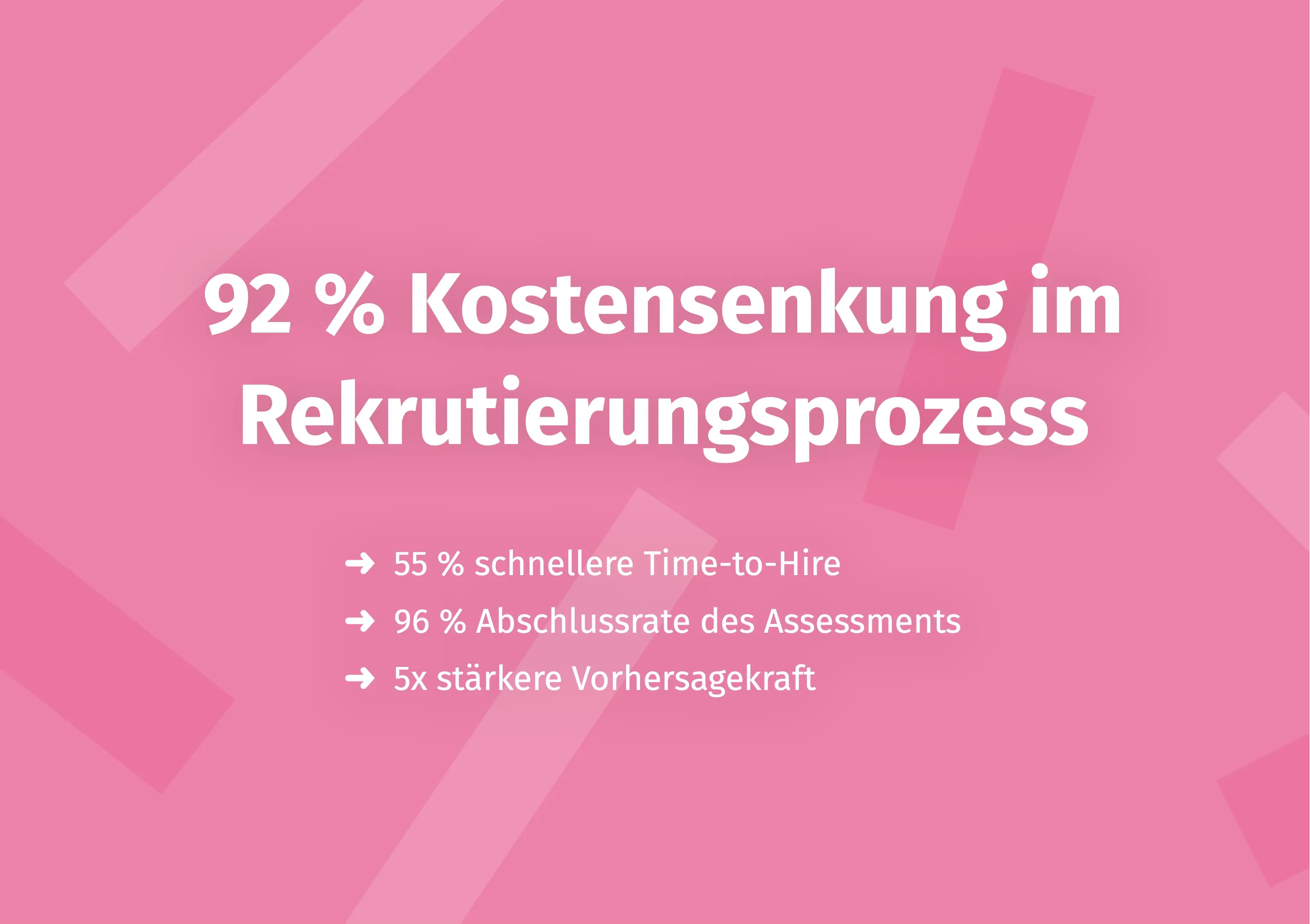
To measure such Key Results reliably, companies increasingly rely on data-driven recruiting tools. Practice shows: MCI Germany was able to reduce time-to-hire by 55% through the use of objective aptitude diagnostics and achieved a 96% completion rate in assessments. Objective data such as predictive validity or candidate experience scores provide the foundation for meaningful Key Results.
Onboarding OKRs
Objective: Create an onboarding experience that makes new employees productive and satisfied from day one.
Key Results:
- Increase onboarding satisfaction from 75% to 90%
- Reduce time-to-productivity from 90 to 60 days
- 100% of new employees complete structured onboarding program
Retention OKRs
Objective: Create a work environment where talent wants to stay long-term.
Key Results:
- Reduce turnover rate from 15% to 10%
- Increase Employee Net Promoter Score (eNPS) to at least 40
- 90% of high performers still with the company after 12 months
Implementing OKR: 5 Steps to Get Started
Implementing OKR requires preparation. Here's a proven roadmap for HR professionals.
1. Secure buy-in: Without support from leadership, OKR will fail. Explain the benefits and show success stories.
2. Choose a pilot team: Start with a motivated team that's open to new methods. HR often works well as a pilot area.
3. Appoint an OKR champion: One person (often called OKR Master) coordinates the process, facilitates meetings, and supports formulation.
4. Keep the first cycle simple: Start with 2-3 Objectives and 3 Key Results each. Perfection comes with time.
5. Conduct a retrospective: After the first cycle: What worked? What didn't? OKR improves through continuous learning.
An agile mindset is a prerequisite for successful OKR implementation. Learn more in the article on agile leadership.
Avoiding Common OKR Mistakes
Many companies fail at OKR implementation due to avoidable mistakes:
- Too many OKRs: More than 5 Objectives per team leads to loss of focus. Less is more.
- Outputs instead of outcomes: Key Results like "conduct 10 job interviews" measure activity, not results. Better: "hire 3 suitable candidates".
- No alignment: If team OKRs don't contribute to company OKRs, the common thread is missing.
- OKRs as performance evaluation: OKRs shouldn't be directly tied to bonuses – this prevents ambitious goals.
- Lack of transparency: OKRs must be visible to everyone, otherwise the alignment effect is lost.
Frequently Asked Questions About OKR
What does OKR mean?
OKR stands for "Objectives and Key Results". It's a framework for agile goal management that links qualitative goals (Objectives) with measurable outcomes (Key Results). Companies like Google, Intel, and BMW use OKR to create focus and alignment.
What's the difference between OKR and KPI?
KPIs (Key Performance Indicators) measure ongoing performance and serve as lagging indicators. OKRs define ambitious future goals and drive change. Key Results can contain KPIs, but OKR as an overall system is broader in scope.
How often are OKRs reviewed?
The typical OKR cycle lasts three months (quarterly). Within the cycle, weekly check-ins monitor progress. At the end of the cycle, a review with scoring and retrospective takes place.
Who invented OKR?
Andrew Grove developed OKR in the 1970s at Intel as an evolution of Management by Objectives (MBO). John Doerr popularized the method at Google in 1999 and is considered one of the most important OKR experts today.
How do you formulate good Key Results?
Good Key Results are SMART: specific, measurable, achievable, relevant, and time-bound. They describe results (outcomes), not activities (outputs). 3-5 Key Results should be defined per Objective.
What are OKR examples for HR?
Typical HR OKRs cover recruiting (time-to-hire, quality of hire), onboarding (satisfaction, time-to-productivity), retention (turnover rate, eNPS), and employee development (training rates, promotion rates).
What is an OKR cycle?
The OKR cycle is the regular rhythm of planning, execution, and review – usually every three months. It includes OKR planning, weekly check-ins, and final scoring with retrospective.
Conclusion
OKR is a proven framework for making ambitious goals measurable and aligning teams around shared priorities. For HR departments, the method offers the opportunity to make their contribution to company success visible – whether in recruiting, onboarding, or employee retention.
The key to success lies in combining clear Objectives, measurable Key Results, and a culture of transparency. Start small, learn from each cycle, and build your OKR practice step by step.
Want to back your recruiting OKRs with valid data? The Aivy platform provides objective aptitude diagnostics that enable measurable Key Results like predictive validity and candidate satisfaction. Learn more about objective aptitude diagnostics
Sources
- Doerr, John. "Measure What Matters: OKRs – The Simple Idea that Drives 10x Growth." Portfolio Penguin, 2018. https://www.whatmatters.com/
- Grove, Andrew S. "High Output Management." Vintage Books, 1983.
- Google re:Work. "Guide: Set goals with OKRs." 2024. https://rework.withgoogle.com/guides/set-goals-with-okrs/
- AIHR. "HR OKRs: All You Need to Know [With 11 Examples]." 2025. https://www.aihr.com/blog/hr-okrs/

Make a better pre-selection — even before the first interview
In just a few minutes, Aivy shows you which candidates really fit the role. Beyond resumes based on strengths.