
HR metrics (also called HR KPIs) are measurable values that represent personnel-relevant aspects of a company – from recruiting efficiency and employee retention to personnel costs. They help HR professionals make informed decisions, optimize processes, and demonstrate the value contribution of the HR department to business success. The most important KPIs include Time-to-Hire, Turnover Rate, Cost-per-Hire, Employee Productivity, and Employee Satisfaction.
What are HR Metrics?
Definition: HR Metrics as Management Tools
HR metrics are quantitative and qualitative measures that systematically capture personnel-relevant aspects of a company. They serve to plan, control, and monitor HR processes – from recruitment and employee retention to personnel development. By analyzing these metrics, you can identify optimization potential, make data-driven decisions, and measure the success of your HR initiatives.
Unlike relying on "gut feeling," HR metrics provide objective data that serve as the foundation for strategic decisions. They enable you to recognize trends early, create benchmarks, and transparently demonstrate your HR department's performance.
Difference Between Metric and KPI
Not every metric is automatically a KPI (Key Performance Indicator). The crucial difference lies in strategic relevance:
- Metric: Any measurable value in HR – for example, the number of employees, the number of incoming applications, or the number of training sessions conducted. Metrics describe the current state.
- KPI (Key Performance Indicator): A strategically relevant metric that directly contributes to business objectives and serves as a success indicator. KPIs evaluate whether HR initiatives achieve the desired impact. Examples: Quality-of-Hire (measures quality of new hires), Time-to-Hire (measures recruiting efficiency), Turnover Rate (measures employee retention).
Key takeaway: All KPIs are metrics, but not all metrics are KPIs. The selection of the right KPIs depends on your individual business objectives.
Why are HR Metrics Important?
The systematic capture and analysis of HR metrics is essential for several reasons:
- Informed Decision-Making: Instead of relying on assumptions, you make decisions based on objective data. If Time-to-Hire is 60 days (benchmark: 28-42 days), you know specifically that your recruiting process needs optimization.
- Early Problem Detection: A suddenly increasing turnover rate in a specific department may indicate leadership problems, poor working conditions, or lack of development opportunities – long before massive departures occur.
- Demonstrating HR Value: In times when HR must prove its strategic role, metrics like Cost-per-Hire, Employee Productivity, or ROI of training initiatives show the concrete contribution to business success.
- Transparency and Benchmarking: You can compare your HR performance with industry averages and set realistic target values. If the average turnover rate in your industry is 15% and you're at 25%, action is needed.
- Process Optimization: Through continuous monitoring, you identify bottlenecks and inefficiencies in your HR processes and can implement targeted improvement measures.
Categories of HR Metrics
HR metrics can be divided into different categories covering various aspects of personnel management:
Recruiting & Talent Acquisition
These metrics measure the efficiency and quality of your recruiting process:
- Time-to-Hire: The average time from job posting to hire. Formula: (Sum of days for all hires) / Number of hires. Benchmark: approximately 28-42 days (industry-dependent). A reduced Time-to-Hire is crucial in the competition for talent.
- Cost-per-Hire: Total costs per new hire, including job advertisements, recruitment agencies, assessment centers, and onboarding. This metric helps you optimize your recruiting budget.
- Quality-of-Hire: The quality of newly hired employees, measured by performance, cultural fit, and tenure at the company. High Quality-of-Hire reduces early turnover and costs of bad hires.
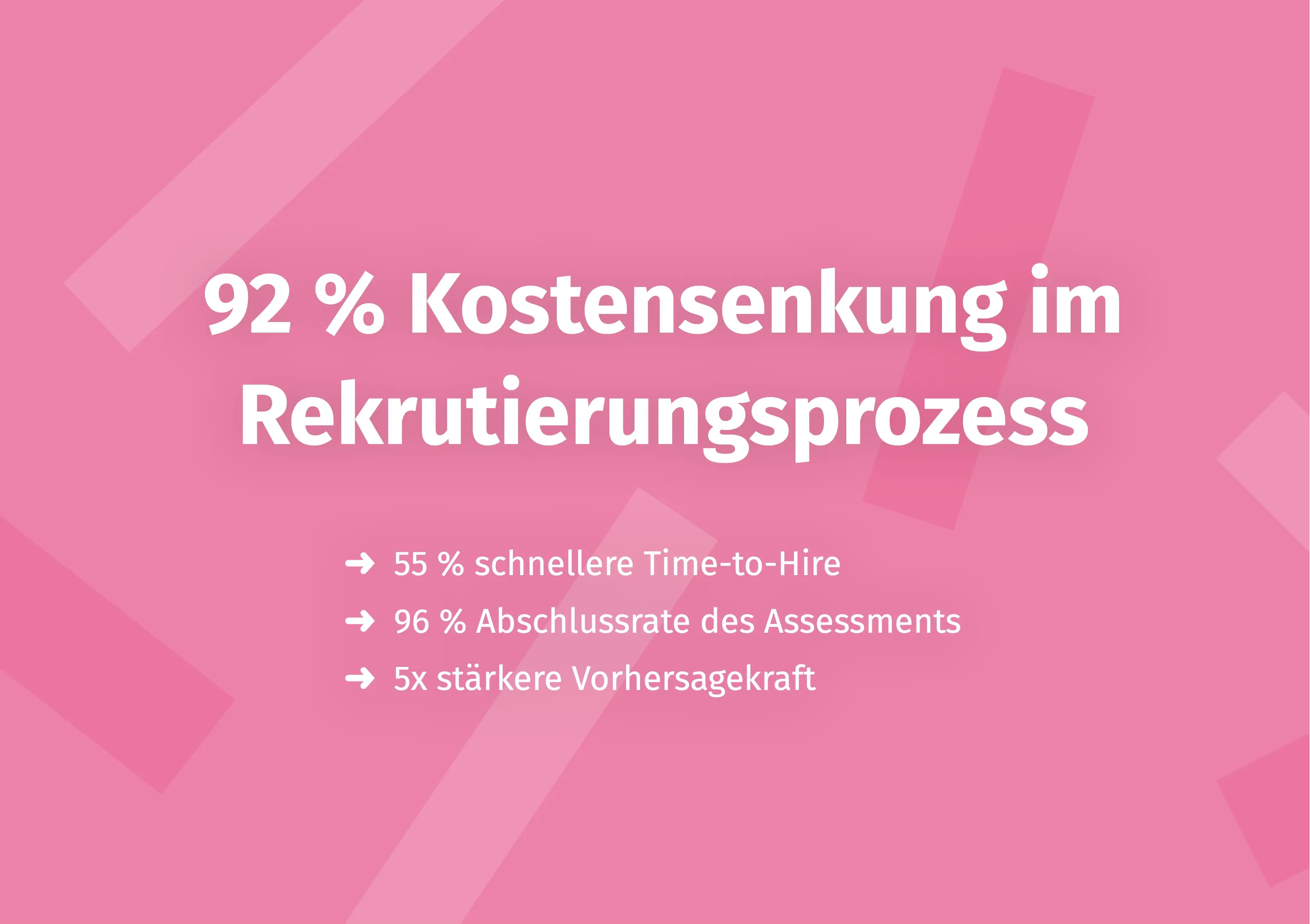
Pro Tip: Objective talent assessment can measurably improve your recruiting KPIs. Companies like MCI were able to reduce Time-to-Hire by 55% and Cost-per-Hire by 92% by using scientifically validated assessments. Game-based assessments enable efficient pre-selection while simultaneously improving Quality-of-Hire through objective evaluation.
Employee Retention
These metrics show how well you succeed in retaining employees long-term:
- Turnover Rate: The percentage of employees who leave the company within a specific period. Formula (BDA): (Departures / Average headcount) × 100. Industry averages: Hospitality 70-80%, IT/Finance 10-20%, Overall average 15-20%.
- Average Tenure: How long do employees stay at the company on average? High tenure indicates good working conditions and development opportunities.
- Early Turnover: Percentage of employees who resign within the first 6-12 months. High early turnover indicates bad hires or inadequate onboarding.
Productivity & Performance
These metrics measure the output and efficiency of your workforce:
- Revenue per Employee: Total revenue divided by number of employees (FTE). This metric shows how productive your workforce is.
- Goal Achievement Rate: Percentage of achieved objectives (e.g., from performance reviews or OKRs). Measures performance at individual or team level.
Personnel Development
These metrics show how much you invest in employee development:
- Training Participation Rate: Percentage of employees participating in training programs. Formula: (Number of participants / Total number of employees) × 100.
- Training Cost per Employee: Total training costs divided by number of employees. Shows your investment level in personnel development.
Personnel Costs
These metrics help you control the cost structure of your HR department:
- Personnel Cost Ratio: Share of personnel costs in total revenue. Formula: (Personnel costs / Revenue) × 100. Benchmark varies greatly by industry (service sector often 40-60%).
- Overtime Rate: Ratio of overtime to standard working hours. A high rate may indicate understaffing or inefficient processes.
Employee Satisfaction & Wellbeing
These metrics measure the wellbeing and engagement of your workforce:
- Absence Rate: Sick leave days relative to standard working hours. A suddenly increasing absence rate may indicate overwork, poor working conditions, or psychological stress.
- Employee Net Promoter Score (eNPS): Measures employee loyalty based on the question: "Would you recommend your company as an employer?" (Scale 0-10). Scores above +10 are considered good, above +30 excellent.
The Most Important HR KPIs at a Glance
Which metrics are truly essential? Here's a quick-start overview of the 7 most important HR KPIs:
Recommendation: Start with 5-7 KPIs that align with your current business objectives. If you're struggling with recruiting challenges, focus on Time-to-Hire, Cost-per-Hire, and Quality-of-Hire. If employee retention is your issue, concentrate on Turnover Rate, eNPS, and Average Tenure.
Practical Implementation – How to Introduce HR Metrics
Introducing HR metrics should be strategic and gradual. Here's your 6-step guide:
Step 1: Define Business Objectives
Before selecting KPIs, clarify: What are the most pressing challenges and strategic goals of your organization?
- Example: High vacancy costs? → Focus on Time-to-Hire and Cost-per-Hire
- Example: High turnover? → Focus on Turnover Rate, eNPS, Exit Interviews
- Example: Productivity increase? → Focus on Revenue per Employee, Goal Achievement
Step 2: Select Relevant KPIs (5-7 to Start)
Less is more! Start with 5-7 KPIs that directly contribute to your goals. Avoid the temptation to track 20+ metrics – this leads to overwhelm and analysis paralysis.
Quick-Start Recommendation for SMEs:
- Time-to-Hire (recruiting efficiency)
- Turnover Rate (employee retention)
- Absence Rate (wellbeing)
- eNPS (satisfaction)
- Revenue per Employee (productivity)
Step 3: Digitize Data Sources
Without digital data capture, KPI measurement becomes painful. Invest in:
- HR software with reporting functions (e.g., Personio, BambooHR, Workday)
- Applicant Tracking System (ATS) for recruiting KPIs
- People Analytics platforms for deeper analysis
- Excel/Google Sheets as budget solution for small companies (templates available)
Important: Data must be centrally and currently available, otherwise you waste time with manual data maintenance.
Step 4: Research Benchmarks
KPIs without context are worthless. Research industry benchmarks to understand where you stand:
- Industry associations often publish HR metrics studies
- HR software providers sometimes offer anonymized benchmarks
- Studies like the HR Insights Report 2024 (Martin Luther University Halle-Wittenberg)
Step 5: Measure and Evaluate Regularly
Define fixed measurement intervals:
- Recruiting KPIs: Monthly (quick response to bottlenecks)
- Turnover Rate, Satisfaction: Quarterly or semi-annually
- Strategic KPIs: Annually (e.g., Training Participation Rate, Productivity)
Create an HR dashboard that visualizes KPIs. Trends are easier to recognize this way than in Excel tables.
Step 6: Derive Actions
KPIs without consequences are useless. Define clear action rules:
- Example: Time-to-Hire over 60 days → Analyze recruiting process, identify bottlenecks, implement measures (e.g., optimize job ads, introduce ATS, use pre-selection tools)
- Example: Turnover Rate over 25% in a department → Collect leadership feedback, evaluate exit interviews, develop countermeasures
Avoiding Common Pitfalls
The most common mistakes in KPI measurement:
- Too many KPIs at once: Focus on 5-7 essential metrics, not 20+
- Manipulation: When KPIs are linked to bonuses, there's a risk of "gaming the numbers." Create transparency and rely on intrinsic motivation instead of penalties.
- Misinterpretation: Never view KPIs in isolation. A high turnover rate alone says nothing – only in combination with exit interviews, eNPS, and leadership quality does a complete picture emerge.
- Overload: Not every metric is strategically relevant. Ask yourself: Does this metric lead to concrete actions?
- Missing context: Compare your KPIs with industry benchmarks. A turnover rate of 40% is normal in hospitality, but an alarm signal in IT.
Frequently Asked Questions About HR Metrics
What are HR Metrics?
HR metrics are measurable values that represent personnel-relevant aspects of a company. They serve to plan, control, and monitor HR processes – from recruiting and employee retention to personnel development. Typical examples are Time-to-Hire (recruiting efficiency), Turnover Rate (employee retention), and Employee Productivity (output). HR metrics help you make data-driven decisions instead of relying on gut feeling.
What is the difference between a metric and a KPI?
A metric is any measurable value in HR – for example, the number of employees or the number of incoming applications. A KPI (Key Performance Indicator) is a strategically relevant metric that directly contributes to business objectives and serves as a success indicator. All KPIs are metrics, but not all metrics are KPIs. Example: "Number of applications" is a metric, "Quality-of-Hire" (quality of hires) is a KPI.
Which HR metrics are most important?
This depends on your business objectives. As a quick start, we recommend:
- Recruiting: Time-to-Hire, Cost-per-Hire, Quality-of-Hire
- Retention: Turnover Rate, Average Tenure
- Productivity: Revenue per Employee, Goal Achievement Rate
- Satisfaction: Employee Net Promoter Score (eNPS), Absence Rate
- Development: Training Participation Rate, Training Cost per Employee
Important: Not all KPIs are relevant for all companies. Choose 5-7 KPIs that match your current challenges.
How do you calculate Time-to-Hire?
Formula: (Sum of days from job posting to hire) / Number of filled positions
Example: You filled 3 positions – one after 30 days, one after 45 days, one after 60 days. Time-to-Hire = (30+45+60)/3 = 45 days.
Benchmark: approximately 28-42 days (industry-dependent)
Alternative: Time-to-Fill measures the time from application receipt to signature (shorter timespan than Time-to-Hire).
How do you calculate Turnover Rate?
There are two common formulas:
BDA formula: (Departures / Average headcount) × 100
Schlüter formula: ((Departures - New hires) / Headcount at beginning of period) × 100
Recommendation: Calculate turnover rate for 12 months (more accurate than quarters). Consider industry benchmarks: Hospitality 70-80%, IT/Finance 10-20%, Average 15-20%.
Tip: Distinguish between natural turnover (retirement, illness), internal turnover (job changes within company), and external turnover (resignations).
What are quantitative vs. qualitative HR metrics?
Quantitative metrics are numerically measurable: Turnover Rate, Time-to-Hire, Absence Rate, Number of Employees. They show "What" is happening.
Qualitative metrics are harder to measure and are often collected through surveys or interviews: Employee Satisfaction, Corporate Culture, Leadership Quality. They show "Why" something is happening.
Important: Both types complement each other. Example: A high turnover rate (quantitative) paired with low leadership quality score (qualitative) indicates need for action with leaders.
Which tools help with capturing HR metrics?
- HR software with integrated reporting: Personio, BambooHR, Workday – automatic KPI capture and dashboards
- People Analytics platforms: For deeper analysis and predictive analytics
- Applicant Tracking Systems (ATS): For recruiting KPIs (Time-to-Hire, Cost-per-Hire, Source-of-Hire)
- Excel/Google Sheets: Budget solution for small companies (templates available)
Critical: Digitization is a prerequisite for efficient KPI capture. Manual data collection leads to errors and time waste.
How do I avoid mistakes when measuring HR metrics?
- Not too many KPIs: Focus on 5-7 relevant metrics, not 20+
- Review regularly: Adapt KPIs to changed business objectives
- Avoid manipulation: Create transparency, avoid "gaming the numbers"
- Consider context: Compare with industry benchmarks, not just absolute numbers
- Combine qualitative + quantitative: Use both KPI types for a complete picture
- Never view in isolation: Always analyze KPIs in context
Conclusion
HR metrics are indispensable for data-driven HR management. They make HR processes measurable, transparent, and strategically controllable. Instead of being overwhelmed by the multitude of possible metrics, start with 5-7 strategically relevant KPIs that directly contribute to your business objectives.
The combination of quantitative metrics (Time-to-Hire, Turnover Rate, Absence Rate) and qualitative indicators (Employee Satisfaction, Leadership Quality) gives you a complete picture of HR performance. The key is not just to measure KPIs, but to derive concrete actions and review them regularly.
Want to measurably improve your recruiting KPIs like Time-to-Hire and Quality-of-Hire? Learn how objective talent assessment with scientifically validated assessments can help you – learn more about Aivy's digital recruiting platform.
Sources
- HR Insights Report 2024. Martin Luther University Halle-Wittenberg, 2024. (49% of employers expect higher turnover in 2025; 70% observed decline in employee engagement in 2024)
- Recruiting Trends 2020. (Only 50% of companies continuously track Time-to-Hire)
- Federal Statistical Office (Destatis) – Labor Market Data. Federal Statistical Office, 2024. https://www.destatis.de
- HR Metrics: The Most Important KPIs for HR Departments. hrworks.de, 2025. https://www.hrworks.de/lexikon/hr-kennzahlen/
- HR KPIs: Achieving Strategic Goals with Personnel Metrics. Alexandra Carlesso, Haufe Group, 2024. https://www.haufe.de/hr/magazin/hr-kpis-mit-personalkennzahlen-strategische-ziele-erreichen

Make a better pre-selection — even before the first interview
In just a few minutes, Aivy shows you which candidates really fit the role. Beyond resumes based on strengths.