You want to explore your strengths as a talent?

This way

Login

External Recruitment: Definition, Methods & Tips

Home
-
Lexicon
-
External Recruitment: Definition, Methods & Tips

The talent shortage has become one of the biggest challenges for companies in recent years. According to a study by Monster Worldwide GmbH, 82% of companies plan to hire new employees – yet 39% struggle to find candidates with the right qualifications. External recruitment is the most important lever here: approximately 80% of all new hires come from external sources.

But how does external recruitment work effectively? Which methods are most successful? And how do you avoid costly mis-hires?

In this guide, you'll learn everything about external recruitment: from the definition to proven methods and concrete success factors. You'll discover how to optimize your recruiting process and attract the best talent for your company using objective selection methods. Current studies and practical examples show you what works – and what doesn't.

What Is External Recruitment? – Definition and Fundamentals

External recruitment refers to the process of hiring new employees from outside the organization. Unlike internal recruitment, where existing employees are transferred or promoted, external recruitment involves searching for and hiring candidates from the labor market.

The goal: Fill open positions with qualified professionals who enrich the company with new skills, fresh perspectives, and additional capacity.

Definition: External vs. Internal Recruitment

Recruitment can essentially be divided into two paths:

Criterion Internal Recruitment External Recruitment
Candidate Source Existing employees External labor market
Methods Transfer, promotion, internal posting Job boards, active sourcing, headhunting
Costs Lower (no advertising costs) Higher (ads, tools, headhunters)
Onboarding Time Shorter (company knowledge exists) Longer (onboarding required)
Know-how Existing knowledge is redistributed New knowledge enters the company
Risk Lower (person is known) Higher (less information available)

Both approaches have their merits – and most companies use a combination of both. However, the Recruiting Trends study from the University of Bamberg shows that over 70% of hires come through external channels such as company websites and job boards.

When Is External Recruitment the Right Choice?

External recruitment is particularly appropriate when:

  • Specialized expertise is needed that doesn't exist internally
  • Fresh perspectives are desired to overcome operational blindness
  • No suitable internal candidates are available for the position
  • The company is growing and needs to build new capacity
  • Innovations need to be brought in from outside
  • Special leadership skills are required that haven't been developed internally

The Most Important Methods of External Recruitment

The options for recruiting externally are diverse. Basically, we distinguish between passive and active methods – depending on whether candidates come to you or you proactively approach them.

Passive Methods: Job Boards, Career Sites, Unsolicited Applications

With passive methods, you wait for qualified applicants to contact you:

Job boards and job portals: They remain the most widely used method of external recruitment. Platforms like Indeed, LinkedIn, or Glassdoor enable broad reach. The University of Bamberg study shows that job boards together with company websites generate over 70% of all hires.

Company career site: A well-designed career site is essential. Here, potential applicants can learn about the company, find open positions, and apply directly. The career site is often the first point of contact and shapes the candidate experience.

Unsolicited applications: Some candidates apply even without a specific job posting. A well-maintained talent pool can systematically capture these applications and activate them when needed.

Active Methods: Active Sourcing, Headhunting, Social Media Recruiting

With active methods, you proactively approach potential candidates:

Active Sourcing: This is the proactive outreach to potential candidates by recruiters – even when they're not actively looking for a job. Platforms like LinkedIn and XING are central channels for this. A recruiter might, for example, message an interesting profile and present an open position.

Headhunting and recruitment agencies: For hard-to-fill positions or executive roles, specialized recruitment consultants are often engaged. They have networks and expertise to reach even passive candidates.

Social Media Recruiting: Social networks like LinkedIn, XING, but also Instagram and Facebook offer opportunities for candidate outreach. Sponsored job ads reach passive candidates who aren't actively searching.

Supporting Measures: Employer Branding, Employee Referrals

In addition to direct recruiting methods, supporting measures play an important role:

Employer Branding: A strong employer brand attracts talent. According to the DGFP Benchmark Study 2023, 62% of companies see recruiting as a core function – and employer branding is the foundation for this. Companies with a good reputation receive more and higher-quality applications.

Employee referral programs: Referrals from existing employees are gaining importance. The DGFP study shows that employee referrals are gaining ground against active sourcing, increasing by 8%. The advantage: Employees know the company and usually recommend suitable candidates.

Advantages and Disadvantages of External Recruitment

Before deciding on external recruitment, you should weigh the pros and cons.

Advantages: New Know-how, Larger Talent Pool, Fresh Perspectives

External recruitment offers numerous advantages:

  • Larger talent pool: You have access to a much broader spectrum of candidates than with internal searches. This increases the chances of finding the ideal person for the position.
  • New know-how: External employees bring experience from other companies and industries. They know different work methods, tools, and processes.
  • Fresh perspectives: New team members question established processes and can break through operational blindness. This promotes innovation and continuous improvement.
  • Closing specific skill gaps: You can specifically search for qualifications that are missing internally – whether technical expertise, leadership experience, or language skills.
  • Building capacity: Unlike internal placement, which merely shifts capacity, external recruitment enables real growth.

Disadvantages: Higher Costs, Longer Onboarding, Risk of Mis-hire

At the same time, there are challenges to consider:

  • Higher costs: The average cost-per-hire ranges from €3,000-5,000. This includes job postings (€100-1,000), headhunters (15-30% of annual salary), tools, and internal time for screening and interviews.
  • Longer onboarding time: External employees need to learn the company, processes, and culture first. Onboarding takes correspondingly longer.
  • Higher mis-hire risk: Since the person is less known, the risk of making the wrong decision is greater. Studies show that without structured selection processes, the mis-hire rate is 24%.
  • Time-to-hire: The entire process – from needs analysis to onboarding – takes time. On average, it takes 78 days to fill a position.
  • Internal employee motivation: When external candidates are preferred, it can reduce the motivation of internal employees who hoped for advancement opportunities.

The External Recruitment Process Step by Step

A structured process is the key to success. Here are the five essential steps:

1. Needs Analysis and Creating a Job Profile

Before you start searching, you need to know exactly who you're looking for. A clear job profile is the foundation for successful recruitment.

The job profile should include:

  • Professional qualifications and work experience
  • Soft skills and personal attributes
  • Cultural fit (Cultural Fit)
  • Nice-to-have vs. must-have criteria

Tip: An unclear job profile is one of the most common mistakes in recruiting. The more precisely you define who you're looking for, the more targeted your search – and the higher the quality of applications.

2. Selecting Recruiting Channels

Not every channel is suitable for every position. The choice of the right channels depends on various factors:

  • Target group: Where are your ideal candidates active?
  • Position: For executives, headhunting is often more effective than job boards
  • Budget: Active sourcing is cheaper than headhunters but requires more time
  • Timeframe: How quickly does the position need to be filled?

The University of Bamberg study shows that a mix of different channels is most successful. E-Recruiting through digital channels dominates, but personal networks and employee referrals also play an important role.

3. Attracting and Pre-selecting Candidates

Once applications come in, the pre-selection begins. This step is crucial for the efficiency of the entire process.

Reviewing application documents: Resumes, cover letters, and references provide initial indications of suitability. However, studies show that the predictive power of documents is limited. The meta-study by Schmidt and Hunter (1998) demonstrates that traditional application documents have only a validity of r=.18 for predicting job success.

Technical pre-selection: Modern tools can accelerate pre-selection. Efficient pre-selection with assessment diagnostics makes it possible to quickly identify candidates with the best fit.

4. Conducting Selection Procedures – Objectively and Fairly

The selection process is the heart of personnel selection. This is where it's decided whether you find the right person.

Structured interviews: The research is clear: Structured interviews (r=.51) have significantly higher validity than unstructured conversations (r=.38), as Schmidt and Hunter (1998) show. Ask all candidates the same questions and evaluate according to uniform criteria.

Assessment diagnostic methods: Scientifically validated tests can further increase predictive power. Aptitude tests achieve a validity of r=.54 – higher than any other method. According to CriteriaCorp analyses, the use of assessment diagnostics reduces the mis-hire rate from 24% to 6%.

Avoiding bias: An often underestimated problem is Unconscious Bias. Subjective assessments lead to poor decisions. Objective, standardized procedures help reduce prejudice.

5. Decision and Onboarding

The final decision should be based on all collected information – not gut feeling. Involve multiple interviewers and use structured evaluation forms.

After hiring: Good onboarding is crucial for long-term retention. The first few weeks shape the relationship between employee and company. Plan onboarding carefully and actively support new team members.

Optimizing External Recruitment: Success Factors

To succeed in the competition for talent, it's not enough to just master the basics. These success factors make the difference:

Objective Assessment Diagnostics Instead of Gut Feeling

The famous gut feeling is one of the biggest risk factors in recruiting. It leads to systematic biases and poor decisions. Objective assessment diagnostics offers a scientifically validated alternative.

The advantages:

  • Higher predictive power for job success
  • Reduction of unconscious bias through standardized procedures
  • Better comparability between candidates
  • Faster pre-selection through automated evaluation
  • Positive candidate experience through modern formats

Modern approaches like Game-Based Assessments combine scientific validity with an engaging candidate experience. Tools like Aivy use such methods, validated at the Freie Universität Berlin, to enable objective, data-driven decisions.

Time-to-Hire and Cost-per-Hire as Key Metrics

If you don't measure, you can't improve. The DGFP Benchmark Study 2023 identifies time-to-hire, cost-per-hire, and channel effectiveness as the most important KPIs in recruiting.

Time-to-Hire: The time span from job posting to hiring. On average, it's 78 days – often too long. Good candidates are quickly off the market, and every delay increases the risk of losing talent.

Cost-per-Hire: The total cost per hire. It includes advertising costs, tools, labor time, and possibly headhunter fees. An awareness of these costs helps deploy resources strategically.

Candidate Experience as a Competitive Advantage

In a candidate's market, not only do companies decide about applicants – candidates also choose their employer. A positive candidate experience is therefore a real competitive advantage.

What makes a good candidate experience:

  • Fast responses (ideally within 24 hours)
  • Transparent communication about the process
  • Respectful treatment at eye level
  • Modern, uncomplicated application procedures
  • Timely feedback – even for rejections

Practical Example: How Companies Succeed with Data-driven Selection

Practice shows: Companies that rely on objective assessment diagnostics achieve measurable success.

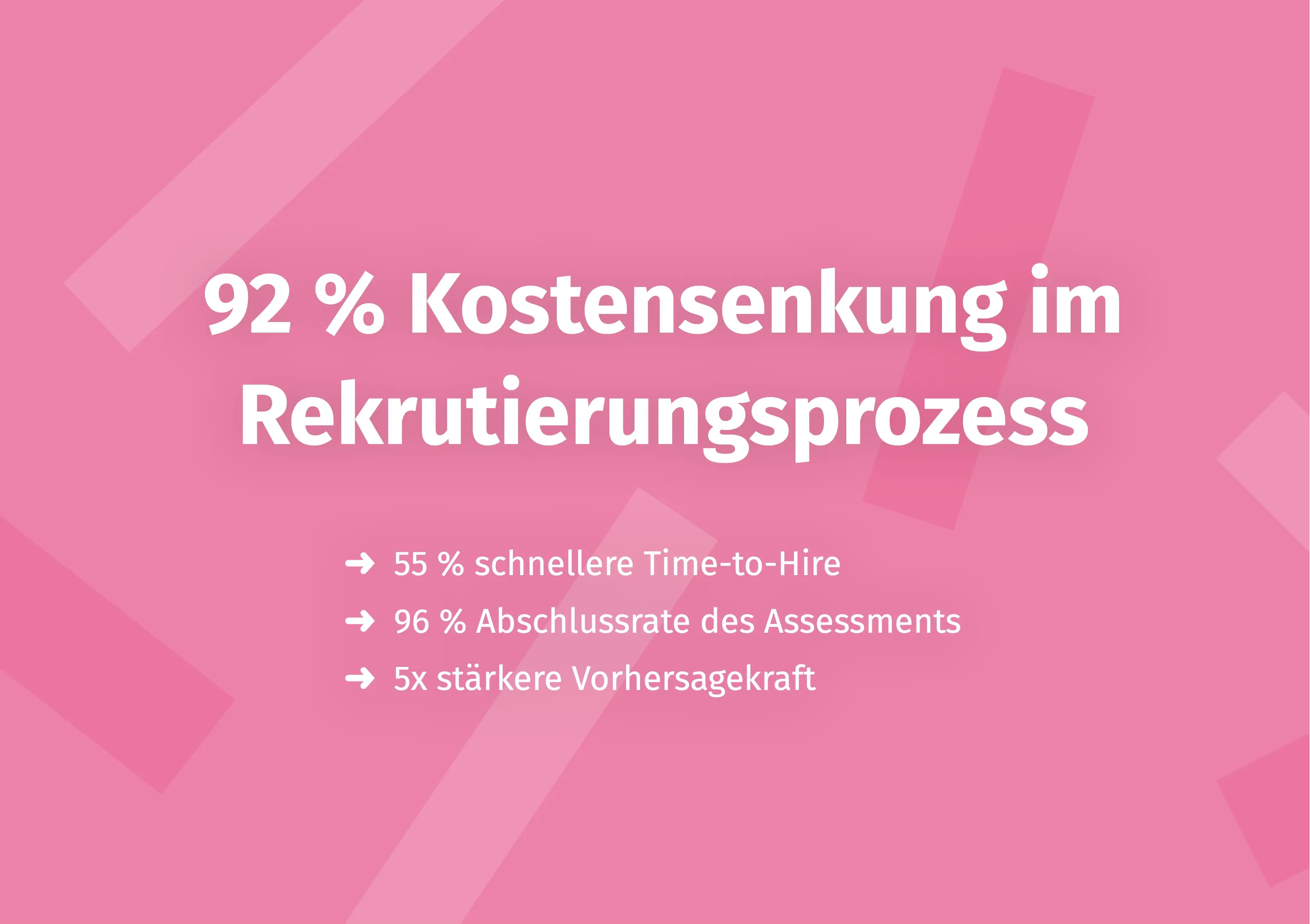
MCI Deutschland was able to reduce time-to-hire by 55% and simultaneously reduce cost-per-hire by 92% through the use of Game-Based Assessments. Matthias Kühne, Director People & Culture at MCI, emphasizes: "We had largely digitized our recruiting process a long time ago thanks to softgarden. With Aivy, we have now digitized another process step in recruitment and significantly professionalized it through a more objective evaluation basis."

Lufthansa also relies on objective methods: With a 96% accuracy rate in predicting candidate suitability and 81% candidate satisfaction, it shows that scientifically validated selection and positive candidate experience go hand in hand. More details can be found in the Lufthansa success story.

Common Mistakes in External Recruitment – And How to Avoid Them

Even experienced HR teams make mistakes. These four are particularly common:

Mistake 1: Unclear Job Profile

The problem: Without a precise definition of who you're looking for, the search becomes inefficient. You receive many unsuitable applications and waste time with wrong candidates.

The solution: Invest time in a detailed job profile. Distinguish between must-have and nice-to-have criteria. Involve the relevant department.

Mistake 2: Using Too Few Recruiting Channels

The problem: Those who rely on only one channel miss potential talent. Different target groups are active on different platforms.

The solution: Use a mix of different channels. Test which channels work best for which positions. The DGFP study shows that evaluating channel effectiveness is among the most important KPIs.

Mistake 3: Subjective Selection Decisions (Unconscious Bias)

The problem: Unconscious prejudices influence decisions – often without us realizing it. Affinity bias leads us to prefer candidates who are similar to us. The halo effect makes us infer other qualities from one positive trait.

The solution: Use structured interviews and objective assessment diagnostics. Standardized procedures reduce the influence of bias. Involve multiple interviewers with different perspectives.

Mistake 4: Time-to-Hire Too Long

The problem: A lengthy process leads to good candidates dropping out. They receive other offers or lose interest.

The solution: Optimize every process step. Fast responses, efficient pre-selection, and clear decision-making processes shorten time-to-hire. MCI shows that a reduction of 55% is possible.

Frequently Asked Questions (FAQ)

What is the difference between internal and external recruitment?In internal recruitment, open positions are filled with existing employees (through transfer, promotion, or internal posting). In external recruitment, candidates are recruited from outside the company. About 80% of all new hires are external.

Which external recruitment methods are most effective?According to the Recruiting Trends study, company websites and job boards together generate over 70% of hires. Employee referrals and active sourcing are gaining importance. However, effectiveness depends heavily on the target group and industry.

What does external recruitment cost?Costs vary widely: Job postings (€100-1,000), headhunters (15-30% of annual salary), tools, and internal labor time. The average cost-per-hire in Germany is €3,000-5,000 but can be significantly higher for executives.

How do I avoid mis-hires in external recruitment?Through clear job profiles, structured interviews instead of unstructured conversations, use of scientifically validated assessment diagnostics, involvement of multiple interviewers, and reduction of unconscious bias through objective procedures. With assessment diagnostics, the mis-hire rate drops from 24% to 6%.

How do I reduce time-to-hire?Through clear job profiles, use of multiple recruiting channels, fast response to applications, efficient pre-selection with assessment diagnostics, structured interviews, and digitized processes. MCI was able to reduce time-to-hire by 55%.

What is assessment diagnostics and why is it important?Assessment diagnostics comprises scientifically validated methods for evaluating competencies and characteristics in a work context. It increases predictive power for job success (r=.54 according to Schmidt & Hunter), reduces bias, and significantly lowers mis-hire rates.

Conclusion: How to Succeed at External Recruitment in Times of Talent Shortage

External recruitment is the most important way for most companies to attract talent. With the right strategy, you can successfully compete for skilled workers.

The key success factors:

  • Clear job profiles as the foundation for targeted searching
  • Mix of different recruiting channels for maximum reach
  • Objective selection procedures instead of gut-feeling decisions
  • Fast processes for a positive candidate experience
  • Continuous measurement and optimization with KPIs

Scientifically validated assessment diagnostic tools like Aivy help you professionalize your recruiting process. They enable data-driven decisions, reduce bias, and improve both the quality of hires and the candidate experience.

The labor market will remain challenging in the future. Companies that design their external recruitment strategically and professionally secure a decisive competitive advantage.

Sources

  • Schmidt, F. L. & Hunter, J. E. (1998). The Validity and Utility of Selection Methods in Personnel Psychology. Psychological Bulletin, 124(2), 262-274.
  • Recruiting Trends (University of Bamberg, 2003-present). Centre of Human Resources Information Systems (CHRIS).
  • DGFP Benchmark Study: Recruiting Structures 2023. German Association for Human Resource Management.
  • Monster Recruiting Study (2021). Monster Worldwide Deutschland GmbH & Dynata.
  • CriteriaCorp / HeyJobs: Analyses on the Effectiveness of Assessment Diagnostics.

Home
-
lexicon
-
External Recruitment: Definition, Methods & Tips

The talent shortage has become one of the biggest challenges for companies in recent years. According to a study by Monster Worldwide GmbH, 82% of companies plan to hire new employees – yet 39% struggle to find candidates with the right qualifications. External recruitment is the most important lever here: approximately 80% of all new hires come from external sources.

But how does external recruitment work effectively? Which methods are most successful? And how do you avoid costly mis-hires?

In this guide, you'll learn everything about external recruitment: from the definition to proven methods and concrete success factors. You'll discover how to optimize your recruiting process and attract the best talent for your company using objective selection methods. Current studies and practical examples show you what works – and what doesn't.

What Is External Recruitment? – Definition and Fundamentals

External recruitment refers to the process of hiring new employees from outside the organization. Unlike internal recruitment, where existing employees are transferred or promoted, external recruitment involves searching for and hiring candidates from the labor market.

The goal: Fill open positions with qualified professionals who enrich the company with new skills, fresh perspectives, and additional capacity.

Definition: External vs. Internal Recruitment

Recruitment can essentially be divided into two paths:

Criterion Internal Recruitment External Recruitment
Candidate Source Existing employees External labor market
Methods Transfer, promotion, internal posting Job boards, active sourcing, headhunting
Costs Lower (no advertising costs) Higher (ads, tools, headhunters)
Onboarding Time Shorter (company knowledge exists) Longer (onboarding required)
Know-how Existing knowledge is redistributed New knowledge enters the company
Risk Lower (person is known) Higher (less information available)

Both approaches have their merits – and most companies use a combination of both. However, the Recruiting Trends study from the University of Bamberg shows that over 70% of hires come through external channels such as company websites and job boards.

When Is External Recruitment the Right Choice?

External recruitment is particularly appropriate when:

  • Specialized expertise is needed that doesn't exist internally
  • Fresh perspectives are desired to overcome operational blindness
  • No suitable internal candidates are available for the position
  • The company is growing and needs to build new capacity
  • Innovations need to be brought in from outside
  • Special leadership skills are required that haven't been developed internally

The Most Important Methods of External Recruitment

The options for recruiting externally are diverse. Basically, we distinguish between passive and active methods – depending on whether candidates come to you or you proactively approach them.

Passive Methods: Job Boards, Career Sites, Unsolicited Applications

With passive methods, you wait for qualified applicants to contact you:

Job boards and job portals: They remain the most widely used method of external recruitment. Platforms like Indeed, LinkedIn, or Glassdoor enable broad reach. The University of Bamberg study shows that job boards together with company websites generate over 70% of all hires.

Company career site: A well-designed career site is essential. Here, potential applicants can learn about the company, find open positions, and apply directly. The career site is often the first point of contact and shapes the candidate experience.

Unsolicited applications: Some candidates apply even without a specific job posting. A well-maintained talent pool can systematically capture these applications and activate them when needed.

Active Methods: Active Sourcing, Headhunting, Social Media Recruiting

With active methods, you proactively approach potential candidates:

Active Sourcing: This is the proactive outreach to potential candidates by recruiters – even when they're not actively looking for a job. Platforms like LinkedIn and XING are central channels for this. A recruiter might, for example, message an interesting profile and present an open position.

Headhunting and recruitment agencies: For hard-to-fill positions or executive roles, specialized recruitment consultants are often engaged. They have networks and expertise to reach even passive candidates.

Social Media Recruiting: Social networks like LinkedIn, XING, but also Instagram and Facebook offer opportunities for candidate outreach. Sponsored job ads reach passive candidates who aren't actively searching.

Supporting Measures: Employer Branding, Employee Referrals

In addition to direct recruiting methods, supporting measures play an important role:

Employer Branding: A strong employer brand attracts talent. According to the DGFP Benchmark Study 2023, 62% of companies see recruiting as a core function – and employer branding is the foundation for this. Companies with a good reputation receive more and higher-quality applications.

Employee referral programs: Referrals from existing employees are gaining importance. The DGFP study shows that employee referrals are gaining ground against active sourcing, increasing by 8%. The advantage: Employees know the company and usually recommend suitable candidates.

Advantages and Disadvantages of External Recruitment

Before deciding on external recruitment, you should weigh the pros and cons.

Advantages: New Know-how, Larger Talent Pool, Fresh Perspectives

External recruitment offers numerous advantages:

  • Larger talent pool: You have access to a much broader spectrum of candidates than with internal searches. This increases the chances of finding the ideal person for the position.
  • New know-how: External employees bring experience from other companies and industries. They know different work methods, tools, and processes.
  • Fresh perspectives: New team members question established processes and can break through operational blindness. This promotes innovation and continuous improvement.
  • Closing specific skill gaps: You can specifically search for qualifications that are missing internally – whether technical expertise, leadership experience, or language skills.
  • Building capacity: Unlike internal placement, which merely shifts capacity, external recruitment enables real growth.

Disadvantages: Higher Costs, Longer Onboarding, Risk of Mis-hire

At the same time, there are challenges to consider:

  • Higher costs: The average cost-per-hire ranges from €3,000-5,000. This includes job postings (€100-1,000), headhunters (15-30% of annual salary), tools, and internal time for screening and interviews.
  • Longer onboarding time: External employees need to learn the company, processes, and culture first. Onboarding takes correspondingly longer.
  • Higher mis-hire risk: Since the person is less known, the risk of making the wrong decision is greater. Studies show that without structured selection processes, the mis-hire rate is 24%.
  • Time-to-hire: The entire process – from needs analysis to onboarding – takes time. On average, it takes 78 days to fill a position.
  • Internal employee motivation: When external candidates are preferred, it can reduce the motivation of internal employees who hoped for advancement opportunities.

The External Recruitment Process Step by Step

A structured process is the key to success. Here are the five essential steps:

1. Needs Analysis and Creating a Job Profile

Before you start searching, you need to know exactly who you're looking for. A clear job profile is the foundation for successful recruitment.

The job profile should include:

  • Professional qualifications and work experience
  • Soft skills and personal attributes
  • Cultural fit (Cultural Fit)
  • Nice-to-have vs. must-have criteria

Tip: An unclear job profile is one of the most common mistakes in recruiting. The more precisely you define who you're looking for, the more targeted your search – and the higher the quality of applications.

2. Selecting Recruiting Channels

Not every channel is suitable for every position. The choice of the right channels depends on various factors:

  • Target group: Where are your ideal candidates active?
  • Position: For executives, headhunting is often more effective than job boards
  • Budget: Active sourcing is cheaper than headhunters but requires more time
  • Timeframe: How quickly does the position need to be filled?

The University of Bamberg study shows that a mix of different channels is most successful. E-Recruiting through digital channels dominates, but personal networks and employee referrals also play an important role.

3. Attracting and Pre-selecting Candidates

Once applications come in, the pre-selection begins. This step is crucial for the efficiency of the entire process.

Reviewing application documents: Resumes, cover letters, and references provide initial indications of suitability. However, studies show that the predictive power of documents is limited. The meta-study by Schmidt and Hunter (1998) demonstrates that traditional application documents have only a validity of r=.18 for predicting job success.

Technical pre-selection: Modern tools can accelerate pre-selection. Efficient pre-selection with assessment diagnostics makes it possible to quickly identify candidates with the best fit.

4. Conducting Selection Procedures – Objectively and Fairly

The selection process is the heart of personnel selection. This is where it's decided whether you find the right person.

Structured interviews: The research is clear: Structured interviews (r=.51) have significantly higher validity than unstructured conversations (r=.38), as Schmidt and Hunter (1998) show. Ask all candidates the same questions and evaluate according to uniform criteria.

Assessment diagnostic methods: Scientifically validated tests can further increase predictive power. Aptitude tests achieve a validity of r=.54 – higher than any other method. According to CriteriaCorp analyses, the use of assessment diagnostics reduces the mis-hire rate from 24% to 6%.

Avoiding bias: An often underestimated problem is Unconscious Bias. Subjective assessments lead to poor decisions. Objective, standardized procedures help reduce prejudice.

5. Decision and Onboarding

The final decision should be based on all collected information – not gut feeling. Involve multiple interviewers and use structured evaluation forms.

After hiring: Good onboarding is crucial for long-term retention. The first few weeks shape the relationship between employee and company. Plan onboarding carefully and actively support new team members.

Optimizing External Recruitment: Success Factors

To succeed in the competition for talent, it's not enough to just master the basics. These success factors make the difference:

Objective Assessment Diagnostics Instead of Gut Feeling

The famous gut feeling is one of the biggest risk factors in recruiting. It leads to systematic biases and poor decisions. Objective assessment diagnostics offers a scientifically validated alternative.

The advantages:

  • Higher predictive power for job success
  • Reduction of unconscious bias through standardized procedures
  • Better comparability between candidates
  • Faster pre-selection through automated evaluation
  • Positive candidate experience through modern formats

Modern approaches like Game-Based Assessments combine scientific validity with an engaging candidate experience. Tools like Aivy use such methods, validated at the Freie Universität Berlin, to enable objective, data-driven decisions.

Time-to-Hire and Cost-per-Hire as Key Metrics

If you don't measure, you can't improve. The DGFP Benchmark Study 2023 identifies time-to-hire, cost-per-hire, and channel effectiveness as the most important KPIs in recruiting.

Time-to-Hire: The time span from job posting to hiring. On average, it's 78 days – often too long. Good candidates are quickly off the market, and every delay increases the risk of losing talent.

Cost-per-Hire: The total cost per hire. It includes advertising costs, tools, labor time, and possibly headhunter fees. An awareness of these costs helps deploy resources strategically.

Candidate Experience as a Competitive Advantage

In a candidate's market, not only do companies decide about applicants – candidates also choose their employer. A positive candidate experience is therefore a real competitive advantage.

What makes a good candidate experience:

  • Fast responses (ideally within 24 hours)
  • Transparent communication about the process
  • Respectful treatment at eye level
  • Modern, uncomplicated application procedures
  • Timely feedback – even for rejections

Practical Example: How Companies Succeed with Data-driven Selection

Practice shows: Companies that rely on objective assessment diagnostics achieve measurable success.

MCI Deutschland was able to reduce time-to-hire by 55% and simultaneously reduce cost-per-hire by 92% through the use of Game-Based Assessments. Matthias Kühne, Director People & Culture at MCI, emphasizes: "We had largely digitized our recruiting process a long time ago thanks to softgarden. With Aivy, we have now digitized another process step in recruitment and significantly professionalized it through a more objective evaluation basis."

Lufthansa also relies on objective methods: With a 96% accuracy rate in predicting candidate suitability and 81% candidate satisfaction, it shows that scientifically validated selection and positive candidate experience go hand in hand. More details can be found in the Lufthansa success story.

Common Mistakes in External Recruitment – And How to Avoid Them

Even experienced HR teams make mistakes. These four are particularly common:

Mistake 1: Unclear Job Profile

The problem: Without a precise definition of who you're looking for, the search becomes inefficient. You receive many unsuitable applications and waste time with wrong candidates.

The solution: Invest time in a detailed job profile. Distinguish between must-have and nice-to-have criteria. Involve the relevant department.

Mistake 2: Using Too Few Recruiting Channels

The problem: Those who rely on only one channel miss potential talent. Different target groups are active on different platforms.

The solution: Use a mix of different channels. Test which channels work best for which positions. The DGFP study shows that evaluating channel effectiveness is among the most important KPIs.

Mistake 3: Subjective Selection Decisions (Unconscious Bias)

The problem: Unconscious prejudices influence decisions – often without us realizing it. Affinity bias leads us to prefer candidates who are similar to us. The halo effect makes us infer other qualities from one positive trait.

The solution: Use structured interviews and objective assessment diagnostics. Standardized procedures reduce the influence of bias. Involve multiple interviewers with different perspectives.

Mistake 4: Time-to-Hire Too Long

The problem: A lengthy process leads to good candidates dropping out. They receive other offers or lose interest.

The solution: Optimize every process step. Fast responses, efficient pre-selection, and clear decision-making processes shorten time-to-hire. MCI shows that a reduction of 55% is possible.

Frequently Asked Questions (FAQ)

What is the difference between internal and external recruitment?In internal recruitment, open positions are filled with existing employees (through transfer, promotion, or internal posting). In external recruitment, candidates are recruited from outside the company. About 80% of all new hires are external.

Which external recruitment methods are most effective?According to the Recruiting Trends study, company websites and job boards together generate over 70% of hires. Employee referrals and active sourcing are gaining importance. However, effectiveness depends heavily on the target group and industry.

What does external recruitment cost?Costs vary widely: Job postings (€100-1,000), headhunters (15-30% of annual salary), tools, and internal labor time. The average cost-per-hire in Germany is €3,000-5,000 but can be significantly higher for executives.

How do I avoid mis-hires in external recruitment?Through clear job profiles, structured interviews instead of unstructured conversations, use of scientifically validated assessment diagnostics, involvement of multiple interviewers, and reduction of unconscious bias through objective procedures. With assessment diagnostics, the mis-hire rate drops from 24% to 6%.

How do I reduce time-to-hire?Through clear job profiles, use of multiple recruiting channels, fast response to applications, efficient pre-selection with assessment diagnostics, structured interviews, and digitized processes. MCI was able to reduce time-to-hire by 55%.

What is assessment diagnostics and why is it important?Assessment diagnostics comprises scientifically validated methods for evaluating competencies and characteristics in a work context. It increases predictive power for job success (r=.54 according to Schmidt & Hunter), reduces bias, and significantly lowers mis-hire rates.

Conclusion: How to Succeed at External Recruitment in Times of Talent Shortage

External recruitment is the most important way for most companies to attract talent. With the right strategy, you can successfully compete for skilled workers.

The key success factors:

  • Clear job profiles as the foundation for targeted searching
  • Mix of different recruiting channels for maximum reach
  • Objective selection procedures instead of gut-feeling decisions
  • Fast processes for a positive candidate experience
  • Continuous measurement and optimization with KPIs

Scientifically validated assessment diagnostic tools like Aivy help you professionalize your recruiting process. They enable data-driven decisions, reduce bias, and improve both the quality of hires and the candidate experience.

The labor market will remain challenging in the future. Companies that design their external recruitment strategically and professionally secure a decisive competitive advantage.

Sources

  • Schmidt, F. L. & Hunter, J. E. (1998). The Validity and Utility of Selection Methods in Personnel Psychology. Psychological Bulletin, 124(2), 262-274.
  • Recruiting Trends (University of Bamberg, 2003-present). Centre of Human Resources Information Systems (CHRIS).
  • DGFP Benchmark Study: Recruiting Structures 2023. German Association for Human Resource Management.
  • Monster Recruiting Study (2021). Monster Worldwide Deutschland GmbH & Dynata.
  • CriteriaCorp / HeyJobs: Analyses on the Effectiveness of Assessment Diagnostics.

Heading 1

Heading 2

Heading 3

Heading 4

Heading 5
Heading 6

Lorem ipsum dolor sit amet, consectetur adipiscing elit, sed do eiusmod tempor incididunt ut laboratories et dolore magna aliqua. Ut Enim ad Minim Veniam, Quis Nostrud Exercitation Ullamco Laboris Nisi ut Aliquip ex ea Commodo Consequat. Duis aute irure dolor in reprehenderite in voluptate velit eat cillum dolore eu fugiate nulla pariature.

Block quote

Ordered list

  1. Item 1
  2. Item 2
  3. Item 3

Unordered list

  • Item A
  • Item B
  • Item C

Text link

Bold text

Emphasis

Superscript

Subscript

Heading 1

Heading 2

Heading 3

Heading 4

Heading 5
Heading 6

Lorem ipsum dolor sit amet, consectetur adipiscing elit, sed do eiusmod tempor incididunt ut laboratories et dolore magna aliqua. Ut Enim ad Minim Veniam, Quis Nostrud Exercitation Ullamco Laboris Nisi ut Aliquip ex ea Commodo Consequat. Duis aute irure dolor in reprehenderite in voluptate velit eat cillum dolore eu fugiate nulla pariature.

Block quote

Ordered list

  1. Item 1
  2. Item 2
  3. Item 3

Unordered list

  • Item A
  • Item B
  • Item C

Text link

Bold text

Emphasis

Superscript

Subscript

Florian Dyballa

CEO, Co-Founder

About Florian

  • Founder & CEO of Aivy — develops innovative ways of personnel diagnostics and is one of the top 10 HR tech founders in Germany (business punk)
  • More than 500,000 digital aptitude tests successfully used by more than 100 companies such as Lufthansa, Würth and Hermes
  • Three times honored with the HR Innovation Award and regularly featured in leading business media (WirtschaftsWoche, Handelsblatt and FAZ)
  • As a business psychologist and digital expert, combines well-founded tests with AI for fair opportunities in personnel selection
  • Shares expertise as a sought-after thought leader in the HR tech industry — in podcasts, media, and at key industry events
  • Actively shapes the future of the working world — by combining science and technology for better and fairer personnel decisions
success stories

You can expect these results

Discover what successes other companies are achieving by using Aivy. Be inspired and do the same as they do.

Many innovative employers already rely on Aivy

Say that #HeRoes

“Through the very high response rate Persuade and retain We our trainees early in the application process. ”

Tamara Molitor
Training manager at Würth
Tamara Molitor

“That Strengths profile reflects 1:1 our experience in a personal conversation. ”

Wolfgang Böhm
Training manager at DIEHL
Wolfgang Böhm Portrait

“Through objective criteria, we promote equal opportunities and Diversity in recruiting. ”

Marie-Jo Goldmann
Head of HR at Nucao
Marie Jo Goldmann Portrait

Aivy is the bestWhat I've come across so far in the German diagnostics start-up sector. ”

Carl-Christoph Fellinger
Strategic Talent Acquisition at Beiersdorf
Christoph Feillinger Portrait

“Selection process which Make fun. ”

Anna Miels
Learning & Development Manager at apoproject
Anna Miels Portrait

“Applicants find out for which position they have the suitable competencies bring along. ”

Jürgen Muthig
Head of Vocational Training at Fresenius
Jürgen Muthig Fresenius Portrait

“Get to know hidden potential and Develop applicants in a targeted manner. ”

Christian Schütz
HR manager at KU64
Christian Schuetz

Saves time and is a lot of fun doing daily work. ”

Matthias Kühne
Director People & Culture at MCI Germany
Matthias Kühne

Engaging candidate experience through communication on equal terms. ”

Theresa Schröder
Head of HR at Horn & Bauer
Theresa Schröder

“Very solid, scientifically based, innovative even from a candidate's point of view and All in all, simply well thought-out. ”

Dr. Kevin-Lim Jungbauer
Recruiting and HR Diagnostics Expert at Beiersdorf
Kevin Jungbauer
YOUR assistant FOR TALENT ASSESSMENT

Try it for free

Become a HeRo 🦸 and understand candidate fit - even before the first job interview...