You want to explore your strengths as a talent?

This way

Login

Analyzing eNPS: How to Properly Interpret Your Employee Net Promoter Score

Home
-
Lexicon
-
Analyzing eNPS: How to Properly Interpret Your Employee Net Promoter Score

High turnover, poor employer ratings on Glassdoor or Kununu, declining employee motivation – many HR professionals know these challenges all too well. But how do you objectively measure how loyal and satisfied your employees really are? The Employee Net Promoter Score (eNPS) has established itself as a simple yet meaningful metric for capturing employee loyalty.

In this comprehensive guide, you'll learn how to correctly calculate, interpret, and analyze your eNPS. You'll discover which eNPS values are considered good, how to segment results by department, and most importantly: what concrete measures you can take to turn detractors into promoters. Research-backed, practical, and with real-world examples from the HR world.

What is eNPS? Definition and Fundamentals

The Employee Net Promoter Score (eNPS) is a metric for measuring employee loyalty. Employees rate on a scale from 0-10 how likely they are to recommend the company as an employer. This simple question gives you a quick overview of the mood in your organization – and shows resignation risks early on.

The eNPS is based on the Net Promoter Score (NPS), a methodology originally developed by Fred Reichheld to measure customer loyalty. In his groundbreaking article "The One Number You Need to Grow" (Harvard Business Review, 2003), Reichheld argued that the question "How likely would you be to recommend our company?" was the best predictor of company growth – simpler and more precise than complex satisfaction scores.

The Evolution: From NPS to eNPS

While the classic NPS measures customer loyalty, eNPS applies this concept to employees. The methodology is identical: one question, a scale from 0-10, and a clear calculation. The difference lies in the target group and significance: a high eNPS signals not only satisfied employees, but also lower turnover costs, better productivity, and a stronger employer brand.

According to a study by Satmetrix Systems (2019), companies with an eNPS above 50 have a 25% lower turnover rate than companies with a negative eNPS. The method has therefore become established worldwide as a standard metric in HR management.

Why eNPS Matters for HR

In times of talent shortage, employee retention is more important than ever. The costs of turnover are significant: Korn Ferry (2021) estimates turnover costs at 150-200% of annual salary – including recruiting, onboarding, and productivity loss. eNPS helps you identify resignation risks early and take countermeasures.

Moreover, the Gallup study "State of the Global Workplace" (2020) shows that 85% of employees worldwide are not engaged. eNPS gives you a quick, regularly measurable indicator to check whether your employee retention measures are working. And the best part: unlike elaborate employee surveys, eNPS can be conducted and evaluated in just a few minutes.

Calculating eNPS: Formula and Step-by-Step Guide

Calculating eNPS is simple, but requires care. The basis is the central question: "How likely is it that you would recommend our company as an employer to friends or acquaintances?" Responses are captured on a scale from 0 (very unlikely) to 10 (very likely).

The eNPS Formula Explained

Based on the responses, employees are divided into three groups:

  • Promoters (9-10): Highly satisfied, loyal employees who actively recommend the company and act as brand ambassadors. They speak positively about the company in their network and are significantly less likely to resign.
  • Passives (7-8): Satisfied but not enthusiastic employees. They're not dissatisfied, but wouldn't actively recommend the company. Passives stay as long as nothing better comes along – when attractive offers arise, they're more likely to switch than promoters.
  • Detractors (0-6): Dissatisfied employees who view the company critically. They potentially speak negatively about the employer, write negative reviews on Glassdoor or Kununu, and are at acute risk of resignation.

The eNPS formula is:

eNPS = % Promoters - % Detractors

Passives are not considered in the calculation – we'll discuss their role in detail later.

Calculation Example: How to Calculate Your eNPS

Let's say you conduct an eNPS survey in your company with 100 employees. The results:

  • 50 employees give a 9 or 10 → 50 Promoters → 50%
  • 30 employees give a 7 or 8 → 30 Passives → 30%
  • 20 employees give a 0-6 → 20 Detractors → 20%

Calculation: eNPS = 50% - 20% = +30

Your eNPS is +30. This means: you have more promoters than detractors – a positive sign. However, there's still considerable room for improvement, as 30% of your workforce are passives, and 20% are actively dissatisfied.

Another example with negative eNPS: With 2,000 employees, you receive 600 promoters (30%) and 800 detractors (40%). The remaining 600 (30%) are passives.

Calculation: eNPS = 30% - 40% = -10

A negative eNPS signals serious problems: you have more detractors than promoters. Urgent action is required here.

Understanding Promoters, Passives, and Detractors

The division into three groups may seem arbitrary at first glance, but follows psychological insights into willingness to recommend. Studies show: people who give a 9 or 10 are indeed significantly more loyal and willing to recommend than those with a 7 or 8.

Promoters are your most valuable employees from an employee experience perspective. They contribute positively to company culture, are more motivated and productive. SHRM (2022) proves that satisfied employees are 12% more productive and have 31% fewer absent days.

Passives are often underestimated. A rating of 7 or 8 initially sounds "satisfied," but the reality is: this group is ready to switch. They wouldn't actively criticize the company, but wouldn't defend it either. When attractive offers arise, passives switch faster than promoters. Many companies make the mistake of ignoring passives – yet there's great potential here to turn "satisfied" into "enthusiastic."

Detractors are your biggest risk. They have a 3-5x higher likelihood of resignation and can cause significant damage through negative word of mouth. Important: not every detractor is "lost." Often the reasons for dissatisfaction can be fixed – such as poor leadership, lack of development opportunities, or unfair processes.

Common Calculation Errors

Error 1: Including Passives Some HR managers mistakenly add passives to promoters or average all three groups. This significantly distorts the score. The eNPS methodology deliberately excludes passives from the calculation.

Error 2: Sample Too Small With fewer than 30 participants, results are not statistically robust. One more or fewer detractor drastically changes the score. For reliable statements, you need a participation rate of at least 60-70%.

Error 3: Wrong Scale Some tools use a 5-point scale instead of the standard 11-point scale (0-10). This leads to different calculations and makes benchmarks incomparable. Stick to the original methodology.

Error 4: Premature Rounding Round only at the end, not at the percentages. With 100 employees with 33 promoters and 15 detractors: eNPS = 33% - 15% = 18, not 30% - 20% = 10.

Interpreting eNPS Values Correctly

You've calculated your eNPS – but what does the number actually mean? Is a value of +20 good or bad? And how do benchmarks differ by industry and company size?

What is a Good eNPS? International Benchmarks

eNPS can theoretically range between -100 (all detractors) and +100 (all promoters). In reality, however, values look different. Here are general guidelines:

eNPS Range Rating Interpretation
< 0 Critical More detractors than promoters. Immediate action required.
0-30 Needs Improvement Positive basic mood, but much room for improvement. Structural changes recommended.
30-50 Good Solid employee loyalty. Fine-tuning and optimization advisable.
50-70 Very Good Above-average employee satisfaction. Maintain excellence.
> 70 Excellent Top performer. Document and share best practices.

Important: These values are guidelines, not absolute truths. The international average varies significantly by region and culture. In North America, scores tend to be higher (+30-40 average) than in Europe (+15-25 average) or Asia (+10-20 average).

Why are values lower in some regions? Cultural factors play a role: Germans, British, and many Asian cultures are generally more reserved in ratings than Americans. A 9 or 10 is given less frequently. This means: compare your eNPS primarily with your own history and with companies in your region – not just with international benchmarks.

eNPS by Industry and Company Size

Industry significantly influences eNPS. Some industry benchmarks (estimated, 2025):

  • Tech/IT: Average +32, Top quartile +58
  • Healthcare: Average +12, Top quartile +28
  • Retail: Average +8, Top quartile +25
  • Manufacturing: Average +20, Top quartile +42
  • Financial Services: Average +15, Top quartile +38

Company size also plays a role:

  • Startups (<50 employees): Often higher values (+40-55), but more volatile
  • SMEs (50-500 employees): Average +25-35
  • Large enterprises (>1,000 employees): Average +15-25, but more stable

Large companies tend to have lower values because employee retention is more difficult and individual bad experiences (e.g., with a manager) affect the overall score. Startups often benefit from higher identification, but must expect strong fluctuations.

Negative eNPS: What Does It Mean?

A negative eNPS is an alarm signal. It means: you have more actively dissatisfied employees than loyal ambassadors. The consequences:

  • High turnover: Detractors resign 3-5x more frequently
  • Negative word of mouth: Poor reviews on Glassdoor/Kununu
  • Declining productivity: Unmotivated teams, "quiet quitting"
  • Recruiting difficulties: Bad reputation as employer
  • Cultural problems: Toxic work climate, conflicts

However, a negative eNPS is not the end. Many companies have improved their score from -20 to +40 – through consistent measures, transparent communication, and real changes. The first step: understand the causes. Conduct detractor interviews (more on this later).

The Difference Between Absolute Value and Trend

An often overlooked insight: The trend is more important than the absolute value.

Example 1: Your eNPS has been stable at +35 for two years. That's good, but also shows: there's no improvement. You may not have reached passives or ignored detractors.

Example 2: Your eNPS increased from +10 to +25 – within 12 months. That's excellent! It shows: your measures are working.

Example 3: Your eNPS drops from +30 to +18. Warning sign! Even though +18 is "okay" in absolute terms, the decline signals a problem. What changed? New manager? Restructuring? Skipped salary round?

Recommendation: Measure eNPS quarterly (for large companies) or semi-annually (for SMEs) and track the trend. A consistent upward trend shows you're on the right path – even if the absolute value isn't "excellent" yet.

Analyzing eNPS: From Number to Insight

An eNPS of +25 is a number. But what's behind it? The real work begins after calculation: you need to segment results, evaluate qualitative data, and identify concrete action areas.

Segmentation: eNPS by Department, Location, Role

One of eNPS's greatest strengths: you can calculate it for different groups and thus identify problem areas. The most important segmentations:

1. By Department: Example: Overall eNPS +30, but IT department +50 and Sales -10. Clear: there's a massive problem in Sales – probably poor leadership, unrealistic targets, or overload.

2. By Location: With multiple locations, you can identify differences in corporate culture or management. Location A: +45, Location B: +5 → What's going wrong in Location B?

3. By Role/Hierarchy Level: Often eNPS differs greatly between managers (+40) and operational employees (+10). This indicates a lack of connection between management and base.

4. By Tenure: New employees (< 1 year): +35. Long-tenured (> 5 years): +15. This signals: the onboarding process is good, but long-term development perspectives are lacking.

5. By Age/Generation: Gen Z (< 30 years): +20. Baby Boomers (> 55 years): +40. Younger employees have different expectations (flexibility, purpose, development) – these must be addressed.

Pro tip: Only segment groups with at least 10 participants, otherwise you risk anonymity.

Detractor Analysis: The Most Important Group

Detractors are your most urgent construction site. They cost you money (turnover), image (bad reviews), and productivity (demotivation). Therefore: focus on this group.

Step 1: Identify the Top 3 ProblemsSupplement the eNPS question with an open follow-up question: "What would you improve about our company as an employer?" Categorize detractors' responses:

Common themes:

  • Poor leadership/lack of appreciation (40% of mentions)
  • Missing development opportunities (25%)
  • Overload/work-life balance (20%)
  • Salary/benefits (15%)
  • Corporate culture/missing purpose (10%)

Step 2: Conduct Detractor Interviews In smaller companies: offer all detractors a confidential conversation (voluntary, with HR or external moderation). Ask:

  • "What's the main reason for your rating?"
  • "Was there a specific event that changed your view?"
  • "What would need to change for you to recommend us?"

Step 3: Prioritize Quick Wins Some problems are quickly solvable (e.g., better home office policy), others long-term (e.g., leadership development). Start with quick wins to show: "We listen and act."

Understanding Passives: The Underestimated Potential

Passives are ignored in eNPS calculation – but that doesn't mean they're unimportant. On the contrary: they're your biggest opportunity.

Why Passives Matter:

  • They often represent 30-40% of the workforce
  • They're ready to switch, but haven't left yet
  • Small improvements can turn them into promoters
  • If ignored, they become detractors

The Passive Trap: A 7 or 8 sounds "satisfied," but that's deceptive. Passives say: "It's okay, but I wouldn't actively promote it." That means: with a better offer, they're gone.

Strategy for Passives: Supplement the eNPS survey with the question: "What would make you rate us with a 9 or 10?" The answers show you specifically what's missing:

  • "More flexibility"
  • "Better development opportunities"
  • "Clearer communication from above"

Passives are often employees who are basically satisfied, but miss that "certain something." A salary increase alone is rarely enough – it's about appreciation, development, and purpose.

Qualitative Data: Using Follow-up Questions Correctly

The eNPS score is quantitative, but only qualitative data makes it valuable. Therefore, always ask follow-up questions:

For Promoters (9-10):

  • "What do you particularly like about our company as an employer?"
  • "What should we definitely keep doing?"

These questions show you what you're doing right. Document the answers and share them internally – as best practices.

For Passives (7-8):

  • "What would make you rate us with a 9 or 10?"
  • "What are you currently missing?"

For Detractors (0-6):

  • "What would you improve about our company as an employer?"
  • "Was there a specific event that made you dissatisfied?"

Important: Use open text fields, not multiple choice. This gives you authentic, unfiltered answers. Yes, the analysis is more elaborate – but the insights are worth gold.

Scientific Perspective: Strengths and Limitations of eNPS

eNPS is popular – but is it scientifically valid? Let's take a critical look at strengths and weaknesses.

What eNPS Does (and Doesn't Do)

Strengths of eNPS:

  1. Simplicity: One question, few minutes, clear calculation
  2. Comparability: Across time, departments, industries
  3. Acceptance: Globally established standard
  4. Speed: Quarterly measurement possible (pulse survey)
  5. Predictive validity: Demonstrably correlates with turnover

Limitations of eNPS:

  1. Single-item measure: Only one question doesn't capture the complexity of employee experience
  2. No depth: Why someone gives a 6 or 8 remains unclear (without follow-up questions)
  3. Cultural bias: Germans rate more reservedly than Americans, for example
  4. Context-dependent: External events (pandemic, economic crisis) distort results

What eNPS Measures:

  • Current mood ("How are you today?")
  • Willingness to recommend as proxy for loyalty

What eNPS Does NOT Measure:

  • Engagement in terms of "discretionary effort"
  • Specific drivers of satisfaction (salary, leadership, development)
  • Long-term retention (only snapshot)

Conclusion: eNPS is a valuable indicator, but not a complete picture. Use it as an early warning system and supplement it with deeper surveys.

Critical Examination: Limitations of the Method

The scientific criticism of eNPS – and the underlying NPS – is not new. Two frequently cited studies:

Keiningham et al. (2007) analyzed data from over 21,000 customers in their study "A Longitudinal Examination of Net Promoter and Firm Revenue Growth" (Journal of Marketing) and concluded: NPS is not significantly better than other loyalty metrics in predicting growth. Willingness to recommend doesn't correlate more strongly with business outcomes than overall satisfaction.

Morgan & Rego (2006) criticize the categorization into three groups in "The Value of Different Customer Satisfaction and Loyalty Metrics" (Marketing Science): dividing into promoters, passives, and detractors causes loss of statistical information. A continuous scale (0-10) would be more precise.

What Does This Mean for eNPS?

The criticism is justified, but not fatal. eNPS is not a perfect scientific instrument – but it doesn't have to be. Its value lies in practicality:

  • Quick to conduct (high participation rate)
  • Easy to communicate (management intuitively understands "+30")
  • Action-oriented (detractors are a clear target group)

The key is: don't use eNPS in isolation. Combine it with:

  • Deeper employee surveys (annually)
  • Pulse surveys on specific topics (monthly/quarterly)
  • Qualitative interviews
  • Other HR KPIs (turnover rate, absenteeism, productivity)

eNPS in Context of Other HR Metrics

eNPS is just one of many HR metrics. It only becomes truly meaningful in conjunction with other metrics.

Important Correlations:

HR KPI Correlation with eNPS Interpretation
Turnover Rate Strongly negatively correlated Low eNPS → higher turnover
Absenteeism Negatively correlated Detractors have more sick days
Productivity Positively correlated Promoters are more productive (SHRM: +12%)
Recruiting Success Positively correlated High eNPS → better reviews → more applicants
Innovation Positively correlated Engagement fosters creativity

Example Dashboard:

  • eNPS: +28 (Trend: +5 vs. previous quarter)
  • Turnover rate: 12% p.a. (Target: <10%)
  • Absenteeism: 4.2% (Industry average: 5.1%)
  • Glassdoor rating: 3.8/5
  • Recruiting time-to-hire: 45 days (Previous year: 52 days)

This context shows: eNPS is rising, turnover is still too high, but absenteeism and recruiting are improving. The measures are working – medium-term.

Improving eNPS: Concrete Measures for Different Score Ranges

You've analyzed your eNPS – now it's time to act. Measures differ depending on score range.

Negative eNPS (< 0): Crisis Intervention

A negative eNPS is an emergency. More detractors than promoters means: massive loss of trust, high turnover, toxic culture. You need immediate, visible changes here.

Immediate Measures (first 4 weeks):

  1. Conduct Detractor Interviews: Offer all detractors a confidential conversation (voluntary, with neutral person). Listen without justifying. Ask: "What's the biggest problem?" and "What would need to change?"
  2. Identify Top 3 Problems: Categorize statements. Usually 2-3 core themes crystallize (e.g., poor leadership, overload, lack of appreciation).
  3. Implement Quick Wins: Look for problems you can solve quickly. Examples:
    • Too little flexibility? → Introduce 2 home office days per week
    • Poor communication? → Start monthly all-hands meetings
    • Lack of appreciation? → Implement a peer recognition system
  4. Communicate Transparently: Share eNPS results openly (without blame). Say: "We have a problem, and we're addressing it. Here are the concrete steps." Show first successes in 6 weeks.

Medium-term Measures (3-6 months):

  • Leadership development: Poor leadership is the most common reason for low eNPS. Invest in trainings, coaching, 360° feedback.
  • Structural changes: Often processes are the problem (overloaded teams, unrealistic goals, inefficient workflows). Systematically revise these.
  • Cultural transformation: A negative eNPS indicates cultural problems. Redefine values, model them, sanction toxic behavior.

Warning: Don't expect miracles. An eNPS of -15 won't become +40 in 3 months. Realistic is +10-15 points per year – if you work consistently.

Low eNPS (0-30): Structural Improvements

An eNPS between 0 and 30 is "okay," but far from good. You have more promoters than detractors, but many passives and too many dissatisfied. Here you need structural improvements.

Focus: Turn Passives into Promoters

Most companies in this range have 30-40% passives. That's your opportunity. Ask them specifically: "What would make you rate us with a 9 or 10?"

Common answers:

  • "More development opportunities"
  • "Better work-life balance"
  • "Clearer communication and transparency"
  • "Stronger purpose/meaning of work"

Concrete Measures:

  1. Create Development Perspectives: Introduce Individual Development Plans (IDPs), mentoring programs, internal job rotations. Passives often stay because they see no perspective.
  2. Strengthen Feedback Culture: Introduce regular 1:1s (every 2 weeks), constructive feedback, transparent goal setting. Many passives feel "left in the dark."
  3. Increase Flexibility: Hybrid work models, flexible working hours, sabbatical options. Work-life balance is a top topic among passives.
  4. Show Appreciation: Recognition doesn't have to be expensive. Small gestures (personal praise, public appreciation, team events) often have big impact.

Timeline: Expect improvements after 6-12 months. An increase from +20 to +35 is realistic.

Medium eNPS (30-50): Fine-tuning

An eNPS between 30 and 50 is good. You're doing many things right, but there's still room for improvement. Now it's about fine-tuning and excellence.

Focus: Address Detractors Specifically

At this score level, you usually have only 10-15% detractors. Often it's specific groups (e.g., a certain department or location). Segment your eNPS and identify outliers.

Concrete Measures:

  1. Department/Location-specific Interventions: If Sales has an eNPS of +10 while the rest is at +45, that's a clear leadership or structural problem. Work specifically with this group.
  2. Share Best Practices: What's going right in departments with high eNPS? Document it and transfer it to other areas.
  3. Optimize Employee Experience Journey: Map the entire employee journey (onboarding, development, offboarding) and identify weak points. Often it's small things (boring onboarding, missing exit interviews) that frustrate.
  4. Strengthen Innovation and Purpose: At this level, it's no longer just about basics (salary, flexibility), but purpose. Involve employees in strategic decisions, foster innovation, give ownership.

Timeline: An increase from +40 to +55 is feasible within a year – but requires continuous work.

High eNPS (> 50): Maintain and Expand Excellence

An eNPS above 50 is excellent. You're a top performer. Now it's about maintaining this level and becoming a benchmark.

Challenge: The higher the eNPS, the more difficult further increases. The jump from +30 to +50 is easier than from +50 to +70.

Concrete Measures:

  1. Document and Share Best Practices: Become a thought leader. Publish case studies, give talks, share your learnings with the HR community.
  2. Continuous Monitoring: With high eNPS, there's a risk of complacency. Measure quarterly, react quickly to declines.
  3. Turn Promoters into Brand Ambassadors: Actively use your promoters for employer branding. Offer them to participate in recruiting campaigns, post on LinkedIn, speak at events.
  4. Stay Innovative: Introduce new benefits (e.g., mental health, parental leave programs, sabbaticals) before employees ask for them. Be a pioneer, not a follower.

Warning: A high eNPS can quickly tip – e.g., through a bad management decision, a botched salary round, or a toxic leader. Stay vigilant.

From Detractors to Promoters: Strategies for Increasing Employee Loyalty

You have the greatest leverage when you convert detractors into promoters. This is harder than mobilizing passives, but the impact is enormous.

Detractor Interviews: Asking the Right Questions

Detractors often feel unheard. A confidential, open-ended conversation can work wonders – even if you can't solve all problems immediately.

The Most Important Questions:

  1. "What's the main reason for your rating?" (Listen openly, without justification)
  2. "Was there a specific event that changed your view?" (Often there's a "trigger")
  3. "What would need to change for you to recommend us?" (Concrete expectations)
  4. "Is there anything you particularly appreciate?" (Don't forget positive aspects)

Important:

  • Conduct conversations with neutral person (HR, external coach)
  • Guarantee confidentiality (no direct consequences)
  • Document patterns (not individual statements)
  • Communicate measures back ("We listened, here are the next steps")

Pro tip: Not every detractor wants a conversation. That's okay. Offer it, don't force anyone. Often 30-50% respond – that's enough to recognize patterns.

Quick Wins for Fast Improvements

Some measures have immediate impact. Use them to show: "We're acting."

Examples of Quick Wins:

  • Flexibility: Introduce 2 home office days per week (if not already done)
  • Communication: Start monthly all-hands meetings with Q&A
  • Appreciation: Implement a peer recognition tool (e.g., Bonusly, Kudos)
  • Development: Create a budget for individual training (e.g., $500/year per person)
  • Processes: Eliminate unnecessary bureaucracy (e.g., simplify approval processes)

Quick wins are important because they build trust: "They listen to us and do something." That's the foundation for long-term changes.

Long-term Cultural Change

Many causes of low eNPS are structural and take time. But: long-term changes have sustainable impact.

Cultural Change Strategies:

  1. Leadership Development: Poor leadership is the most common reason for detractors. Invest massively in trainings, coaching, 360° feedback. Consistently sanction toxic behavior.
  2. Define and Live Values: Many companies have values on their website – but do they live them? Define 3-5 core values, communicate them clearly, integrate them into performance reviews, reward values-aligned behavior.
  3. Transparency and Trust: Share business numbers, explain decisions, provide insight into strategy. Trust emerges through transparency.
  4. Participation: Involve employees in decisions (e.g., about work models, benefits, processes). Ownership increases loyalty.
  5. Purpose and Impact: Especially younger generations seek meaning. Show how work makes a difference – for customers, society, environment.

Timeline: Cultural change takes 2-3 years. But: you should measure progress every quarter (eNPS trend).

eNPS in Practice: Success Stories and Learnings

How do successful companies implement employee experience and objective selection? Three practical examples.

How Objective Assessment Improves Employee Experience

Many companies underestimate the connection between recruiting and employee satisfaction. Yet candidate experience is the first touchpoint – and shapes the entire employee journey.

Objective assessment, as used by platforms like Aivy, creates fair, transparent selection processes. This directly affects employee experience:

  • Fairness: Employees selected through objective processes perceive the process as more just
  • Better fit: Better matching between person and role reduces frustration and turnover
  • Diversity: Bias reduction leads to more diverse teams – and diverse teams are demonstrably more satisfied and innovative
  • Trust: A research-based process signals: "This company takes talent selection seriously"

Case Study: Lufthansa's Focus on Candidate & Employee Satisfaction

Lufthansa relies on objective assessment with game-based assessments. The results speak for themselves:

  • 81% satisfaction among candidates – significantly above industry average
  • 96% accuracy rate (correct prediction compared to in-house assessment)
  • 100+ minutes saved testing time per candidate
  • 86% completion rate in assessment

As Susanne Berthold-Neumann from Lufthansa emphasizes: "We look at documents late because they only show a small part of the person and say little about whether someone has the competencies for future challenges."

The focus on objective, competency-based selection leads not only to better candidate experience, but also to higher employee satisfaction: the right person in the right place is the best guarantee for long-term loyalty.

Find more details in the Lufthansa success story.

MCI: Efficiency Gains Through Better Employee Retention

MCI Deutschland GmbH shows how objective assessment improves not only candidate experience, but also recruiting efficiency – with direct effect on employee experience:

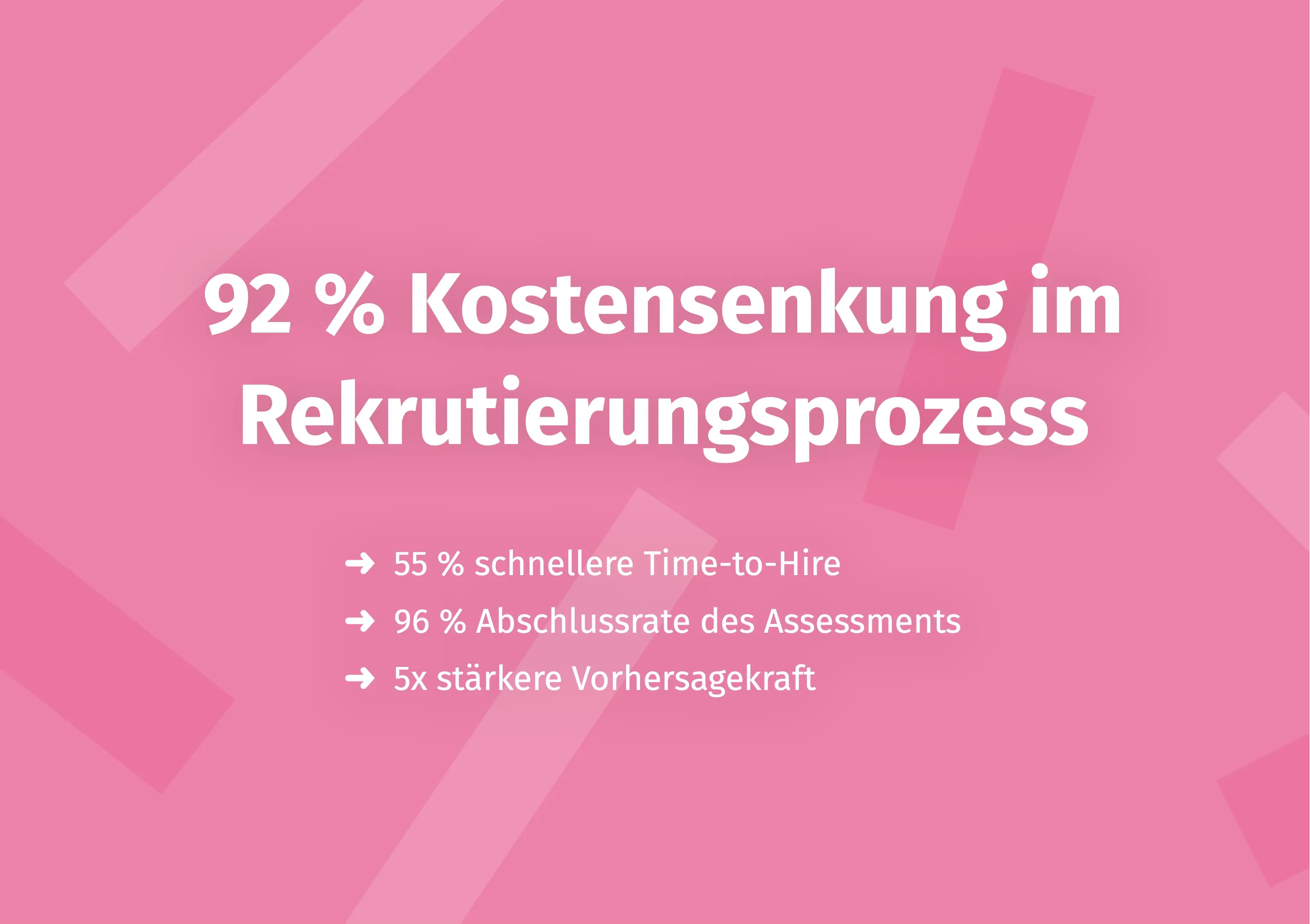
  • 55% faster time-to-hire
  • 92% lower cost-per-hire
  • 96% completion rate in assessment

Matthias Kühne, Director People & Culture at MCI, explains: "We had digitalized the recruiting process extensively with softgarden. With Aivy, we've now digitalized another process step in recruitment and significantly professionalized it through more objective evaluation. Since both systems interact seamlessly, the whole thing not only saves time, but is also really fun in daily work!"

The connection to eNPS: Faster, more efficient processes mean less frustration for recruiters – and better matches lead to more satisfied new employees. This positively affects the overall eNPS long-term.

Find more details in the MCI success story.

Another example is OMR: Kaya Kruse, People Lead at OMR, reports concrete bias reduction: "Aivy works. We reduce bias, gain more objectivity in hiring, and strengthen diversity long-term." Objective selection leads to diverse teams – and diverse teams demonstrably have higher employee satisfaction and better problem-solving capabilities.

Tools and Resources for Your eNPS Measurement

You now know the theory – but how do you implement eNPS in practice? Here are concrete tips on tools, data protection, and communication.

Creating eNPS Surveys: Best Practices

The Central Question:"How likely is it that you would recommend our company as an employer to friends or acquaintances?"

Scale: 0 (very unlikely) to 10 (very likely)

Recommended Follow-up Questions:

For all:

  • "What's the main reason for your rating?" (open text field)

Segmented by score:

  • Promoters (9-10): "What do you particularly like about our company as an employer?"
  • Passives (7-8): "What would make you rate us with a 9 or 10?"
  • Detractors (0-6): "What would you improve about our company as an employer?"

Tool Recommendations:

  • Qualtrics (comprehensive, expensive)
  • SurveyMonkey (simple, free basic version)
  • Typeform (beautiful design, high completion rate)
  • Culture Amp (specialized in employee engagement)
  • Personio (integrated into HR software)

Implementation Tips:

  • Send survey via email (not just as link in intranet)
  • Choose a neutral time (not directly after salary round or layoff wave)
  • Send 1-2 reminders (increases participation rate by 20-30%)
  • Set a clear timeframe (e.g., "Please respond by Friday")
  • Communicate transparently why you're measuring eNPS

Ensuring Anonymity and Data Protection

No honest answers without anonymity. Employees must be sure their rating has no negative consequences.

Measures for Anonymity:

  1. Use External Tools: Internal tools (e.g., own Excel survey) create distrust. Use established survey tools with anonymity guarantee.
  2. No Individual Analysis for Small Groups: With fewer than 10 participants in a segmentation (e.g., department), anonymity cannot be guaranteed. Combine smaller groups.
  3. Transparent Communication: Explain in advance how data will be processed: "Your response is anonymous. No one can attribute your rating to you. We only analyze aggregated data."
  4. GDPR Compliance: Ensure the tool is GDPR-compliant (servers in EU, no unnecessary data collection, opt-out option).
  5. No IP Tracking or Timestamp Analysis: Some tools store IP addresses or timestamps. This undermines anonymity. Deactivate these functions.

Building Trust:

  • Communicate anonymity measures in advance
  • Show after survey that no individuals were identified
  • Use external service providers or HR (not direct managers) for analysis

Communicating Results in the Organization

The results are in – now comes the critical part: How do you communicate them transparently without causing panic or resignation?

Best Practices for Result Communication:

  1. Be Transparent – But With Context: Share overall eNPS, but also explain what the number means. "Our eNPS is +22. That's good for industry average, but we want to improve."
  2. Focus on Measures, Not Blame: Avoid phrases like "The IT department failed." Instead: "There are challenges in IT that we'll address together."
  3. Emphasize Successes: If eNPS increased, celebrate it! "A year ago we were at +15, now at +28. Your feedback worked."
  4. Name Concrete Next Steps: "Based on your responses, we've identified three priorities: 1) Increase flexibility, 2) Strengthen feedback culture, 3) Expand development opportunities. Here are the concrete measures..."
  5. Communicate Follow-up: "We'll inform you about progress in 3 months – and measure eNPS again in 6 months."

Communication Formats:

  • All-hands meeting (for overall eNPS)
  • Department meetings (for segmented results)
  • Written summary via email
  • Dashboard in intranet (for continuous tracking)

What NOT to Do:

  • Hide results (creates distrust)
  • Only share good results (cherry-picking)
  • Don't communicate measures (shows: "This was a waste of time")

Conclusion: eNPS as Part of a Holistic Employee Experience Strategy

eNPS is a powerful tool – but not a panacea. It's an early warning system that shows where you stand. The real work begins afterward: understanding detractors, mobilizing passives, strengthening promoters.

The key insights:

eNPS measures employee loyalty quickly and easily – but doesn't replace deeper surveys
A good eNPS is +30 or higher internationally – but trend is more important than absolute value
Passives are the underestimated potential – don't ignore them, mobilize them
Detractors need to be heard and acted upon – conduct interviews, identify top 3 problems, implement quick wins
Segmentation is key – analyze eNPS by department, location, role to identify problem areas
Research-based yes, but with critical view – eNPS has limitations, combine it with other metrics
Objective assessment improves employee experience – fair selection processes build trust and better matches

eNPS is just one part of your employee experience strategy. Combine it with objective selection processes, continuous development, transparent communication, and appreciative leadership. Companies like Lufthansa and MCI show: when you approach the entire employee journey holistically – from recruiting to employee retention – not only eNPS rises, but also productivity, innovation, and employer attractiveness.

Want to learn more about how objective assessment can improve your employee experience?

Frequently Asked Questions (FAQ)

What's the difference between eNPS and NPS?

NPS measures customer loyalty, eNPS measures employee loyalty. The methodology is identical: one question on a scale of 0-10, division into promoters, passives, and detractors, calculation as difference between promoter and detractor percentage. The only difference is the target group – and significance: a high eNPS correlates with lower turnover and higher productivity.

How often should I conduct eNPS surveys?

For large companies (>500 employees), quarterly measurement is recommended. For SMEs, semi-annual is sufficient. For major changes (restructuring, new CEO, crisis), measure ad-hoc. Important: consistency is crucial. Choose a fixed rhythm and stick to it to recognize trends.

What's a good eNPS value internationally?

Values above +30 are considered good, above +50 excellent. The international average varies significantly: North America +30-40, Europe +15-25, Asia +10-20. A negative eNPS (below 0) is critical and requires immediate action. Important: compare your eNPS primarily with your own trend and regional companies – not just international benchmarks, as cultural differences strongly influence ratings.

Are passives really neutral?

No! That's a widespread misconception. Passives aren't "neutral" employees, but ready to switch. A rating of 7 or 8 means: "Satisfied, but wouldn't actively recommend." With an attractive offer, passives leave faster than promoters. They tend more toward detractors than promoters, so you should actively address them: "What would make you give a 9 or 10?"

How do I handle a negative eNPS?

Four immediate measures: 1) Conduct detractor interviews to identify main problems. 2) Identify top 3 problems from interviews. 3) Implement quick wins – small but visible improvements that show: "We listen and act." 4) Communicate transparently: share results openly, without blame, and explain concrete next steps. Don't expect miracles: a negative eNPS needs 1-2 years to improve significantly.

Which follow-up questions complement eNPS meaningfully?

Open questions are crucial to understand the "why" behind the score. For all: "What's the main reason for your rating?" Segmented by score groups: Promoters: "What do you particularly like?", Passives: "What would make you give a 9 or 10?", Detractors: "What would you improve?" Avoid multiple choice – the authentic, unfiltered answers in open text fields are more valuable, even though analysis is more elaborate.

Can I compare eNPS with other companies?

Yes, but carefully. Industry, company size, and culture strongly influence eNPS. Tech companies tend to have higher values than retail. Large corporations lower than startups. North American companies higher than European (cultural reservation in ratings). Use benchmarks as orientation, but focus on your own trend: an increase from +15 to +30 is more valuable than a static value of +35.

How do I ensure anonymity in eNPS surveys?

Five measures: 1) Use external, established survey tools (not internal Excel surveys). 2) No individual analysis for groups with fewer than 10 participants. 3) Communicate transparently in advance how data will be processed. 4) Ensure GDPR compliance (servers in EU, opt-out option). 5) Deactivate IP tracking and detailed timestamp analysis. Without true anonymity, you won't get honest answers – distrust is the greatest enemy of valid data.

Should I publicly communicate eNPS results?

Yes, transparency increases trust! Share overall eNPS, key insights, and especially concrete measures you're taking. Avoid blame ("IT failed") and focus on solutions. Also show progress: if eNPS increased, celebrate it! Employees want to know their feedback was heard and leads to changes. Hiding results signals: "Was a waste of time" – and destroys trust for future surveys.

Can eNPS predict resignations?

Yes, with limitations. Detractors have 3-5x higher resignation probability than promoters. eNPS is a statistical early warning system: declining eNPS signals increased turnover risk. But: eNPS doesn't predict individual resignations. A person with score 6 may stay while one with score 7 leaves. Use eNPS as trend indicator and combine it with other signals (absenteeism, performance, 1:1 conversations).

What do I do when individual departments have extremely low values?

Four steps: 1) Involve the manager – often this is the problem. 2) Conduct a team workshop to discuss problems openly (with neutral moderation). 3) Implement quick, visible improvements (quick wins). 4) Conduct follow-up survey after 3 months to check if measures work. Often department-specific problems are solvable – but only if you look specifically and don't just stare at overall eNPS.

How does eNPS differ from traditional employee surveys?

eNPS is a single-item measure: one question, few minutes, quick analysis. Traditional employee surveys are multi-dimensional: 30-50 questions on various topics (leadership, development, salary, culture) and provide in-depth analysis. eNPS is a quick indicator ("thermometer"), traditional surveys are the diagnosis. Ideal: eNPS quarterly as early warning system, comprehensive survey annually for detailed insights.

Can external factors (pandemic, economic crisis) distort eNPS?

Yes, considerably. eNPS measures current mood – not long-term loyalty. During a crisis or after negative headlines, eNPS can temporarily drop even if the company itself is well managed. Therefore: always consider context. If your eNPS drops after a layoff wave, that's normal – but watch if it recovers afterward. The trend over 12-24 months is more meaningful than a single snapshot.

How do I connect eNPS with recruiting success?

The connection is clear: High eNPS → satisfied employees → better employer reviews (Glassdoor, Kununu) → more qualified applications → shorter time-to-hire. Your employees are your best brand ambassadors. Promoters actively recommend your company in their network, post positively on LinkedIn, speak enthusiastically about their work in interviews. That's authentic employer branding – and significantly more effective than any advertising campaign.

What's the ideal timing for an eNPS survey?

Avoid sensitive times: not directly after salary rounds (expectations are high), not during layoff waves (mood at bottom), not in acute crises (distorts results). Ideal is mid-quarter when daily routine is "normal." More important than perfect timing is consistency: choose a fixed rhythm (e.g., always mid-February, May, August, November) and stick to it. This makes trends comparable.

Home
-
lexicon
-
Analyzing eNPS: How to Properly Interpret Your Employee Net Promoter Score

High turnover, poor employer ratings on Glassdoor or Kununu, declining employee motivation – many HR professionals know these challenges all too well. But how do you objectively measure how loyal and satisfied your employees really are? The Employee Net Promoter Score (eNPS) has established itself as a simple yet meaningful metric for capturing employee loyalty.

In this comprehensive guide, you'll learn how to correctly calculate, interpret, and analyze your eNPS. You'll discover which eNPS values are considered good, how to segment results by department, and most importantly: what concrete measures you can take to turn detractors into promoters. Research-backed, practical, and with real-world examples from the HR world.

What is eNPS? Definition and Fundamentals

The Employee Net Promoter Score (eNPS) is a metric for measuring employee loyalty. Employees rate on a scale from 0-10 how likely they are to recommend the company as an employer. This simple question gives you a quick overview of the mood in your organization – and shows resignation risks early on.

The eNPS is based on the Net Promoter Score (NPS), a methodology originally developed by Fred Reichheld to measure customer loyalty. In his groundbreaking article "The One Number You Need to Grow" (Harvard Business Review, 2003), Reichheld argued that the question "How likely would you be to recommend our company?" was the best predictor of company growth – simpler and more precise than complex satisfaction scores.

The Evolution: From NPS to eNPS

While the classic NPS measures customer loyalty, eNPS applies this concept to employees. The methodology is identical: one question, a scale from 0-10, and a clear calculation. The difference lies in the target group and significance: a high eNPS signals not only satisfied employees, but also lower turnover costs, better productivity, and a stronger employer brand.

According to a study by Satmetrix Systems (2019), companies with an eNPS above 50 have a 25% lower turnover rate than companies with a negative eNPS. The method has therefore become established worldwide as a standard metric in HR management.

Why eNPS Matters for HR

In times of talent shortage, employee retention is more important than ever. The costs of turnover are significant: Korn Ferry (2021) estimates turnover costs at 150-200% of annual salary – including recruiting, onboarding, and productivity loss. eNPS helps you identify resignation risks early and take countermeasures.

Moreover, the Gallup study "State of the Global Workplace" (2020) shows that 85% of employees worldwide are not engaged. eNPS gives you a quick, regularly measurable indicator to check whether your employee retention measures are working. And the best part: unlike elaborate employee surveys, eNPS can be conducted and evaluated in just a few minutes.

Calculating eNPS: Formula and Step-by-Step Guide

Calculating eNPS is simple, but requires care. The basis is the central question: "How likely is it that you would recommend our company as an employer to friends or acquaintances?" Responses are captured on a scale from 0 (very unlikely) to 10 (very likely).

The eNPS Formula Explained

Based on the responses, employees are divided into three groups:

  • Promoters (9-10): Highly satisfied, loyal employees who actively recommend the company and act as brand ambassadors. They speak positively about the company in their network and are significantly less likely to resign.
  • Passives (7-8): Satisfied but not enthusiastic employees. They're not dissatisfied, but wouldn't actively recommend the company. Passives stay as long as nothing better comes along – when attractive offers arise, they're more likely to switch than promoters.
  • Detractors (0-6): Dissatisfied employees who view the company critically. They potentially speak negatively about the employer, write negative reviews on Glassdoor or Kununu, and are at acute risk of resignation.

The eNPS formula is:

eNPS = % Promoters - % Detractors

Passives are not considered in the calculation – we'll discuss their role in detail later.

Calculation Example: How to Calculate Your eNPS

Let's say you conduct an eNPS survey in your company with 100 employees. The results:

  • 50 employees give a 9 or 10 → 50 Promoters → 50%
  • 30 employees give a 7 or 8 → 30 Passives → 30%
  • 20 employees give a 0-6 → 20 Detractors → 20%

Calculation: eNPS = 50% - 20% = +30

Your eNPS is +30. This means: you have more promoters than detractors – a positive sign. However, there's still considerable room for improvement, as 30% of your workforce are passives, and 20% are actively dissatisfied.

Another example with negative eNPS: With 2,000 employees, you receive 600 promoters (30%) and 800 detractors (40%). The remaining 600 (30%) are passives.

Calculation: eNPS = 30% - 40% = -10

A negative eNPS signals serious problems: you have more detractors than promoters. Urgent action is required here.

Understanding Promoters, Passives, and Detractors

The division into three groups may seem arbitrary at first glance, but follows psychological insights into willingness to recommend. Studies show: people who give a 9 or 10 are indeed significantly more loyal and willing to recommend than those with a 7 or 8.

Promoters are your most valuable employees from an employee experience perspective. They contribute positively to company culture, are more motivated and productive. SHRM (2022) proves that satisfied employees are 12% more productive and have 31% fewer absent days.

Passives are often underestimated. A rating of 7 or 8 initially sounds "satisfied," but the reality is: this group is ready to switch. They wouldn't actively criticize the company, but wouldn't defend it either. When attractive offers arise, passives switch faster than promoters. Many companies make the mistake of ignoring passives – yet there's great potential here to turn "satisfied" into "enthusiastic."

Detractors are your biggest risk. They have a 3-5x higher likelihood of resignation and can cause significant damage through negative word of mouth. Important: not every detractor is "lost." Often the reasons for dissatisfaction can be fixed – such as poor leadership, lack of development opportunities, or unfair processes.

Common Calculation Errors

Error 1: Including Passives Some HR managers mistakenly add passives to promoters or average all three groups. This significantly distorts the score. The eNPS methodology deliberately excludes passives from the calculation.

Error 2: Sample Too Small With fewer than 30 participants, results are not statistically robust. One more or fewer detractor drastically changes the score. For reliable statements, you need a participation rate of at least 60-70%.

Error 3: Wrong Scale Some tools use a 5-point scale instead of the standard 11-point scale (0-10). This leads to different calculations and makes benchmarks incomparable. Stick to the original methodology.

Error 4: Premature Rounding Round only at the end, not at the percentages. With 100 employees with 33 promoters and 15 detractors: eNPS = 33% - 15% = 18, not 30% - 20% = 10.

Interpreting eNPS Values Correctly

You've calculated your eNPS – but what does the number actually mean? Is a value of +20 good or bad? And how do benchmarks differ by industry and company size?

What is a Good eNPS? International Benchmarks

eNPS can theoretically range between -100 (all detractors) and +100 (all promoters). In reality, however, values look different. Here are general guidelines:

eNPS Range Rating Interpretation
< 0 Critical More detractors than promoters. Immediate action required.
0-30 Needs Improvement Positive basic mood, but much room for improvement. Structural changes recommended.
30-50 Good Solid employee loyalty. Fine-tuning and optimization advisable.
50-70 Very Good Above-average employee satisfaction. Maintain excellence.
> 70 Excellent Top performer. Document and share best practices.

Important: These values are guidelines, not absolute truths. The international average varies significantly by region and culture. In North America, scores tend to be higher (+30-40 average) than in Europe (+15-25 average) or Asia (+10-20 average).

Why are values lower in some regions? Cultural factors play a role: Germans, British, and many Asian cultures are generally more reserved in ratings than Americans. A 9 or 10 is given less frequently. This means: compare your eNPS primarily with your own history and with companies in your region – not just with international benchmarks.

eNPS by Industry and Company Size

Industry significantly influences eNPS. Some industry benchmarks (estimated, 2025):

  • Tech/IT: Average +32, Top quartile +58
  • Healthcare: Average +12, Top quartile +28
  • Retail: Average +8, Top quartile +25
  • Manufacturing: Average +20, Top quartile +42
  • Financial Services: Average +15, Top quartile +38

Company size also plays a role:

  • Startups (<50 employees): Often higher values (+40-55), but more volatile
  • SMEs (50-500 employees): Average +25-35
  • Large enterprises (>1,000 employees): Average +15-25, but more stable

Large companies tend to have lower values because employee retention is more difficult and individual bad experiences (e.g., with a manager) affect the overall score. Startups often benefit from higher identification, but must expect strong fluctuations.

Negative eNPS: What Does It Mean?

A negative eNPS is an alarm signal. It means: you have more actively dissatisfied employees than loyal ambassadors. The consequences:

  • High turnover: Detractors resign 3-5x more frequently
  • Negative word of mouth: Poor reviews on Glassdoor/Kununu
  • Declining productivity: Unmotivated teams, "quiet quitting"
  • Recruiting difficulties: Bad reputation as employer
  • Cultural problems: Toxic work climate, conflicts

However, a negative eNPS is not the end. Many companies have improved their score from -20 to +40 – through consistent measures, transparent communication, and real changes. The first step: understand the causes. Conduct detractor interviews (more on this later).

The Difference Between Absolute Value and Trend

An often overlooked insight: The trend is more important than the absolute value.

Example 1: Your eNPS has been stable at +35 for two years. That's good, but also shows: there's no improvement. You may not have reached passives or ignored detractors.

Example 2: Your eNPS increased from +10 to +25 – within 12 months. That's excellent! It shows: your measures are working.

Example 3: Your eNPS drops from +30 to +18. Warning sign! Even though +18 is "okay" in absolute terms, the decline signals a problem. What changed? New manager? Restructuring? Skipped salary round?

Recommendation: Measure eNPS quarterly (for large companies) or semi-annually (for SMEs) and track the trend. A consistent upward trend shows you're on the right path – even if the absolute value isn't "excellent" yet.

Analyzing eNPS: From Number to Insight

An eNPS of +25 is a number. But what's behind it? The real work begins after calculation: you need to segment results, evaluate qualitative data, and identify concrete action areas.

Segmentation: eNPS by Department, Location, Role

One of eNPS's greatest strengths: you can calculate it for different groups and thus identify problem areas. The most important segmentations:

1. By Department: Example: Overall eNPS +30, but IT department +50 and Sales -10. Clear: there's a massive problem in Sales – probably poor leadership, unrealistic targets, or overload.

2. By Location: With multiple locations, you can identify differences in corporate culture or management. Location A: +45, Location B: +5 → What's going wrong in Location B?

3. By Role/Hierarchy Level: Often eNPS differs greatly between managers (+40) and operational employees (+10). This indicates a lack of connection between management and base.

4. By Tenure: New employees (< 1 year): +35. Long-tenured (> 5 years): +15. This signals: the onboarding process is good, but long-term development perspectives are lacking.

5. By Age/Generation: Gen Z (< 30 years): +20. Baby Boomers (> 55 years): +40. Younger employees have different expectations (flexibility, purpose, development) – these must be addressed.

Pro tip: Only segment groups with at least 10 participants, otherwise you risk anonymity.

Detractor Analysis: The Most Important Group

Detractors are your most urgent construction site. They cost you money (turnover), image (bad reviews), and productivity (demotivation). Therefore: focus on this group.

Step 1: Identify the Top 3 ProblemsSupplement the eNPS question with an open follow-up question: "What would you improve about our company as an employer?" Categorize detractors' responses:

Common themes:

  • Poor leadership/lack of appreciation (40% of mentions)
  • Missing development opportunities (25%)
  • Overload/work-life balance (20%)
  • Salary/benefits (15%)
  • Corporate culture/missing purpose (10%)

Step 2: Conduct Detractor Interviews In smaller companies: offer all detractors a confidential conversation (voluntary, with HR or external moderation). Ask:

  • "What's the main reason for your rating?"
  • "Was there a specific event that changed your view?"
  • "What would need to change for you to recommend us?"

Step 3: Prioritize Quick Wins Some problems are quickly solvable (e.g., better home office policy), others long-term (e.g., leadership development). Start with quick wins to show: "We listen and act."

Understanding Passives: The Underestimated Potential

Passives are ignored in eNPS calculation – but that doesn't mean they're unimportant. On the contrary: they're your biggest opportunity.

Why Passives Matter:

  • They often represent 30-40% of the workforce
  • They're ready to switch, but haven't left yet
  • Small improvements can turn them into promoters
  • If ignored, they become detractors

The Passive Trap: A 7 or 8 sounds "satisfied," but that's deceptive. Passives say: "It's okay, but I wouldn't actively promote it." That means: with a better offer, they're gone.

Strategy for Passives: Supplement the eNPS survey with the question: "What would make you rate us with a 9 or 10?" The answers show you specifically what's missing:

  • "More flexibility"
  • "Better development opportunities"
  • "Clearer communication from above"

Passives are often employees who are basically satisfied, but miss that "certain something." A salary increase alone is rarely enough – it's about appreciation, development, and purpose.

Qualitative Data: Using Follow-up Questions Correctly

The eNPS score is quantitative, but only qualitative data makes it valuable. Therefore, always ask follow-up questions:

For Promoters (9-10):

  • "What do you particularly like about our company as an employer?"
  • "What should we definitely keep doing?"

These questions show you what you're doing right. Document the answers and share them internally – as best practices.

For Passives (7-8):

  • "What would make you rate us with a 9 or 10?"
  • "What are you currently missing?"

For Detractors (0-6):

  • "What would you improve about our company as an employer?"
  • "Was there a specific event that made you dissatisfied?"

Important: Use open text fields, not multiple choice. This gives you authentic, unfiltered answers. Yes, the analysis is more elaborate – but the insights are worth gold.

Scientific Perspective: Strengths and Limitations of eNPS

eNPS is popular – but is it scientifically valid? Let's take a critical look at strengths and weaknesses.

What eNPS Does (and Doesn't Do)

Strengths of eNPS:

  1. Simplicity: One question, few minutes, clear calculation
  2. Comparability: Across time, departments, industries
  3. Acceptance: Globally established standard
  4. Speed: Quarterly measurement possible (pulse survey)
  5. Predictive validity: Demonstrably correlates with turnover

Limitations of eNPS:

  1. Single-item measure: Only one question doesn't capture the complexity of employee experience
  2. No depth: Why someone gives a 6 or 8 remains unclear (without follow-up questions)
  3. Cultural bias: Germans rate more reservedly than Americans, for example
  4. Context-dependent: External events (pandemic, economic crisis) distort results

What eNPS Measures:

  • Current mood ("How are you today?")
  • Willingness to recommend as proxy for loyalty

What eNPS Does NOT Measure:

  • Engagement in terms of "discretionary effort"
  • Specific drivers of satisfaction (salary, leadership, development)
  • Long-term retention (only snapshot)

Conclusion: eNPS is a valuable indicator, but not a complete picture. Use it as an early warning system and supplement it with deeper surveys.

Critical Examination: Limitations of the Method

The scientific criticism of eNPS – and the underlying NPS – is not new. Two frequently cited studies:

Keiningham et al. (2007) analyzed data from over 21,000 customers in their study "A Longitudinal Examination of Net Promoter and Firm Revenue Growth" (Journal of Marketing) and concluded: NPS is not significantly better than other loyalty metrics in predicting growth. Willingness to recommend doesn't correlate more strongly with business outcomes than overall satisfaction.

Morgan & Rego (2006) criticize the categorization into three groups in "The Value of Different Customer Satisfaction and Loyalty Metrics" (Marketing Science): dividing into promoters, passives, and detractors causes loss of statistical information. A continuous scale (0-10) would be more precise.

What Does This Mean for eNPS?

The criticism is justified, but not fatal. eNPS is not a perfect scientific instrument – but it doesn't have to be. Its value lies in practicality:

  • Quick to conduct (high participation rate)
  • Easy to communicate (management intuitively understands "+30")
  • Action-oriented (detractors are a clear target group)

The key is: don't use eNPS in isolation. Combine it with:

  • Deeper employee surveys (annually)
  • Pulse surveys on specific topics (monthly/quarterly)
  • Qualitative interviews
  • Other HR KPIs (turnover rate, absenteeism, productivity)

eNPS in Context of Other HR Metrics

eNPS is just one of many HR metrics. It only becomes truly meaningful in conjunction with other metrics.

Important Correlations:

HR KPI Correlation with eNPS Interpretation
Turnover Rate Strongly negatively correlated Low eNPS → higher turnover
Absenteeism Negatively correlated Detractors have more sick days
Productivity Positively correlated Promoters are more productive (SHRM: +12%)
Recruiting Success Positively correlated High eNPS → better reviews → more applicants
Innovation Positively correlated Engagement fosters creativity

Example Dashboard:

  • eNPS: +28 (Trend: +5 vs. previous quarter)
  • Turnover rate: 12% p.a. (Target: <10%)
  • Absenteeism: 4.2% (Industry average: 5.1%)
  • Glassdoor rating: 3.8/5
  • Recruiting time-to-hire: 45 days (Previous year: 52 days)

This context shows: eNPS is rising, turnover is still too high, but absenteeism and recruiting are improving. The measures are working – medium-term.

Improving eNPS: Concrete Measures for Different Score Ranges

You've analyzed your eNPS – now it's time to act. Measures differ depending on score range.

Negative eNPS (< 0): Crisis Intervention

A negative eNPS is an emergency. More detractors than promoters means: massive loss of trust, high turnover, toxic culture. You need immediate, visible changes here.

Immediate Measures (first 4 weeks):

  1. Conduct Detractor Interviews: Offer all detractors a confidential conversation (voluntary, with neutral person). Listen without justifying. Ask: "What's the biggest problem?" and "What would need to change?"
  2. Identify Top 3 Problems: Categorize statements. Usually 2-3 core themes crystallize (e.g., poor leadership, overload, lack of appreciation).
  3. Implement Quick Wins: Look for problems you can solve quickly. Examples:
    • Too little flexibility? → Introduce 2 home office days per week
    • Poor communication? → Start monthly all-hands meetings
    • Lack of appreciation? → Implement a peer recognition system
  4. Communicate Transparently: Share eNPS results openly (without blame). Say: "We have a problem, and we're addressing it. Here are the concrete steps." Show first successes in 6 weeks.

Medium-term Measures (3-6 months):

  • Leadership development: Poor leadership is the most common reason for low eNPS. Invest in trainings, coaching, 360° feedback.
  • Structural changes: Often processes are the problem (overloaded teams, unrealistic goals, inefficient workflows). Systematically revise these.
  • Cultural transformation: A negative eNPS indicates cultural problems. Redefine values, model them, sanction toxic behavior.

Warning: Don't expect miracles. An eNPS of -15 won't become +40 in 3 months. Realistic is +10-15 points per year – if you work consistently.

Low eNPS (0-30): Structural Improvements

An eNPS between 0 and 30 is "okay," but far from good. You have more promoters than detractors, but many passives and too many dissatisfied. Here you need structural improvements.

Focus: Turn Passives into Promoters

Most companies in this range have 30-40% passives. That's your opportunity. Ask them specifically: "What would make you rate us with a 9 or 10?"

Common answers:

  • "More development opportunities"
  • "Better work-life balance"
  • "Clearer communication and transparency"
  • "Stronger purpose/meaning of work"

Concrete Measures:

  1. Create Development Perspectives: Introduce Individual Development Plans (IDPs), mentoring programs, internal job rotations. Passives often stay because they see no perspective.
  2. Strengthen Feedback Culture: Introduce regular 1:1s (every 2 weeks), constructive feedback, transparent goal setting. Many passives feel "left in the dark."
  3. Increase Flexibility: Hybrid work models, flexible working hours, sabbatical options. Work-life balance is a top topic among passives.
  4. Show Appreciation: Recognition doesn't have to be expensive. Small gestures (personal praise, public appreciation, team events) often have big impact.

Timeline: Expect improvements after 6-12 months. An increase from +20 to +35 is realistic.

Medium eNPS (30-50): Fine-tuning

An eNPS between 30 and 50 is good. You're doing many things right, but there's still room for improvement. Now it's about fine-tuning and excellence.

Focus: Address Detractors Specifically

At this score level, you usually have only 10-15% detractors. Often it's specific groups (e.g., a certain department or location). Segment your eNPS and identify outliers.

Concrete Measures:

  1. Department/Location-specific Interventions: If Sales has an eNPS of +10 while the rest is at +45, that's a clear leadership or structural problem. Work specifically with this group.
  2. Share Best Practices: What's going right in departments with high eNPS? Document it and transfer it to other areas.
  3. Optimize Employee Experience Journey: Map the entire employee journey (onboarding, development, offboarding) and identify weak points. Often it's small things (boring onboarding, missing exit interviews) that frustrate.
  4. Strengthen Innovation and Purpose: At this level, it's no longer just about basics (salary, flexibility), but purpose. Involve employees in strategic decisions, foster innovation, give ownership.

Timeline: An increase from +40 to +55 is feasible within a year – but requires continuous work.

High eNPS (> 50): Maintain and Expand Excellence

An eNPS above 50 is excellent. You're a top performer. Now it's about maintaining this level and becoming a benchmark.

Challenge: The higher the eNPS, the more difficult further increases. The jump from +30 to +50 is easier than from +50 to +70.

Concrete Measures:

  1. Document and Share Best Practices: Become a thought leader. Publish case studies, give talks, share your learnings with the HR community.
  2. Continuous Monitoring: With high eNPS, there's a risk of complacency. Measure quarterly, react quickly to declines.
  3. Turn Promoters into Brand Ambassadors: Actively use your promoters for employer branding. Offer them to participate in recruiting campaigns, post on LinkedIn, speak at events.
  4. Stay Innovative: Introduce new benefits (e.g., mental health, parental leave programs, sabbaticals) before employees ask for them. Be a pioneer, not a follower.

Warning: A high eNPS can quickly tip – e.g., through a bad management decision, a botched salary round, or a toxic leader. Stay vigilant.

From Detractors to Promoters: Strategies for Increasing Employee Loyalty

You have the greatest leverage when you convert detractors into promoters. This is harder than mobilizing passives, but the impact is enormous.

Detractor Interviews: Asking the Right Questions

Detractors often feel unheard. A confidential, open-ended conversation can work wonders – even if you can't solve all problems immediately.

The Most Important Questions:

  1. "What's the main reason for your rating?" (Listen openly, without justification)
  2. "Was there a specific event that changed your view?" (Often there's a "trigger")
  3. "What would need to change for you to recommend us?" (Concrete expectations)
  4. "Is there anything you particularly appreciate?" (Don't forget positive aspects)

Important:

  • Conduct conversations with neutral person (HR, external coach)
  • Guarantee confidentiality (no direct consequences)
  • Document patterns (not individual statements)
  • Communicate measures back ("We listened, here are the next steps")

Pro tip: Not every detractor wants a conversation. That's okay. Offer it, don't force anyone. Often 30-50% respond – that's enough to recognize patterns.

Quick Wins for Fast Improvements

Some measures have immediate impact. Use them to show: "We're acting."

Examples of Quick Wins:

  • Flexibility: Introduce 2 home office days per week (if not already done)
  • Communication: Start monthly all-hands meetings with Q&A
  • Appreciation: Implement a peer recognition tool (e.g., Bonusly, Kudos)
  • Development: Create a budget for individual training (e.g., $500/year per person)
  • Processes: Eliminate unnecessary bureaucracy (e.g., simplify approval processes)

Quick wins are important because they build trust: "They listen to us and do something." That's the foundation for long-term changes.

Long-term Cultural Change

Many causes of low eNPS are structural and take time. But: long-term changes have sustainable impact.

Cultural Change Strategies:

  1. Leadership Development: Poor leadership is the most common reason for detractors. Invest massively in trainings, coaching, 360° feedback. Consistently sanction toxic behavior.
  2. Define and Live Values: Many companies have values on their website – but do they live them? Define 3-5 core values, communicate them clearly, integrate them into performance reviews, reward values-aligned behavior.
  3. Transparency and Trust: Share business numbers, explain decisions, provide insight into strategy. Trust emerges through transparency.
  4. Participation: Involve employees in decisions (e.g., about work models, benefits, processes). Ownership increases loyalty.
  5. Purpose and Impact: Especially younger generations seek meaning. Show how work makes a difference – for customers, society, environment.

Timeline: Cultural change takes 2-3 years. But: you should measure progress every quarter (eNPS trend).

eNPS in Practice: Success Stories and Learnings

How do successful companies implement employee experience and objective selection? Three practical examples.

How Objective Assessment Improves Employee Experience

Many companies underestimate the connection between recruiting and employee satisfaction. Yet candidate experience is the first touchpoint – and shapes the entire employee journey.

Objective assessment, as used by platforms like Aivy, creates fair, transparent selection processes. This directly affects employee experience:

  • Fairness: Employees selected through objective processes perceive the process as more just
  • Better fit: Better matching between person and role reduces frustration and turnover
  • Diversity: Bias reduction leads to more diverse teams – and diverse teams are demonstrably more satisfied and innovative
  • Trust: A research-based process signals: "This company takes talent selection seriously"

Case Study: Lufthansa's Focus on Candidate & Employee Satisfaction

Lufthansa relies on objective assessment with game-based assessments. The results speak for themselves:

  • 81% satisfaction among candidates – significantly above industry average
  • 96% accuracy rate (correct prediction compared to in-house assessment)
  • 100+ minutes saved testing time per candidate
  • 86% completion rate in assessment

As Susanne Berthold-Neumann from Lufthansa emphasizes: "We look at documents late because they only show a small part of the person and say little about whether someone has the competencies for future challenges."

The focus on objective, competency-based selection leads not only to better candidate experience, but also to higher employee satisfaction: the right person in the right place is the best guarantee for long-term loyalty.

Find more details in the Lufthansa success story.

MCI: Efficiency Gains Through Better Employee Retention

MCI Deutschland GmbH shows how objective assessment improves not only candidate experience, but also recruiting efficiency – with direct effect on employee experience:

  • 55% faster time-to-hire
  • 92% lower cost-per-hire
  • 96% completion rate in assessment

Matthias Kühne, Director People & Culture at MCI, explains: "We had digitalized the recruiting process extensively with softgarden. With Aivy, we've now digitalized another process step in recruitment and significantly professionalized it through more objective evaluation. Since both systems interact seamlessly, the whole thing not only saves time, but is also really fun in daily work!"

The connection to eNPS: Faster, more efficient processes mean less frustration for recruiters – and better matches lead to more satisfied new employees. This positively affects the overall eNPS long-term.

Find more details in the MCI success story.

Another example is OMR: Kaya Kruse, People Lead at OMR, reports concrete bias reduction: "Aivy works. We reduce bias, gain more objectivity in hiring, and strengthen diversity long-term." Objective selection leads to diverse teams – and diverse teams demonstrably have higher employee satisfaction and better problem-solving capabilities.

Tools and Resources for Your eNPS Measurement

You now know the theory – but how do you implement eNPS in practice? Here are concrete tips on tools, data protection, and communication.

Creating eNPS Surveys: Best Practices

The Central Question:"How likely is it that you would recommend our company as an employer to friends or acquaintances?"

Scale: 0 (very unlikely) to 10 (very likely)

Recommended Follow-up Questions:

For all:

  • "What's the main reason for your rating?" (open text field)

Segmented by score:

  • Promoters (9-10): "What do you particularly like about our company as an employer?"
  • Passives (7-8): "What would make you rate us with a 9 or 10?"
  • Detractors (0-6): "What would you improve about our company as an employer?"

Tool Recommendations:

  • Qualtrics (comprehensive, expensive)
  • SurveyMonkey (simple, free basic version)
  • Typeform (beautiful design, high completion rate)
  • Culture Amp (specialized in employee engagement)
  • Personio (integrated into HR software)

Implementation Tips:

  • Send survey via email (not just as link in intranet)
  • Choose a neutral time (not directly after salary round or layoff wave)
  • Send 1-2 reminders (increases participation rate by 20-30%)
  • Set a clear timeframe (e.g., "Please respond by Friday")
  • Communicate transparently why you're measuring eNPS

Ensuring Anonymity and Data Protection

No honest answers without anonymity. Employees must be sure their rating has no negative consequences.

Measures for Anonymity:

  1. Use External Tools: Internal tools (e.g., own Excel survey) create distrust. Use established survey tools with anonymity guarantee.
  2. No Individual Analysis for Small Groups: With fewer than 10 participants in a segmentation (e.g., department), anonymity cannot be guaranteed. Combine smaller groups.
  3. Transparent Communication: Explain in advance how data will be processed: "Your response is anonymous. No one can attribute your rating to you. We only analyze aggregated data."
  4. GDPR Compliance: Ensure the tool is GDPR-compliant (servers in EU, no unnecessary data collection, opt-out option).
  5. No IP Tracking or Timestamp Analysis: Some tools store IP addresses or timestamps. This undermines anonymity. Deactivate these functions.

Building Trust:

  • Communicate anonymity measures in advance
  • Show after survey that no individuals were identified
  • Use external service providers or HR (not direct managers) for analysis

Communicating Results in the Organization

The results are in – now comes the critical part: How do you communicate them transparently without causing panic or resignation?

Best Practices for Result Communication:

  1. Be Transparent – But With Context: Share overall eNPS, but also explain what the number means. "Our eNPS is +22. That's good for industry average, but we want to improve."
  2. Focus on Measures, Not Blame: Avoid phrases like "The IT department failed." Instead: "There are challenges in IT that we'll address together."
  3. Emphasize Successes: If eNPS increased, celebrate it! "A year ago we were at +15, now at +28. Your feedback worked."
  4. Name Concrete Next Steps: "Based on your responses, we've identified three priorities: 1) Increase flexibility, 2) Strengthen feedback culture, 3) Expand development opportunities. Here are the concrete measures..."
  5. Communicate Follow-up: "We'll inform you about progress in 3 months – and measure eNPS again in 6 months."

Communication Formats:

  • All-hands meeting (for overall eNPS)
  • Department meetings (for segmented results)
  • Written summary via email
  • Dashboard in intranet (for continuous tracking)

What NOT to Do:

  • Hide results (creates distrust)
  • Only share good results (cherry-picking)
  • Don't communicate measures (shows: "This was a waste of time")

Conclusion: eNPS as Part of a Holistic Employee Experience Strategy

eNPS is a powerful tool – but not a panacea. It's an early warning system that shows where you stand. The real work begins afterward: understanding detractors, mobilizing passives, strengthening promoters.

The key insights:

eNPS measures employee loyalty quickly and easily – but doesn't replace deeper surveys
A good eNPS is +30 or higher internationally – but trend is more important than absolute value
Passives are the underestimated potential – don't ignore them, mobilize them
Detractors need to be heard and acted upon – conduct interviews, identify top 3 problems, implement quick wins
Segmentation is key – analyze eNPS by department, location, role to identify problem areas
Research-based yes, but with critical view – eNPS has limitations, combine it with other metrics
Objective assessment improves employee experience – fair selection processes build trust and better matches

eNPS is just one part of your employee experience strategy. Combine it with objective selection processes, continuous development, transparent communication, and appreciative leadership. Companies like Lufthansa and MCI show: when you approach the entire employee journey holistically – from recruiting to employee retention – not only eNPS rises, but also productivity, innovation, and employer attractiveness.

Want to learn more about how objective assessment can improve your employee experience?

Frequently Asked Questions (FAQ)

What's the difference between eNPS and NPS?

NPS measures customer loyalty, eNPS measures employee loyalty. The methodology is identical: one question on a scale of 0-10, division into promoters, passives, and detractors, calculation as difference between promoter and detractor percentage. The only difference is the target group – and significance: a high eNPS correlates with lower turnover and higher productivity.

How often should I conduct eNPS surveys?

For large companies (>500 employees), quarterly measurement is recommended. For SMEs, semi-annual is sufficient. For major changes (restructuring, new CEO, crisis), measure ad-hoc. Important: consistency is crucial. Choose a fixed rhythm and stick to it to recognize trends.

What's a good eNPS value internationally?

Values above +30 are considered good, above +50 excellent. The international average varies significantly: North America +30-40, Europe +15-25, Asia +10-20. A negative eNPS (below 0) is critical and requires immediate action. Important: compare your eNPS primarily with your own trend and regional companies – not just international benchmarks, as cultural differences strongly influence ratings.

Are passives really neutral?

No! That's a widespread misconception. Passives aren't "neutral" employees, but ready to switch. A rating of 7 or 8 means: "Satisfied, but wouldn't actively recommend." With an attractive offer, passives leave faster than promoters. They tend more toward detractors than promoters, so you should actively address them: "What would make you give a 9 or 10?"

How do I handle a negative eNPS?

Four immediate measures: 1) Conduct detractor interviews to identify main problems. 2) Identify top 3 problems from interviews. 3) Implement quick wins – small but visible improvements that show: "We listen and act." 4) Communicate transparently: share results openly, without blame, and explain concrete next steps. Don't expect miracles: a negative eNPS needs 1-2 years to improve significantly.

Which follow-up questions complement eNPS meaningfully?

Open questions are crucial to understand the "why" behind the score. For all: "What's the main reason for your rating?" Segmented by score groups: Promoters: "What do you particularly like?", Passives: "What would make you give a 9 or 10?", Detractors: "What would you improve?" Avoid multiple choice – the authentic, unfiltered answers in open text fields are more valuable, even though analysis is more elaborate.

Can I compare eNPS with other companies?

Yes, but carefully. Industry, company size, and culture strongly influence eNPS. Tech companies tend to have higher values than retail. Large corporations lower than startups. North American companies higher than European (cultural reservation in ratings). Use benchmarks as orientation, but focus on your own trend: an increase from +15 to +30 is more valuable than a static value of +35.

How do I ensure anonymity in eNPS surveys?

Five measures: 1) Use external, established survey tools (not internal Excel surveys). 2) No individual analysis for groups with fewer than 10 participants. 3) Communicate transparently in advance how data will be processed. 4) Ensure GDPR compliance (servers in EU, opt-out option). 5) Deactivate IP tracking and detailed timestamp analysis. Without true anonymity, you won't get honest answers – distrust is the greatest enemy of valid data.

Should I publicly communicate eNPS results?

Yes, transparency increases trust! Share overall eNPS, key insights, and especially concrete measures you're taking. Avoid blame ("IT failed") and focus on solutions. Also show progress: if eNPS increased, celebrate it! Employees want to know their feedback was heard and leads to changes. Hiding results signals: "Was a waste of time" – and destroys trust for future surveys.

Can eNPS predict resignations?

Yes, with limitations. Detractors have 3-5x higher resignation probability than promoters. eNPS is a statistical early warning system: declining eNPS signals increased turnover risk. But: eNPS doesn't predict individual resignations. A person with score 6 may stay while one with score 7 leaves. Use eNPS as trend indicator and combine it with other signals (absenteeism, performance, 1:1 conversations).

What do I do when individual departments have extremely low values?

Four steps: 1) Involve the manager – often this is the problem. 2) Conduct a team workshop to discuss problems openly (with neutral moderation). 3) Implement quick, visible improvements (quick wins). 4) Conduct follow-up survey after 3 months to check if measures work. Often department-specific problems are solvable – but only if you look specifically and don't just stare at overall eNPS.

How does eNPS differ from traditional employee surveys?

eNPS is a single-item measure: one question, few minutes, quick analysis. Traditional employee surveys are multi-dimensional: 30-50 questions on various topics (leadership, development, salary, culture) and provide in-depth analysis. eNPS is a quick indicator ("thermometer"), traditional surveys are the diagnosis. Ideal: eNPS quarterly as early warning system, comprehensive survey annually for detailed insights.

Can external factors (pandemic, economic crisis) distort eNPS?

Yes, considerably. eNPS measures current mood – not long-term loyalty. During a crisis or after negative headlines, eNPS can temporarily drop even if the company itself is well managed. Therefore: always consider context. If your eNPS drops after a layoff wave, that's normal – but watch if it recovers afterward. The trend over 12-24 months is more meaningful than a single snapshot.

How do I connect eNPS with recruiting success?

The connection is clear: High eNPS → satisfied employees → better employer reviews (Glassdoor, Kununu) → more qualified applications → shorter time-to-hire. Your employees are your best brand ambassadors. Promoters actively recommend your company in their network, post positively on LinkedIn, speak enthusiastically about their work in interviews. That's authentic employer branding – and significantly more effective than any advertising campaign.

What's the ideal timing for an eNPS survey?

Avoid sensitive times: not directly after salary rounds (expectations are high), not during layoff waves (mood at bottom), not in acute crises (distorts results). Ideal is mid-quarter when daily routine is "normal." More important than perfect timing is consistency: choose a fixed rhythm (e.g., always mid-February, May, August, November) and stick to it. This makes trends comparable.

Heading 1

Heading 2

Heading 3

Heading 4

Heading 5
Heading 6

Lorem ipsum dolor sit amet, consectetur adipiscing elit, sed do eiusmod tempor incididunt ut laboratories et dolore magna aliqua. Ut Enim ad Minim Veniam, Quis Nostrud Exercitation Ullamco Laboris Nisi ut Aliquip ex ea Commodo Consequat. Duis aute irure dolor in reprehenderite in voluptate velit eat cillum dolore eu fugiate nulla pariature.

Block quote

Ordered list

  1. Item 1
  2. Item 2
  3. Item 3

Unordered list

  • Item A
  • Item B
  • Item C

Text link

Bold text

Emphasis

Superscript

Subscript

Heading 1

Heading 2

Heading 3

Heading 4

Heading 5
Heading 6

Lorem ipsum dolor sit amet, consectetur adipiscing elit, sed do eiusmod tempor incididunt ut laboratories et dolore magna aliqua. Ut Enim ad Minim Veniam, Quis Nostrud Exercitation Ullamco Laboris Nisi ut Aliquip ex ea Commodo Consequat. Duis aute irure dolor in reprehenderite in voluptate velit eat cillum dolore eu fugiate nulla pariature.

Block quote

Ordered list

  1. Item 1
  2. Item 2
  3. Item 3

Unordered list

  • Item A
  • Item B
  • Item C

Text link

Bold text

Emphasis

Superscript

Subscript

Florian Dyballa

CEO, Co-Founder

About Florian

  • Founder & CEO of Aivy — develops innovative ways of personnel diagnostics and is one of the top 10 HR tech founders in Germany (business punk)
  • More than 500,000 digital aptitude tests successfully used by more than 100 companies such as Lufthansa, Würth and Hermes
  • Three times honored with the HR Innovation Award and regularly featured in leading business media (WirtschaftsWoche, Handelsblatt and FAZ)
  • As a business psychologist and digital expert, combines well-founded tests with AI for fair opportunities in personnel selection
  • Shares expertise as a sought-after thought leader in the HR tech industry — in podcasts, media, and at key industry events
  • Actively shapes the future of the working world — by combining science and technology for better and fairer personnel decisions
success stories

You can expect these results

Discover what successes other companies are achieving by using Aivy. Be inspired and do the same as they do.

Many innovative employers already rely on Aivy

Say that #HeRoes

“Through the very high response rate Persuade and retain We our trainees early in the application process. ”

Tamara Molitor
Training manager at Würth
Tamara Molitor

“That Strengths profile reflects 1:1 our experience in a personal conversation. ”

Wolfgang Böhm
Training manager at DIEHL
Wolfgang Böhm Portrait

“Through objective criteria, we promote equal opportunities and Diversity in recruiting. ”

Marie-Jo Goldmann
Head of HR at Nucao
Marie Jo Goldmann Portrait

Aivy is the bestWhat I've come across so far in the German diagnostics start-up sector. ”

Carl-Christoph Fellinger
Strategic Talent Acquisition at Beiersdorf
Christoph Feillinger Portrait

“Selection process which Make fun. ”

Anna Miels
Learning & Development Manager at apoproject
Anna Miels Portrait

“Applicants find out for which position they have the suitable competencies bring along. ”

Jürgen Muthig
Head of Vocational Training at Fresenius
Jürgen Muthig Fresenius Portrait

“Get to know hidden potential and Develop applicants in a targeted manner. ”

Christian Schütz
HR manager at KU64
Christian Schuetz

Saves time and is a lot of fun doing daily work. ”

Matthias Kühne
Director People & Culture at MCI Germany
Matthias Kühne

Engaging candidate experience through communication on equal terms. ”

Theresa Schröder
Head of HR at Horn & Bauer
Theresa Schröder

“Very solid, scientifically based, innovative even from a candidate's point of view and All in all, simply well thought-out. ”

Dr. Kevin-Lim Jungbauer
Recruiting and HR Diagnostics Expert at Beiersdorf
Kevin Jungbauer
YOUR assistant FOR TALENT ASSESSMENT

Try it for free

Become a HeRo 🦸 and understand candidate fit - even before the first job interview...