
You know the problem: job postings generate too few applications, qualified candidates drop out of the process, or new hires turn out to be poor fits within months. In today's talent shortage, no company can afford this.
The good news: recruiting can be systematically improved. Current research shows that companies with structured selection processes not only hire faster but also make better decisions. A meta-analysis by Schmidt and Hunter (1998) demonstrates that scientifically validated aptitude tests have a predictive validity of r=.54 for future job success – unstructured interviews only achieve r=.38.
In this guide, you'll discover the 10 most effective recruiting tips for 2025. You'll learn why traditional recruiting often fails, which methods are scientifically proven to work, and how to integrate objective selection processes into your hiring workflow. Including concrete case studies from companies like Lufthansa and MCI.
Why Traditional Recruiting Often Fails
Before we dive into solutions, we need to understand where the problems lie. Many recruiting processes are based on methods that have barely changed in decades – even though science has long known better alternatives.
The Most Common Mistakes in the Recruiting Process
The biggest mistake in recruiting? Relying on resumes and gut feeling. A LinkedIn study (2019) shows: 89% of all bad hires fail due to lacking soft skills, not missing technical qualifications. This means: qualifications on paper say little about actual job fit.
Other common mistakes include:
- Unstructured interviews: Every interviewer asks different questions – comparability impossible
- Lengthy processes: On average, hiring takes 36 days – top candidates are long gone by then
- Lack of transparency: 48% of applicants expect salary information in job postings (Talent Board CandE Report 2024)
- Poor communication: 94% of candidates want feedback after interviews – few receive it
What Bad Hires Really Cost
A bad hire is more expensive than most realize. According to the Society for Human Resource Management (SHRM), a wrong hiring decision costs an average of 30-50% of the annual salary for that position.
For a role with a $60,000 annual salary, that means: $18,000 to $30,000 per bad hire. These costs include:
- Recruiting costs (job ads, tools, staff time)
- Onboarding and training
- Productivity loss during the learning curve
- Starting the search again after termination
- Impact on the team (motivation, additional workload)
The Problem with Subjective Decisions
Our brains are programmed to take shortcuts. While helpful in daily life, this leads to systematic errors in recruiting decisions. Unconscious bias – implicit prejudices – influences hiring decisions more than we realize.
A groundbreaking study by Bertrand and Mullainathan (2004) examined over 5,000 job applications and reached an alarming conclusion: applicants with typically "white" names like Emily or Greg received 50% more callbacks than candidates with African-American names like Lakisha or Jamal – with identical qualifications.
Other common bias types in recruiting:
- Affinity Bias: We favor people who are similar to us
- Halo Effect: One positive trait overshadows the entire perception
- Confirmation Bias: We seek confirmation of our first impressions
The solution? Structured, objective selection processes that minimize bias.
The 10 Most Effective Recruiting Tips for 2025
Now let's get practical. These 10 recruiting tips are based on scientific findings and real-world experience from successful companies.
1. Employer Branding: Become an Attractive Employer
In today's competitive job market, simply posting jobs isn't enough. You need to actively demonstrate why candidates should work for you.
Strong employer branding includes:
- Authentic insights: Show real employees, real projects, real daily work life
- Clear values: What does your company stand for? What makes you special?
- Social proof: Manage reviews on Glassdoor, LinkedIn, and industry platforms
- Optimized career page: 65% of candidates research there before applying
2. Optimize Job Postings: Reach the Right Candidates
A good job posting isn't a wish list – it's a sales pitch. Focus on what matters:
Do's:
- Specific tasks instead of vague descriptions
- Realistic requirements (not "unicorn hunting")
- Transparent salary range
- Clear communication of benefits
- Mobile-optimized format
Don'ts:
- Excessive requirement lists ("10 years experience for junior role")
- Generic phrases ("dynamic team")
- Missing information about the application process
3. Active Sourcing: Proactively Approach Talent
The best candidates often aren't actively job searching. Active sourcing means proactively reaching out to potential employees – especially on LinkedIn.
Successful active sourcing strategies:
- Personalized messages (no mass outreach)
- Clear value proposition for the person being contacted
- Building relationships over time (talent pool)
- Using Boolean searches for better results
4. Social Recruiting: The Power of LinkedIn, TikTok & Co.
Social media is much more than employer branding. For many target groups, platforms like LinkedIn, Instagram, or TikTok are the first touchpoint with potential employers.
Effective social recruiting means:
- LinkedIn: Professional networking, active sourcing, thought leadership
- Instagram: Insights into company culture, employee stories
- TikTok: Especially relevant for Gen Z and early career recruiting
- Industry platforms: Niche communities for specialized roles
5. Candidate Experience: First Impressions Matter
The candidate experience encompasses all experiences applicants have throughout the entire process – from the job posting to onboarding.
Checklist for a Positive Candidate Experience:
- Quick responses (ideally within 48 hours)
- Transparent communication about timeline and next steps
- Respectful treatment (even with rejections)
- Constructive feedback after interviews
- Mobile-optimized application processes
- Personal contact instead of automated mass emails
6. Structured Interviews: Objectivity Over Gut Feeling
The difference between a structured and an unstructured interview is scientifically significant. In structured interviews, all interviewers ask the same questions in the same order – dramatically increasing objectivity and comparability.
According to the meta-analysis by Schmidt and Hunter (1998), structured interviews have a predictive validity of r=.51, while unstructured interviews only reach r=.38. This means: with structured interviews, you make measurably better hiring decisions.
Elements of a Structured Interview:
| Element | Description | Example |
|---|---|---|
| Standardized Questions | All candidates receive the same questions | "Describe a situation where you had to solve a problem under time pressure." |
| Rating Scale | Uniform criteria for evaluation | 1-5 scale per competency |
| Interviewer Training | Training interviewers on the method | Workshop on bias prevention |
| Documentation | Systematic recording of responses | Standardized evaluation form |
7. Talent Assessment: Scientifically Validated Selection
This is where the greatest potential for better recruiting results lies. Scientifically validated talent assessment has significantly higher predictive validity than traditional methods.
Comparison of Predictive Validity Across Selection Methods:
| Method | Validity (r) | Rating |
|---|---|---|
| Cognitive Ability Tests | .54 | Very High |
| Structured Interviews | .51 | High |
| Work Samples | .54 | Very High |
| Assessment Centers | .37 | Medium |
| Unstructured Interviews | .38 | Medium |
| Resume Evaluation | .18 | Low |
| References | .26 | Low-Medium |
Source: Schmidt & Hunter (1998)
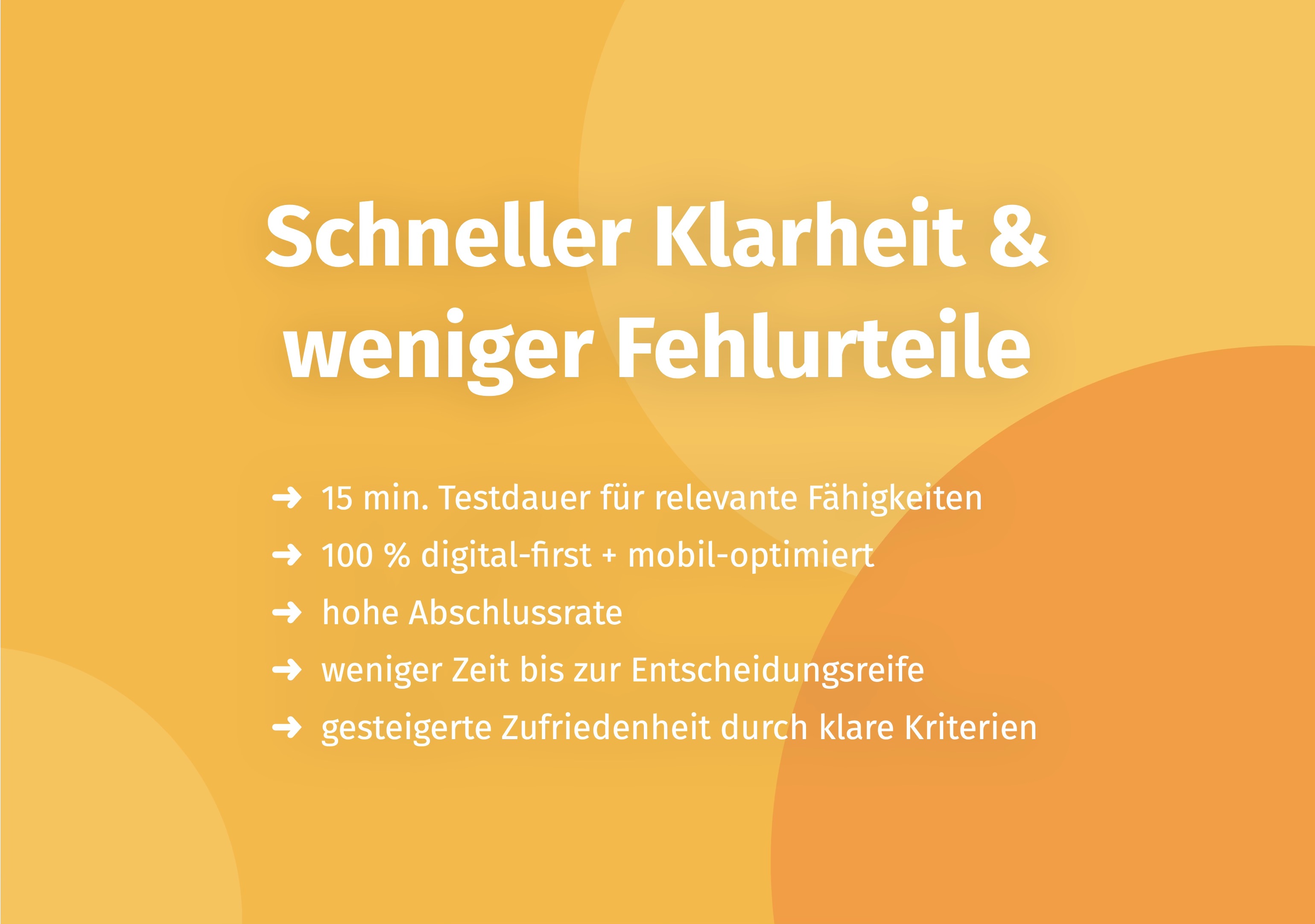
Modern talent assessment tools like Aivy use Game-Based Assessments – gamified tests that measure competencies and personality traits with scientific validity. Unlike traditional questionnaires, they capture cognitive abilities, problem-solving behavior, and soft skills in 15-20 minutes – with high acceptance from applicants.
8. Measure Soft Skills: Competencies Over Qualifications
Since 89% of bad hires fail due to lacking soft skills (LinkedIn 2019), measuring them should be a priority. Relevant soft skills in recruiting include:
- Communication skills
- Teamwork
- Problem-solving ability
- Adaptability
- Receptiveness to feedback
- Initiative
The challenge: soft skills can't be read from a resume. This is where potential analysis and scientifically validated assessments help make these competencies objectively measurable.
9. Recruiting KPIs: Measure What Matters
What you don't measure, you can't improve. The most important recruiting KPIs are:
| KPI | Definition | Benchmark |
|---|---|---|
| Time-to-Hire | Time from posting to signed contract | 30-45 days |
| Cost-per-Hire | Total costs per hire | ~$5,000 (US average) |
| Quality-of-Hire | Quality of new hires (performance, retention) | Define individually |
| Candidate Satisfaction | Applicant satisfaction | >80% |
| Offer Acceptance Rate | Percentage of accepted offers | >85% |
| Time-to-Fill | Time until position is filled | Industry-dependent |
10. Continuous Optimization: Learn from Every Process
Recruiting isn't a one-time project – it's a continuous improvement process. Successful companies:
- Regularly analyze their recruiting data
- Collect feedback from candidates and hiring managers
- Test new methods and channels
- Adapt processes to changing market conditions
Objective Hiring: The Scientific Foundation
Why do we emphasize the scientific approach so strongly? Because it makes the crucial difference between "recruiting by feeling" and "recruiting by evidence."
Why Gut Feeling Misleads
Our gut feeling is evolutionarily optimized for quick decisions – not for the complexity of modern hiring. Studies consistently show that experienced recruiters perform no better than beginners when relying on intuition.
The McKinsey Diversity Report (2024) underscores: companies in the top quartile for ethnic and cultural diversity are 36% more profitable than those in the bottom quartile. This shows: objective selection leads not only to fairer but also to better business outcomes.
Structured vs. Unstructured Interviews
The difference in practice:
Unstructured Interview:
- "Tell me about yourself"
- Different questions depending on the interviewer
- Evaluation based on likability
- No comparability
Structured Interview:
- Pre-defined competencies
- Standardized, behavior-based questions
- Uniform rating scale
- Documentation and comparability
The Role of Talent Assessment
Scientifically validated talent assessment perfectly complements structured interviews. It measures what interviews cannot capture: cognitive abilities, personality traits, and behavioral tendencies under standardized conditions.
The combination of structured interviews and aptitude tests achieves the highest predictive validity for future job success.
Game-Based Assessments: Modern Talent Assessment in Practice
A particularly innovative form of talent assessment is Game-Based Assessments. They combine scientific validity with a positive candidate experience.
How Gamified Tests Work
Game-Based Assessments use short mini-games to measure competencies. They don't test gaming skills, but capture cognitive abilities and behaviors under standardized conditions.
Examples of measured dimensions:
- Problem-solving ability
- Working memory
- Risk tolerance
- Reaction speed
- Concentration
The major advantage: the gamified design reduces test anxiety and increases acceptance among applicants – without compromising scientific validity.
Case Study: Lufthansa Achieves 96% Accuracy
What does the use of objective talent assessment look like in practice? Lufthansa uses Game-Based Assessments and achieves impressive results:
- 96% accuracy rate (correct prediction vs. in-house assessment)
- 81% satisfaction from applicants
- 100+ minutes saved testing time per applicant
- 86% completion rate in the assessment
Susanne Berthold-Neumann from Lufthansa explains the approach: "We look at the application documents late in the process because they only show a small part of the person and say little about whether someone has the competencies for future challenges."
This approach demonstrates: those who rely on objective assessment make better decisions – while also providing a better candidate experience.
Benefits for Candidates and Companies
For Companies:
- Higher predictive validity for job success
- Reduction of unconscious bias
- Faster pre-selection
- Measurable, comparable results
- Lower costs through fewer bad hires
For Candidates:
- Fair chance regardless of resume
- Pleasant, gamified experience
- Quick feedback
- Transparent process
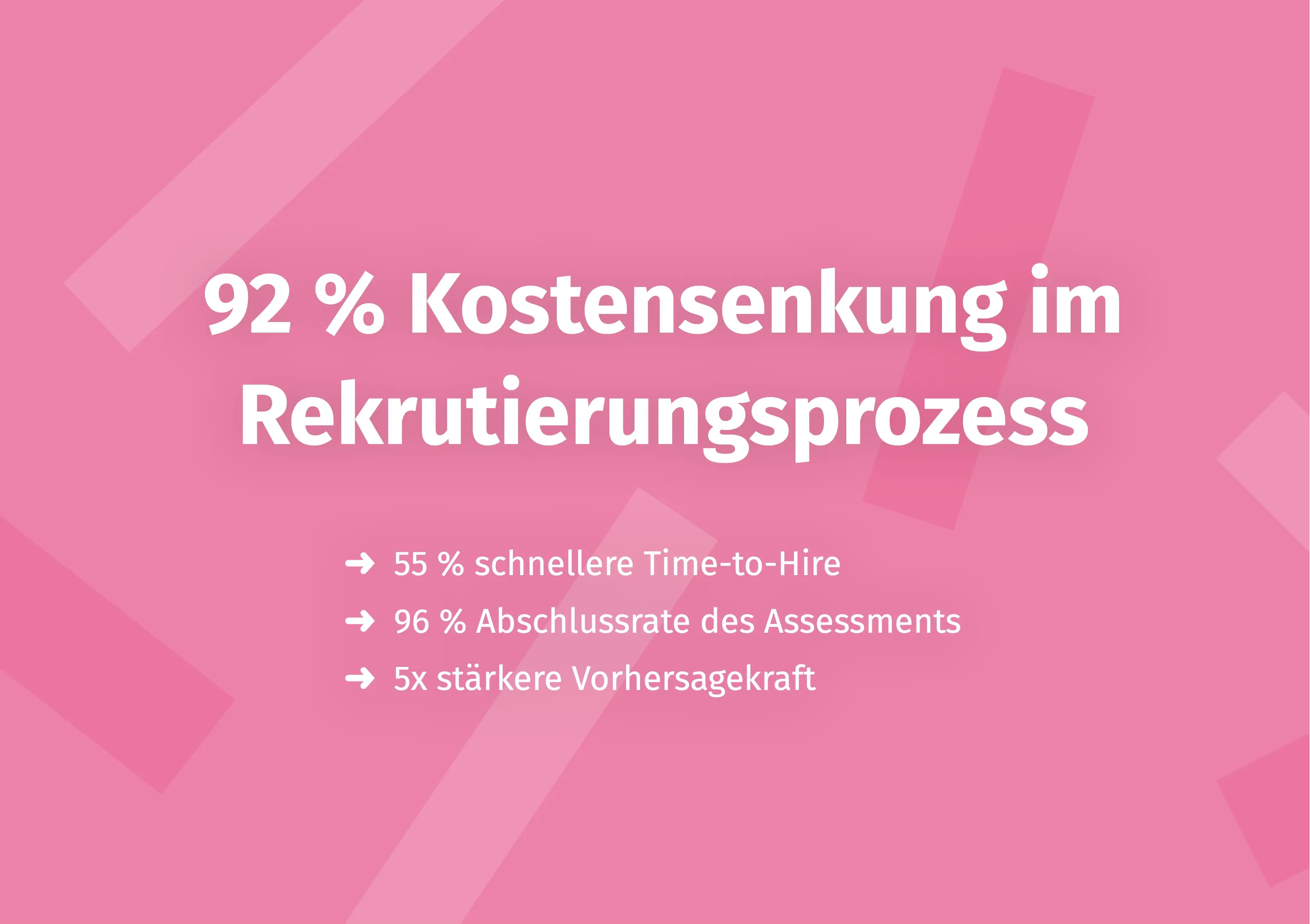
MCI Germany was able to reduce time-to-hire by 55% and cut cost-per-hire by 92% through objective talent assessment. Matthias Kühne, Director People & Culture at MCI, highlights: "With Aivy, we have digitized another process step in talent acquisition and significantly professionalized it through a more objective evaluation foundation."
More details can be found in the Lufthansa success story and the MCI success story.
Recruiting Trends 2025: What You Need to Know
The recruiting market is changing rapidly. Keep these trends on your radar.
AI in Recruiting: Opportunities and Limitations
Artificial intelligence is entering recruiting – from CV parsing to chatbots to predictive analytics. The advantages are clear: automation of repetitive tasks, faster processes, data-driven decisions.
Applications of AI in Recruiting:
- Automatic CV parsing and pre-selection
- Chatbots for applicant questions
- Scheduling and communication
- Predictive analytics for candidate fit
- Text generation for job postings
Important: AI should support human decisions, not replace them. And: algorithms can amplify existing bias when trained on historically biased data. That's why the combination of AI and scientifically validated assessment is crucial.
Skills-Based Hiring Instead of Degree Focus
An important trend: more and more companies are dropping formal degree requirements. According to SHRM (2025), 27% of organizations have eliminated college requirements for certain positions – with success: 76% have subsequently hired candidates successfully.
The focus is shifting from "What did you study?" to "What can you do?" This requires new methods to objectively measure skills – this is where scientifically validated assessments come into play.
Remote Recruiting and Hybrid Work Environments
Remote work is here to stay. This also changes recruiting:
- Virtual interviews become standard
- Asynchronous video assessments gain importance
- The talent pool expands geographically
- Cultural fit needs to be redefined
Companies offering flexible work models have a clear competitive advantage in the war for talent.
Frequently Asked Questions (FAQ)
What are the most important recruiting tips for 2025?
The most important recruiting tips for 2025 are: strengthen employer branding, optimize candidate experience, conduct structured interviews instead of relying on gut feeling, use objective talent assessment, leverage active sourcing, and consistently track recruiting KPIs.
How do I find the right employees?
Combine multiple methods: define a clear job requirements profile, use multiple recruiting channels, conduct structured interviews, and deploy scientifically validated talent assessment to measure competencies objectively.
Why am I getting so few applications?
Common reasons include: unattractive job postings without clear benefits, weak employer branding, overly long or complicated application processes, no salary information, and lack of visibility on relevant channels.
What is the difference between structured and unstructured interviews?
In structured interviews, all interviewers ask the same questions in the same order. Studies show: structured interviews have a predictive validity of r=.51, unstructured only r=.38 (Schmidt & Hunter, 1998).
How can I reduce unconscious bias in recruiting?
Through structured interviews with standardized questions, objective talent assessment instead of gut feeling, anonymized applications (blind hiring), involving multiple people in decisions, and raising awareness of common bias types.
What does a bad hire cost?
A bad hire costs an average of 30-50% of the annual salary for that position (SHRM). For a role with a $60,000 annual salary, that means $18,000-30,000 – through recruiting costs, onboarding, productivity loss, and starting the search again.
Which recruiting KPIs should I track?
The most important ones are: Time-to-Hire, Cost-per-Hire, Quality-of-Hire, Candidate Satisfaction, and Offer Acceptance Rate.
What is Game-Based Assessment?
Game-Based Assessments are gamified tests that measure competencies and personality traits with scientific validity. They use mini-games that capture cognitive abilities and soft skills in 15-20 minutes – with high acceptance from applicants.
How do I improve candidate experience?
Through quick responses, transparency about the process and timeline, personal communication, constructive feedback after rejections, mobile-optimized application processes, and respectful onboarding.
What role does AI play in recruiting in 2025?
AI supports CV parsing, chatbots, scheduling, and predictive analytics. Important: AI should support human decisions, not replace them – and must be checked for bias.
Conclusion: The Most Important Recruiting Tips Summarized
Successful recruiting in 2025 requires more than good job postings. It needs:
- Strong employer branding that authentically shows what your company stands for
- Optimized candidate experience that signals appreciation
- Structured interviews that ensure comparability and objectivity
- Scientifically validated talent assessment that makes competencies measurable
- Data-driven optimization based on relevant KPIs
The science is clear: objective selection methods have significantly higher predictive validity than gut decisions – while also reducing unconscious bias. Companies like Lufthansa and MCI demonstrate that using Game-Based Assessments and structured processes pays off measurably.
Objective talent assessment tools like Aivy help you make data-driven decisions. This is how you find not just faster, but the right employees for your team.
Sources
- Bertrand, M. & Mullainathan, S. (2004). Are Emily and Greg More Employable than Lakisha and Jamal? A Field Experiment on Labor Market Discrimination. American Economic Review, 94(4), 991-1013.
- Schmidt, F. L. & Hunter, J. E. (1998). The Validity and Utility of Selection Methods in Personnel Psychology. Psychological Bulletin, 124(2), 262-274.
- LinkedIn (2019). Global Talent Trends Report.
- McKinsey & Company (2024). Diversity Wins: How Inclusion Matters.
- SHRM (2025). Talent Trends Report.
- Talent Board (2024). Candidate Experience Report.

Make a better pre-selection — even before the first interview
In just a few minutes, Aivy shows you which candidates really fit the role. Beyond resumes based on strengths.