You want to explore your strengths as a talent?

This way

Login

People Analytics – Definition, Types & Practical Examples

Home
-
Lexicon
-
People Analytics – Definition, Types & Practical Examples

People Analytics is the analysis of employee data to make better HR decisions. It goes beyond traditional HR controlling and uses data from various sources (HR systems, surveys, external benchmarks) to identify correlations, predict developments, and derive actions. The goal is to optimize recruiting, employee retention, performance, and company culture based on data.

What is People Analytics? – Definition

People Analytics (also called HR Analytics or Workforce Analytics) refers to the systematic collection and analysis of people-related data to improve HR processes and make strategic personnel decisions. According to Gartner, People Analytics is "the collection and application of talent data to improve critical talent and business outcomes."

Unlike traditional HR reporting, People Analytics goes beyond merely presenting metrics. It identifies correlations, recognizes patterns, and enables predictions about future developments. While HR controlling documents what the turnover rate was, for example, People Analytics analyzes why employees are leaving and which measures could reduce turnover.

Difference: HR Analytics vs. People Analytics

The terms are often used synonymously, but there are subtle differences:

Feature HR Analytics People Analytics
Focus HR processes and functions Entire workforce and business outcomes
Data sources Primarily HR systems HR + other departments (Sales, Finance, etc.)
Objective Operational efficiency of HR department Strategic business goals
Perspective Past-oriented (descriptive) Future-oriented (predictive, prescriptive)
Examples Time-to-Hire, recruiting costs Employee engagement, business impact

People Analytics takes a more holistic approach and integrates various data sources to measure the impact of HR measures on business success. HR Analytics focuses more on evaluating the HR department itself.

The 4 Types of People Analytics

People Analytics can be divided into four maturity levels that build on each other. Each company can use different types depending on data availability and competence.

1. Descriptive Analytics – What happened?

Descriptive Analytics describes historical data and provides an overview of past events. This is the foundation of any data analysis.

Typical questions:

  • What was the turnover rate last quarter?
  • How many applications came through which channels?
  • What is the average tenure?

Methods: Dashboards, tables, charts, HR reports

Example: A dashboard shows that turnover in the IT department is 15%, while the company average is 8%.

2. Diagnostic Analytics – Why did it happen?

Diagnostic Analytics goes a step further and looks for causes of observed phenomena. It identifies correlations between different factors.

Typical questions:

  • Why is turnover in the IT department higher than average?
  • Which factors influence employee satisfaction?
  • Is there a correlation between commute time and resignations?

Methods: Correlation analyses, regression analyses, segmentation

Example: The analysis shows that IT employees with more than 45 minutes commute time have a 3x higher probability of leaving. Important: Correlation does not automatically mean causation – other factors must be examined.

3. Predictive Analytics – What will happen?

Predictive Analytics uses historical data to predict future developments. Through statistical models and machine learning, probabilities can be calculated.

Typical questions:

  • Which employees have a high resignation risk (flight risk)?
  • How will staffing needs develop over the next 12 months?
  • Which candidates will be successful in the job?

Methods: Regression models, machine learning, predictive models

Example: An algorithm calculates a resignation risk for each employee. People with high risk are proactively approached by the HR team to implement retention measures.

4. Prescriptive Analytics – What should we do?

Prescriptive Analytics is the highest level and provides concrete recommendations for action. It combines predictions with optimization algorithms to identify the best measure.

Typical questions:

  • Which measure reduces turnover most effectively?
  • How should shifts be optimally planned?
  • Which training increases performance most strongly?

Methods: Optimization algorithms, simulations, AI-supported recommendation systems

Example: The system recommends offering employees with high resignation risk an 8% salary adjustment, as this is the most cost-effective measure according to the model (ROI: 3.2x).

Why is People Analytics Important?

People Analytics has evolved from a "nice-to-have" to a strategic must. Current studies show:

  • 84% of People Analytics teams have a clear vision and mission according to Deloitte (2023) – an increase of 23% since 2020
  • 70% of executives say they could make better decisions faster with better access to people data (Deloitte/Visier study)
  • Only 32% of companies rate themselves as "good" or "very good" at using People Analytics insights according to HR.com (2023-2024)

The most important benefits:

  1. Objective decisions: Replaces gut feeling with data-based insights
  2. Proactive action: Problems are identified before they escalate (e.g., turnover)
  3. ROI proof: HR measures become measurable and justifiable
  4. Talent acquisition: Optimization of recruiting channels and processes
  5. Employee retention: Early identification of resignation risks
  6. Fairness & diversity: Reduction of unconscious bias in personnel decisions

In the context of the skills shortage, People Analytics enables precise workforce planning, targeted training design, and strategic investment in employee retention.

Typical Use Cases

People Analytics can be applied in various HR areas. Here are the most important use cases:

Recruiting Analytics – Finding the Right Talent

Goal: Optimize recruiting processes, make better hiring decisions

Typical questions:

  • Which recruiting channels deliver the best candidates?
  • How long does the recruiting process take (time-to-hire)?
  • Which factors predict job success?

Practice: Objective talent assessment such as game-based assessments (e.g., the Aivy platform) provides data-based insights into candidate suitability. Scientifically validated assessments reduce unconscious bias through standardized, fair testing procedures. Lufthansa, for example, uses game-based assessments and achieves a 96% accuracy rate in predicting suitability – clear proof of the predictive validity of such procedures.

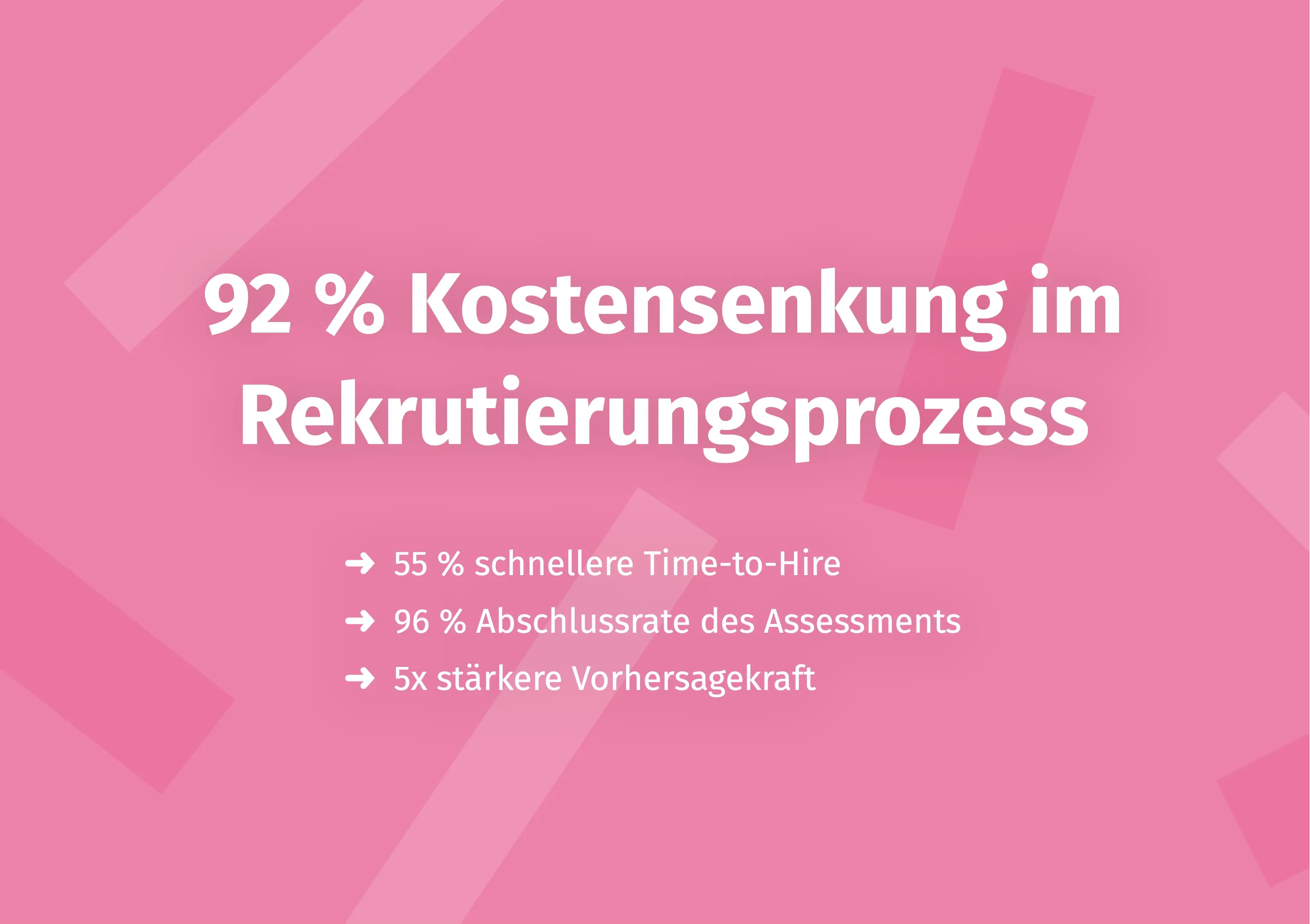
Additional success examples: MCI Deutschland reduced time-to-hire by 55% and cost-per-hire by 92% through objective talent assessment.

Retention Analytics – Predicting and Reducing Turnover

Goal: Identify resignations early and prevent them

Typical questions:

  • Which employees have a high resignation risk?
  • What are the main reasons for resignations?
  • Which measures reduce turnover most effectively?

Practice: Predictive models analyze factors such as salary, commute time, last salary increase, performance reviews, and engagement scores. Employees with high flight risk are identified and proactively included in development conversations.

Performance Analytics – Objectively Measuring Performance

Goal: Understand and increase performance

Typical questions:

  • Which factors influence employee performance?
  • Are there correlations between team composition and productivity?
  • Which training programs increase performance most strongly?

Practice: Google's "Project Oxygen" analyzed data over years to identify the characteristics of effective leaders. The insights flowed into coaching programs and led to measurable improvement in manager quality.

Diversity Analytics – Promoting Diversity

Goal: Make diversity measurable and promote it

Typical questions:

  • How diverse is our workforce (gender, age, origin)?
  • Are there pay gaps between genders or ethnicities?
  • Are diverse candidates disadvantaged in recruiting?

Practice: People Analytics helps identify unconscious bias. For example, data analyses show whether certain demographic groups systematically perform worse in the application process. Objective selection procedures reduce such distortions.

People Analytics in Practice

What does People Analytics look like in companies? Here are three practical examples:

Practical Example 1: Google (Project Oxygen)

Google's "People Operations" team has been using People Analytics for years to answer HR questions scientifically. In Project Oxygen, Google analyzed data from thousands of employees to find out what makes a good manager.

Result: Eight core characteristics were identified (e.g., "Is a good coach", "Empowers the team"). These insights flowed into training and led to measurable improvement in leadership quality.

Practical Example 2: McKinsey Case Study (Quick-Service Restaurant)

A global restaurant chain used People Analytics to analyze the relationship between employee characteristics and business success. Over 100 hypotheses were tested.

Result: Four personality archetypes were identified ("Potential Leaders", "Socializers", two types of "Taskmasters"). The optimal team composition significantly increased customer satisfaction and revenue.

Practical Example 3: Lufthansa – Predictive Validity Through Assessments

Lufthansa uses game-based assessments to objectively measure candidate suitability. The assessments were validated against the established in-house assessment center.

Key metrics:

  • 96% accuracy rate (correct prediction vs. in-house assessment)
  • 81% satisfaction of applicants
  • 100+ minutes saved testing time per applicant
  • Diversity increases: Gender balance and international applicants benefit from objective selection

More details in the Lufthansa success story.

Getting Started: 4-Step Framework

Prof. Emilio Castilla from MIT Sloan recommends a structured approach for People Analytics projects:

Step 1: Define the problem

  • Formulate a concrete question (e.g., "Why are high performers leaving us?")
  • Ensure the problem is business-relevant
  • Involve stakeholders early

Step 2: Collect and prepare data

  • Identify relevant data sources (HR system, surveys, performance data)
  • Ensure data quality (completeness, correctness)
  • Clean and structure data

Step 3: Analyze

  • Use appropriate analysis methods (descriptive, diagnostic, predictive)
  • Interpret results critically (correlation ≠ causation!)
  • Validate insights with stakeholders

Step 4: Act and communicate

  • Derive concrete measures
  • Communicate insights understandably to management
  • Measure the success of measures (ROI)

Important: Start with simple use cases (e.g., turnover analysis) and build competencies step by step.

People Analytics & Data Privacy

People Analytics works with sensitive employee data. Strict data protection rules apply in Germany and the EU.

GDPR Requirements

The General Data Protection Regulation (GDPR) governs how companies may process personal data. Core principles:

Purpose limitation: Data may only be used for the originally defined purpose. If HR data was collected for payroll, it cannot simply be used for turnover analyses without further consideration.

Transparency: Employees must be informed about which data is processed for which purpose. This should be recorded in the privacy policy or works agreement.

Data minimization: Only the data that is actually necessary may be collected. Not every piece of information is relevant for People Analytics.

Pseudonymization/anonymization: Where possible, data should be pseudonymized (replacement of names with IDs) or anonymized (no traceability to individuals).

Works Council & Co-Determination

In Germany, works councils (from 5 employees) have co-determination rights when introducing People Analytics systems. This particularly affects:

  • Introduction of technical systems for behavioral and performance monitoring (§87 para. 1 no. 6 BetrVG)
  • Processing of personal data

Practical tip: Involve the works council early and conclude works agreements that clearly regulate which data is processed for which purpose.

Ethical Aspects: Transparency & Fairness

Beyond legal requirements, there are ethical questions:

Algorithmic Management: When algorithms make decisions (e.g., bonus distribution), this can be perceived as unfair. Studies show that employees perceive decisions as more unjust when algorithms are involved – even if the decision is substantively the same.

Fairness Paradox: People Analytics should reduce bias – but can also create new distortions if historical data contains discriminatory patterns (e.g., if mainly men were promoted in the past, an algorithm learns this pattern).

Best Practice:

  • Create transparency: Explain how algorithms work
  • Human final decision: Algorithms should support, not replace
  • Regular audits: Check whether algorithms deliver fair results

Frequently Asked Questions About People Analytics

What is the difference between HR Analytics and People Analytics?

HR Analytics focuses on HR processes such as recruiting, turnover, and payroll. It is mostly descriptive and answers the question "What happened?".

People Analytics takes a broader approach: It includes data from other departments (Sales, Finance, Customer Experience) and is more strategically oriented. It is also predictive and prescriptive, thus answering "What will happen?" and "What should we do?".

In short: People Analytics is more strategic, HR Analytics more operational.

What data do I need for People Analytics?

For People Analytics, you need various data sources:

  • HR master data: Age, gender, department, position, salary
  • Process data: Time-to-hire, absences, turnover
  • Performance data: Performance reviews, goal agreements
  • Engagement data: Employee surveys, pulse surveys
  • External data: Salary benchmarks, labor market data
  • Recruiting data: Applicant sources, assessment results, candidate experience

Important: You don't need to have all data from the start. Begin with what's available and build up gradually.

How do I get started with People Analytics?

Follow this 4-step process:

  1. Define business problem: Start with a concrete challenge (e.g., "High turnover in the IT department")
  2. Collect and clean relevant data: Identify which data you need and ensure data quality
  3. Analyze data: Use analyses to identify correlations (e.g., between commute time and turnover)
  4. Communicate insights and derive measures: Present results understandably and derive concrete actions

Important: Start with simple use cases (e.g., turnover analysis with Excel) and build competencies step by step.

Which People Analytics tools are available?

There are different tool categories:

  • HRIS systems with analytics: Personio, SAP SuccessFactors (integrated dashboards)
  • Specialized People Analytics platforms: Visier, Crunchr, peopleIX (extensive analysis functions)
  • Business Intelligence tools: Tableau, Power BI (flexible dashboards, require data connection)
  • Excel/Google Sheets: For simple analyses and getting started
  • Assessment platforms: Aivy, Pymetrics (for recruiting analytics with game-based assessments)

The choice depends on: Company size, budget, existing IT infrastructure, and analytics maturity level.

How can People Analytics reduce turnover?

People Analytics helps on multiple levels:

  1. Predictive Analytics identifies flight risk: Algorithms calculate resignation probabilities based on factors such as salary development, last promotion, engagement scores
  2. Understand resignation reasons: Analysis shows patterns (e.g., long commutes, poor managers)
  3. Early intervention: HR can proactively conduct conversations, make salary adjustments, or offer development opportunities
  4. Optimize candidate experience: Companies like Lufthansa use analytics to improve the applicant experience – 81% satisfaction leads to lower drop-offs

Is People Analytics GDPR-compliant?

Yes, when implemented correctly:

  • Purpose limitation: Use data only for defined purpose
  • Transparency: Inform employees about data processing
  • Data minimization: Collect only necessary data
  • Pseudonymization/anonymization: Anonymize data where possible
  • Involve works council: Observe co-determination rights in larger companies
  • No purely automated decisions: Algorithmic management should be transparent and provide for human final decision

What ROI does People Analytics bring?

The return on investment varies by use case:

  • Frankfurt School: 4x ROI in the first year through reduction of mis-hires
  • MCI Deutschland: 92% lower cost-per-hire and 55% faster time-to-hire
  • SSE (UK): £4.29 return per £1 investment in training programs

The ROI depends on: Data quality, implementation of insights, and chosen use case. Recruiting and retention analytics often have the highest ROI, as mis-hires and turnover are very expensive.

How do I present People Analytics results to management?

Follow these principles:

  1. Emphasize business impact: Don't just talk about HR metrics, but about business results (revenue, costs, productivity)
  2. Use visualizations: Dashboards and charts instead of tables
  3. Concrete recommendations for action: What should the company do?
  4. Quantify ROI: Specify cost savings or revenue increase
  5. Show success stories: Use best practices from Google, McKinsey, or other companies

Example: Instead of "Turnover is at 12%," say "12% turnover costs us €2.4 million annually (€200,000 per person). With retention measures, we can reduce this by 30% and save €720,000."

Conclusion

People Analytics transforms HR from a reactive to a strategic, data-driven function. By analyzing employee data, companies can make better hiring decisions, reduce turnover, increase performance, and promote diversity. The four types – Descriptive, Diagnostic, Predictive, and Prescriptive Analytics – enable moving from pure reporting to concrete recommendations for action.

Practice shows: Companies like Google, McKinsey clients, and Lufthansa achieve measurable success. Lufthansa achieves a 96% accuracy rate with objective assessments, MCI reduces time-to-hire by 55%. The ROI is proven – Frankfurt School achieved a 4x return in the first year.

At the same time, data protection (GDPR), co-determination (works council), and ethical aspects (transparency, fairness) must be observed. People Analytics should not monitor employees but help them develop.

Want to use objective talent assessment in your recruiting process? The Aivy platform offers game-based assessments that enable scientifically validated, fair, and bias-free personnel selection. Learn more about objective talent assessment with People Analytics.

Sources

Home
-
lexicon
-
People Analytics – Definition, Types & Practical Examples

People Analytics is the analysis of employee data to make better HR decisions. It goes beyond traditional HR controlling and uses data from various sources (HR systems, surveys, external benchmarks) to identify correlations, predict developments, and derive actions. The goal is to optimize recruiting, employee retention, performance, and company culture based on data.

What is People Analytics? – Definition

People Analytics (also called HR Analytics or Workforce Analytics) refers to the systematic collection and analysis of people-related data to improve HR processes and make strategic personnel decisions. According to Gartner, People Analytics is "the collection and application of talent data to improve critical talent and business outcomes."

Unlike traditional HR reporting, People Analytics goes beyond merely presenting metrics. It identifies correlations, recognizes patterns, and enables predictions about future developments. While HR controlling documents what the turnover rate was, for example, People Analytics analyzes why employees are leaving and which measures could reduce turnover.

Difference: HR Analytics vs. People Analytics

The terms are often used synonymously, but there are subtle differences:

Feature HR Analytics People Analytics
Focus HR processes and functions Entire workforce and business outcomes
Data sources Primarily HR systems HR + other departments (Sales, Finance, etc.)
Objective Operational efficiency of HR department Strategic business goals
Perspective Past-oriented (descriptive) Future-oriented (predictive, prescriptive)
Examples Time-to-Hire, recruiting costs Employee engagement, business impact

People Analytics takes a more holistic approach and integrates various data sources to measure the impact of HR measures on business success. HR Analytics focuses more on evaluating the HR department itself.

The 4 Types of People Analytics

People Analytics can be divided into four maturity levels that build on each other. Each company can use different types depending on data availability and competence.

1. Descriptive Analytics – What happened?

Descriptive Analytics describes historical data and provides an overview of past events. This is the foundation of any data analysis.

Typical questions:

  • What was the turnover rate last quarter?
  • How many applications came through which channels?
  • What is the average tenure?

Methods: Dashboards, tables, charts, HR reports

Example: A dashboard shows that turnover in the IT department is 15%, while the company average is 8%.

2. Diagnostic Analytics – Why did it happen?

Diagnostic Analytics goes a step further and looks for causes of observed phenomena. It identifies correlations between different factors.

Typical questions:

  • Why is turnover in the IT department higher than average?
  • Which factors influence employee satisfaction?
  • Is there a correlation between commute time and resignations?

Methods: Correlation analyses, regression analyses, segmentation

Example: The analysis shows that IT employees with more than 45 minutes commute time have a 3x higher probability of leaving. Important: Correlation does not automatically mean causation – other factors must be examined.

3. Predictive Analytics – What will happen?

Predictive Analytics uses historical data to predict future developments. Through statistical models and machine learning, probabilities can be calculated.

Typical questions:

  • Which employees have a high resignation risk (flight risk)?
  • How will staffing needs develop over the next 12 months?
  • Which candidates will be successful in the job?

Methods: Regression models, machine learning, predictive models

Example: An algorithm calculates a resignation risk for each employee. People with high risk are proactively approached by the HR team to implement retention measures.

4. Prescriptive Analytics – What should we do?

Prescriptive Analytics is the highest level and provides concrete recommendations for action. It combines predictions with optimization algorithms to identify the best measure.

Typical questions:

  • Which measure reduces turnover most effectively?
  • How should shifts be optimally planned?
  • Which training increases performance most strongly?

Methods: Optimization algorithms, simulations, AI-supported recommendation systems

Example: The system recommends offering employees with high resignation risk an 8% salary adjustment, as this is the most cost-effective measure according to the model (ROI: 3.2x).

Why is People Analytics Important?

People Analytics has evolved from a "nice-to-have" to a strategic must. Current studies show:

  • 84% of People Analytics teams have a clear vision and mission according to Deloitte (2023) – an increase of 23% since 2020
  • 70% of executives say they could make better decisions faster with better access to people data (Deloitte/Visier study)
  • Only 32% of companies rate themselves as "good" or "very good" at using People Analytics insights according to HR.com (2023-2024)

The most important benefits:

  1. Objective decisions: Replaces gut feeling with data-based insights
  2. Proactive action: Problems are identified before they escalate (e.g., turnover)
  3. ROI proof: HR measures become measurable and justifiable
  4. Talent acquisition: Optimization of recruiting channels and processes
  5. Employee retention: Early identification of resignation risks
  6. Fairness & diversity: Reduction of unconscious bias in personnel decisions

In the context of the skills shortage, People Analytics enables precise workforce planning, targeted training design, and strategic investment in employee retention.

Typical Use Cases

People Analytics can be applied in various HR areas. Here are the most important use cases:

Recruiting Analytics – Finding the Right Talent

Goal: Optimize recruiting processes, make better hiring decisions

Typical questions:

  • Which recruiting channels deliver the best candidates?
  • How long does the recruiting process take (time-to-hire)?
  • Which factors predict job success?

Practice: Objective talent assessment such as game-based assessments (e.g., the Aivy platform) provides data-based insights into candidate suitability. Scientifically validated assessments reduce unconscious bias through standardized, fair testing procedures. Lufthansa, for example, uses game-based assessments and achieves a 96% accuracy rate in predicting suitability – clear proof of the predictive validity of such procedures.

Additional success examples: MCI Deutschland reduced time-to-hire by 55% and cost-per-hire by 92% through objective talent assessment.

Retention Analytics – Predicting and Reducing Turnover

Goal: Identify resignations early and prevent them

Typical questions:

  • Which employees have a high resignation risk?
  • What are the main reasons for resignations?
  • Which measures reduce turnover most effectively?

Practice: Predictive models analyze factors such as salary, commute time, last salary increase, performance reviews, and engagement scores. Employees with high flight risk are identified and proactively included in development conversations.

Performance Analytics – Objectively Measuring Performance

Goal: Understand and increase performance

Typical questions:

  • Which factors influence employee performance?
  • Are there correlations between team composition and productivity?
  • Which training programs increase performance most strongly?

Practice: Google's "Project Oxygen" analyzed data over years to identify the characteristics of effective leaders. The insights flowed into coaching programs and led to measurable improvement in manager quality.

Diversity Analytics – Promoting Diversity

Goal: Make diversity measurable and promote it

Typical questions:

  • How diverse is our workforce (gender, age, origin)?
  • Are there pay gaps between genders or ethnicities?
  • Are diverse candidates disadvantaged in recruiting?

Practice: People Analytics helps identify unconscious bias. For example, data analyses show whether certain demographic groups systematically perform worse in the application process. Objective selection procedures reduce such distortions.

People Analytics in Practice

What does People Analytics look like in companies? Here are three practical examples:

Practical Example 1: Google (Project Oxygen)

Google's "People Operations" team has been using People Analytics for years to answer HR questions scientifically. In Project Oxygen, Google analyzed data from thousands of employees to find out what makes a good manager.

Result: Eight core characteristics were identified (e.g., "Is a good coach", "Empowers the team"). These insights flowed into training and led to measurable improvement in leadership quality.

Practical Example 2: McKinsey Case Study (Quick-Service Restaurant)

A global restaurant chain used People Analytics to analyze the relationship between employee characteristics and business success. Over 100 hypotheses were tested.

Result: Four personality archetypes were identified ("Potential Leaders", "Socializers", two types of "Taskmasters"). The optimal team composition significantly increased customer satisfaction and revenue.

Practical Example 3: Lufthansa – Predictive Validity Through Assessments

Lufthansa uses game-based assessments to objectively measure candidate suitability. The assessments were validated against the established in-house assessment center.

Key metrics:

  • 96% accuracy rate (correct prediction vs. in-house assessment)
  • 81% satisfaction of applicants
  • 100+ minutes saved testing time per applicant
  • Diversity increases: Gender balance and international applicants benefit from objective selection

More details in the Lufthansa success story.

Getting Started: 4-Step Framework

Prof. Emilio Castilla from MIT Sloan recommends a structured approach for People Analytics projects:

Step 1: Define the problem

  • Formulate a concrete question (e.g., "Why are high performers leaving us?")
  • Ensure the problem is business-relevant
  • Involve stakeholders early

Step 2: Collect and prepare data

  • Identify relevant data sources (HR system, surveys, performance data)
  • Ensure data quality (completeness, correctness)
  • Clean and structure data

Step 3: Analyze

  • Use appropriate analysis methods (descriptive, diagnostic, predictive)
  • Interpret results critically (correlation ≠ causation!)
  • Validate insights with stakeholders

Step 4: Act and communicate

  • Derive concrete measures
  • Communicate insights understandably to management
  • Measure the success of measures (ROI)

Important: Start with simple use cases (e.g., turnover analysis) and build competencies step by step.

People Analytics & Data Privacy

People Analytics works with sensitive employee data. Strict data protection rules apply in Germany and the EU.

GDPR Requirements

The General Data Protection Regulation (GDPR) governs how companies may process personal data. Core principles:

Purpose limitation: Data may only be used for the originally defined purpose. If HR data was collected for payroll, it cannot simply be used for turnover analyses without further consideration.

Transparency: Employees must be informed about which data is processed for which purpose. This should be recorded in the privacy policy or works agreement.

Data minimization: Only the data that is actually necessary may be collected. Not every piece of information is relevant for People Analytics.

Pseudonymization/anonymization: Where possible, data should be pseudonymized (replacement of names with IDs) or anonymized (no traceability to individuals).

Works Council & Co-Determination

In Germany, works councils (from 5 employees) have co-determination rights when introducing People Analytics systems. This particularly affects:

  • Introduction of technical systems for behavioral and performance monitoring (§87 para. 1 no. 6 BetrVG)
  • Processing of personal data

Practical tip: Involve the works council early and conclude works agreements that clearly regulate which data is processed for which purpose.

Ethical Aspects: Transparency & Fairness

Beyond legal requirements, there are ethical questions:

Algorithmic Management: When algorithms make decisions (e.g., bonus distribution), this can be perceived as unfair. Studies show that employees perceive decisions as more unjust when algorithms are involved – even if the decision is substantively the same.

Fairness Paradox: People Analytics should reduce bias – but can also create new distortions if historical data contains discriminatory patterns (e.g., if mainly men were promoted in the past, an algorithm learns this pattern).

Best Practice:

  • Create transparency: Explain how algorithms work
  • Human final decision: Algorithms should support, not replace
  • Regular audits: Check whether algorithms deliver fair results

Frequently Asked Questions About People Analytics

What is the difference between HR Analytics and People Analytics?

HR Analytics focuses on HR processes such as recruiting, turnover, and payroll. It is mostly descriptive and answers the question "What happened?".

People Analytics takes a broader approach: It includes data from other departments (Sales, Finance, Customer Experience) and is more strategically oriented. It is also predictive and prescriptive, thus answering "What will happen?" and "What should we do?".

In short: People Analytics is more strategic, HR Analytics more operational.

What data do I need for People Analytics?

For People Analytics, you need various data sources:

  • HR master data: Age, gender, department, position, salary
  • Process data: Time-to-hire, absences, turnover
  • Performance data: Performance reviews, goal agreements
  • Engagement data: Employee surveys, pulse surveys
  • External data: Salary benchmarks, labor market data
  • Recruiting data: Applicant sources, assessment results, candidate experience

Important: You don't need to have all data from the start. Begin with what's available and build up gradually.

How do I get started with People Analytics?

Follow this 4-step process:

  1. Define business problem: Start with a concrete challenge (e.g., "High turnover in the IT department")
  2. Collect and clean relevant data: Identify which data you need and ensure data quality
  3. Analyze data: Use analyses to identify correlations (e.g., between commute time and turnover)
  4. Communicate insights and derive measures: Present results understandably and derive concrete actions

Important: Start with simple use cases (e.g., turnover analysis with Excel) and build competencies step by step.

Which People Analytics tools are available?

There are different tool categories:

  • HRIS systems with analytics: Personio, SAP SuccessFactors (integrated dashboards)
  • Specialized People Analytics platforms: Visier, Crunchr, peopleIX (extensive analysis functions)
  • Business Intelligence tools: Tableau, Power BI (flexible dashboards, require data connection)
  • Excel/Google Sheets: For simple analyses and getting started
  • Assessment platforms: Aivy, Pymetrics (for recruiting analytics with game-based assessments)

The choice depends on: Company size, budget, existing IT infrastructure, and analytics maturity level.

How can People Analytics reduce turnover?

People Analytics helps on multiple levels:

  1. Predictive Analytics identifies flight risk: Algorithms calculate resignation probabilities based on factors such as salary development, last promotion, engagement scores
  2. Understand resignation reasons: Analysis shows patterns (e.g., long commutes, poor managers)
  3. Early intervention: HR can proactively conduct conversations, make salary adjustments, or offer development opportunities
  4. Optimize candidate experience: Companies like Lufthansa use analytics to improve the applicant experience – 81% satisfaction leads to lower drop-offs

Is People Analytics GDPR-compliant?

Yes, when implemented correctly:

  • Purpose limitation: Use data only for defined purpose
  • Transparency: Inform employees about data processing
  • Data minimization: Collect only necessary data
  • Pseudonymization/anonymization: Anonymize data where possible
  • Involve works council: Observe co-determination rights in larger companies
  • No purely automated decisions: Algorithmic management should be transparent and provide for human final decision

What ROI does People Analytics bring?

The return on investment varies by use case:

  • Frankfurt School: 4x ROI in the first year through reduction of mis-hires
  • MCI Deutschland: 92% lower cost-per-hire and 55% faster time-to-hire
  • SSE (UK): £4.29 return per £1 investment in training programs

The ROI depends on: Data quality, implementation of insights, and chosen use case. Recruiting and retention analytics often have the highest ROI, as mis-hires and turnover are very expensive.

How do I present People Analytics results to management?

Follow these principles:

  1. Emphasize business impact: Don't just talk about HR metrics, but about business results (revenue, costs, productivity)
  2. Use visualizations: Dashboards and charts instead of tables
  3. Concrete recommendations for action: What should the company do?
  4. Quantify ROI: Specify cost savings or revenue increase
  5. Show success stories: Use best practices from Google, McKinsey, or other companies

Example: Instead of "Turnover is at 12%," say "12% turnover costs us €2.4 million annually (€200,000 per person). With retention measures, we can reduce this by 30% and save €720,000."

Conclusion

People Analytics transforms HR from a reactive to a strategic, data-driven function. By analyzing employee data, companies can make better hiring decisions, reduce turnover, increase performance, and promote diversity. The four types – Descriptive, Diagnostic, Predictive, and Prescriptive Analytics – enable moving from pure reporting to concrete recommendations for action.

Practice shows: Companies like Google, McKinsey clients, and Lufthansa achieve measurable success. Lufthansa achieves a 96% accuracy rate with objective assessments, MCI reduces time-to-hire by 55%. The ROI is proven – Frankfurt School achieved a 4x return in the first year.

At the same time, data protection (GDPR), co-determination (works council), and ethical aspects (transparency, fairness) must be observed. People Analytics should not monitor employees but help them develop.

Want to use objective talent assessment in your recruiting process? The Aivy platform offers game-based assessments that enable scientifically validated, fair, and bias-free personnel selection. Learn more about objective talent assessment with People Analytics.

Sources

Heading 1

Heading 2

Heading 3

Heading 4

Heading 5
Heading 6

Lorem ipsum dolor sit amet, consectetur adipiscing elit, sed do eiusmod tempor incididunt ut laboratories et dolore magna aliqua. Ut Enim ad Minim Veniam, Quis Nostrud Exercitation Ullamco Laboris Nisi ut Aliquip ex ea Commodo Consequat. Duis aute irure dolor in reprehenderite in voluptate velit eat cillum dolore eu fugiate nulla pariature.

Block quote

Ordered list

  1. Item 1
  2. Item 2
  3. Item 3

Unordered list

  • Item A
  • Item B
  • Item C

Text link

Bold text

Emphasis

Superscript

Subscript

Heading 1

Heading 2

Heading 3

Heading 4

Heading 5
Heading 6

Lorem ipsum dolor sit amet, consectetur adipiscing elit, sed do eiusmod tempor incididunt ut laboratories et dolore magna aliqua. Ut Enim ad Minim Veniam, Quis Nostrud Exercitation Ullamco Laboris Nisi ut Aliquip ex ea Commodo Consequat. Duis aute irure dolor in reprehenderite in voluptate velit eat cillum dolore eu fugiate nulla pariature.

Block quote

Ordered list

  1. Item 1
  2. Item 2
  3. Item 3

Unordered list

  • Item A
  • Item B
  • Item C

Text link

Bold text

Emphasis

Superscript

Subscript

Florian Dyballa

CEO, Co-Founder

About Florian

  • Founder & CEO of Aivy — develops innovative ways of personnel diagnostics and is one of the top 10 HR tech founders in Germany (business punk)
  • More than 500,000 digital aptitude tests successfully used by more than 100 companies such as Lufthansa, Würth and Hermes
  • Three times honored with the HR Innovation Award and regularly featured in leading business media (WirtschaftsWoche, Handelsblatt and FAZ)
  • As a business psychologist and digital expert, combines well-founded tests with AI for fair opportunities in personnel selection
  • Shares expertise as a sought-after thought leader in the HR tech industry — in podcasts, media, and at key industry events
  • Actively shapes the future of the working world — by combining science and technology for better and fairer personnel decisions
success stories

You can expect these results

Discover what successes other companies are achieving by using Aivy. Be inspired and do the same as they do.

Many innovative employers already rely on Aivy

Say that #HeRoes

“Through the very high response rate Persuade and retain We our trainees early in the application process. ”

Tamara Molitor
Training manager at Würth
Tamara Molitor

“That Strengths profile reflects 1:1 our experience in a personal conversation. ”

Wolfgang Böhm
Training manager at DIEHL
Wolfgang Böhm Portrait

“Through objective criteria, we promote equal opportunities and Diversity in recruiting. ”

Marie-Jo Goldmann
Head of HR at Nucao
Marie Jo Goldmann Portrait

Aivy is the bestWhat I've come across so far in the German diagnostics start-up sector. ”

Carl-Christoph Fellinger
Strategic Talent Acquisition at Beiersdorf
Christoph Feillinger Portrait

“Selection process which Make fun. ”

Anna Miels
Learning & Development Manager at apoproject
Anna Miels Portrait

“Applicants find out for which position they have the suitable competencies bring along. ”

Jürgen Muthig
Head of Vocational Training at Fresenius
Jürgen Muthig Fresenius Portrait

“Get to know hidden potential and Develop applicants in a targeted manner. ”

Christian Schütz
HR manager at KU64
Christian Schuetz

Saves time and is a lot of fun doing daily work. ”

Matthias Kühne
Director People & Culture at MCI Germany
Matthias Kühne

Engaging candidate experience through communication on equal terms. ”

Theresa Schröder
Head of HR at Horn & Bauer
Theresa Schröder

“Very solid, scientifically based, innovative even from a candidate's point of view and All in all, simply well thought-out. ”

Dr. Kevin-Lim Jungbauer
Recruiting and HR Diagnostics Expert at Beiersdorf
Kevin Jungbauer
YOUR assistant FOR TALENT ASSESSMENT

Try it for free

Become a HeRo 🦸 and understand candidate fit - even before the first job interview...